MV-02: Free Vibration of SDOF Systems – Damping, Stability, and Energy Methods
Imagine pulling a child back on a swing and letting go. You aren’t pushing them (forcing function); you simply gave them an initial displacement and let physics take over. This is Free Vibration—the oscillation of a system under an initial disturbance with no external forces acting afterward.
In this post, we will explore Chapter 2 of Rao’s text, covering how systems vibrate naturally, how energy methods can simplify analysis, and how different types of damping bring motion to a halt.
The Undamped System: Newton Meets Hooke
Let’s start with the simplest case: a mass ($m$) attached to a spring ($k$) on a frictionless surface. If we displace the mass by a distance $x(t)$, the spring pulls back.
According to Newton’s Second Law, the rate of change of momentum is equal to the force acting on the mass. Sir Isaac Newton, whose Principia Mathematica (1687) laid the groundwork for this analysis, provided us with the tools to derive the equation of motion.
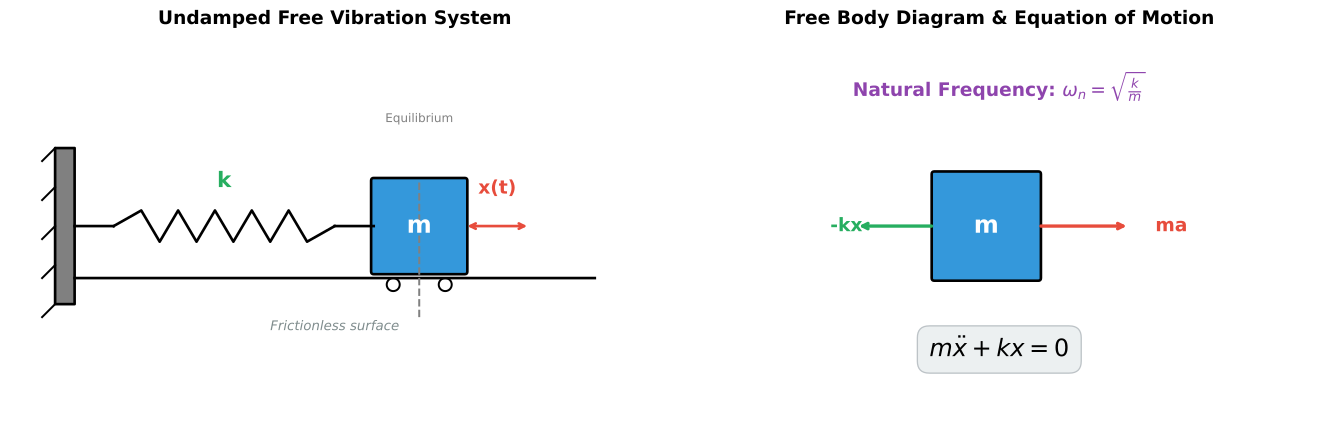
For a mass-spring system, the governing equation is: $$ F(t) = -kx = m\ddot{x} $$ $$ m\ddot{x} + kx = 0 $$
This is a homogeneous second-order linear differential equation. Its solution tells us that the mass will oscillate forever in Simple Harmonic Motion at a specific rate called the Natural Frequency ($\omega_n$):
$$ \omega_n = \sqrt{\frac{k}{m}} $$
This frequency is the system’s “fingerprint.” Whether it is a guitar string or a skyscraper, every structure has a tendency to vibrate at its own specific natural frequencies.
A Shortcut: Rayleigh’s Energy Method
Deriving equations using Newton’s laws can get messy for complex geometries. Enter Lord Rayleigh.
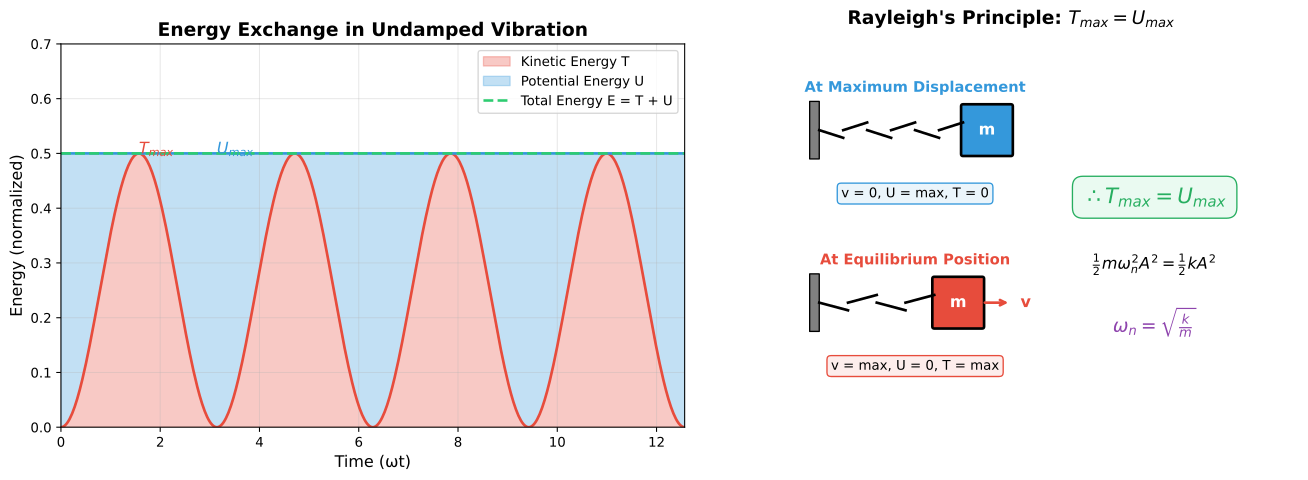
Rayleigh’s principle relies on the Conservation of Energy. In a conservative (undamped) system, the total energy (Kinetic $T$ + Potential $U$) is constant.
- At the static equilibrium position, velocity is maximum, and Kinetic Energy ($T$) is maximum.
- At maximum displacement (amplitude), velocity is zero, and Potential Energy ($U$) is maximum.
By equating $T_{max}$ and $U_{max}$, we can rapidly compute the fundamental natural frequency without fully solving the differential equation. This method is particularly powerful for estimating frequencies of continuous systems like beams and shafts.
Enter the Real World: Viscous Damping
So far, we have assumed an ideal, frictionless world. In reality, perpetual motion machines don’t exist—a swinging pendulum eventually stops. This energy dissipation is called Damping.
The most common mathematical model is Viscous Damping, where the resisting force is proportional to velocity ($F_d = -c\dot{x}$). Our equation of motion becomes:
$$ m\ddot{x} + c\dot{x} + kx = 0 $$
The behavior of this system depends entirely on the Damping Ratio ($\zeta$), defined as the ratio of the actual damping constant ($c$) to the critical damping constant ($c_c$).
The Three Personalities of Damping
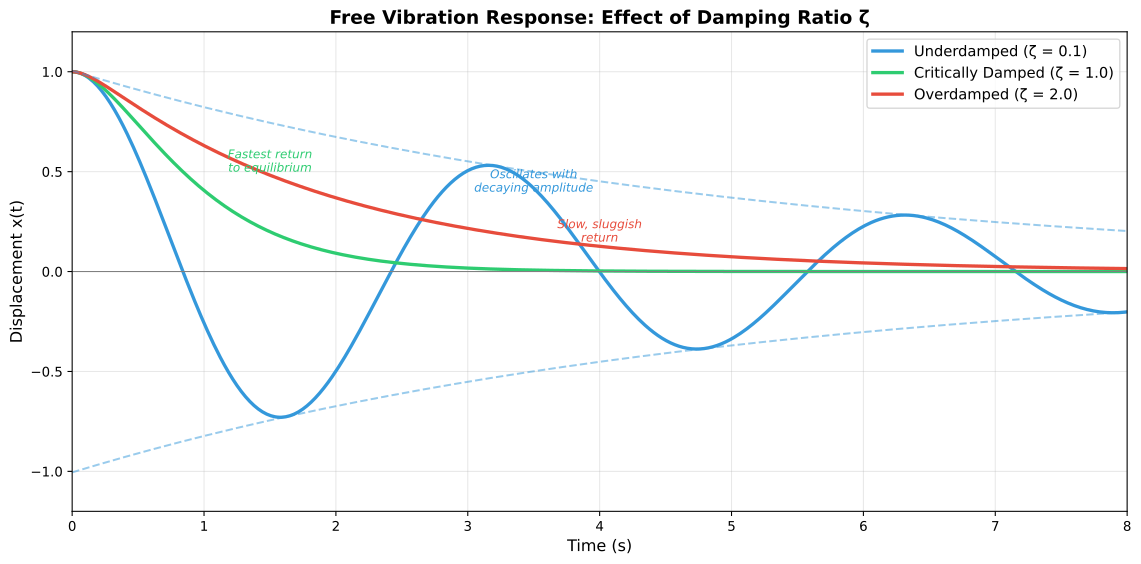
Depending on the value of $\zeta$, the system exhibits one of three distinct behaviors:
| Regime | Condition | Behavior | Real-World Example |
|---|---|---|---|
| Underdamped | $\zeta < 1$ | Oscillates with exponential decay | Car suspension, building sway |
| Critically Damped | $\zeta = 1$ | Returns to equilibrium fastest (no overshoot) | Door closer, meter needle |
| Overdamped | $\zeta > 1$ | Slow, exponential return | Shock absorber in heavy oil |
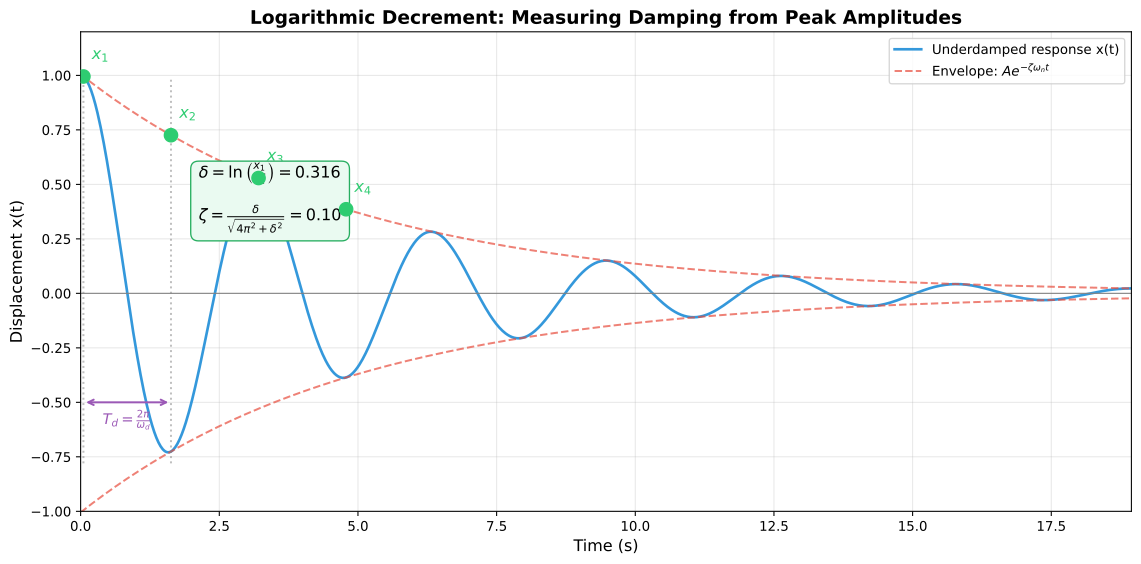
Logarithmic Decrement ($\delta$) is a practical method for measuring damping from experimental data.
Derivation: For underdamped vibration, the response is $x(t) = Ae^{-\zeta\omega_n t}\sin(\omega_d t + \phi)$. At successive peaks separated by one damped period $T_d$:
$$\frac{x_n}{x_{n+1}} = \frac{Ae^{-\zeta\omega_n t_n}}{Ae^{-\zeta\omega_n (t_n + T_d)}} = e^{\zeta\omega_n T_d}$$
Taking the natural logarithm: $$\delta = \ln\left(\frac{x_n}{x_{n+1}}\right) = \zeta\omega_n T_d = \frac{2\pi\zeta}{\sqrt{1-\zeta^2}}$$
From $\delta$, we can solve for: $\zeta = \dfrac{\delta}{\sqrt{4\pi^2 + \delta^2}}$
Other Flavors of Friction
While viscous damping is mathematically convenient, other forms exist:
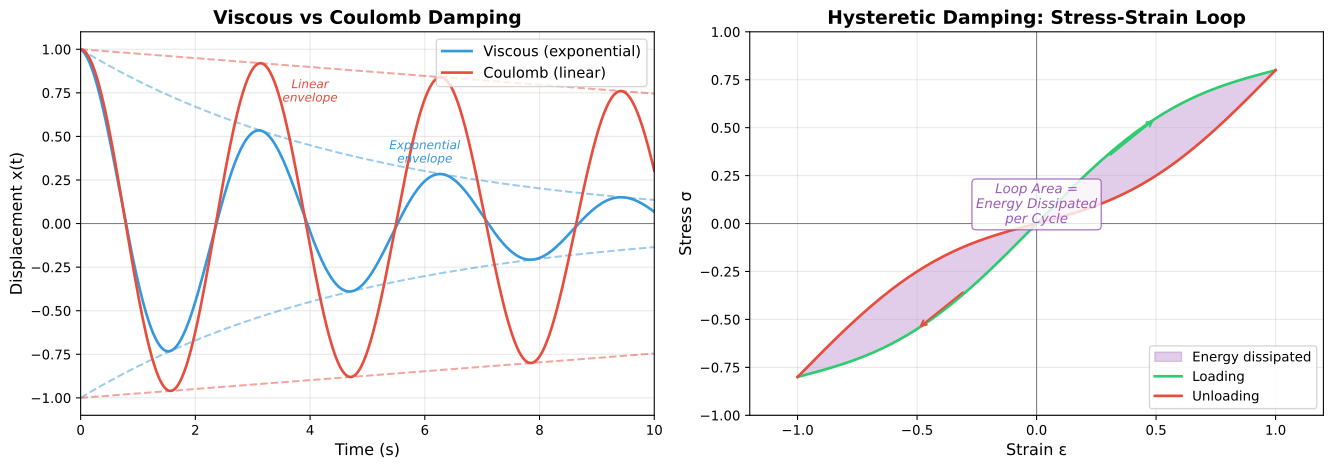
- Coulomb Damping (Dry Friction): This occurs when surfaces rub together. Unlike viscous damping (exponential decay), Coulomb damping causes the amplitude to decay linearly.
- Hysteretic Damping: Also known as solid damping, this is caused by internal friction within the material itself. The energy dissipated corresponds to the area of the hysteresis loop in the stress-strain diagram.
Stability: When Vibration Goes Wrong
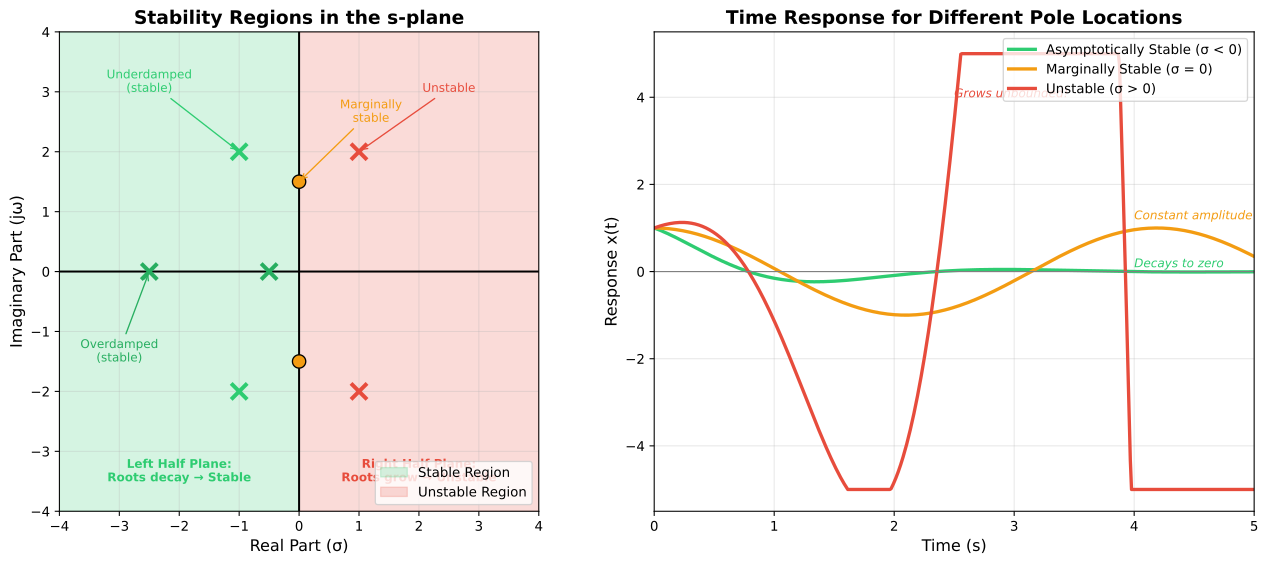
Stability is the most critical concern in vibration design. The characteristic equation of a vibrating system has roots in the complex $s$-plane, and the location of these roots determines system behavior:
| Pole Location | Real Part | System Behavior |
|---|---|---|
| Left Half Plane | σ < 0 | Asymptotically stable (vibration dies out) |
| Imaginary Axis | σ = 0 | Marginally stable (constant amplitude) |
| Right Half Plane | σ > 0 | Unstable (vibration grows unbounded) |
Julia Example: Damping Comparison
Let’s visualize the difference between an undamped and an underdamped system using Julia.
| |

What’s Next?
We have seen how systems behave when left alone. But what happens when we start shaking them? In the next post, “Harmonically Excited Vibration,” we will introduce external forces, explore the dangerous phenomenon of Resonance, and learn why soldiers break stride when crossing a bridge.
References
Rao, S. S. (2018). Mechanical Vibrations (6th ed.). Pearson.