EWPS-08: Understanding Acoustic Dispersion Curves
Welcome to Part 8 of our Elastic Wave Propagation Series. In previous posts, we explored spectral analysis techniques and wave behavior in various structures. Now we focus on one of the most important tools for understanding wave propagation: the dispersion curve.
If you’ve worked with ultrasonic testing, phononic crystals, or acoustic metamaterials, you’ve certainly encountered dispersion diagrams. But reading them correctly—and extracting actionable insights—requires understanding both the mathematics and the physics behind these curves.
What is Dispersion?
In its simplest form, dispersion describes how wave speed varies with frequency. The term originates from optics: a prism “disperses” white light into a rainbow because different colors (frequencies) travel at different speeds through the glass.
In acoustics, the same principle applies. When we say a system is dispersive, we mean: Different frequency components of a wave travel at different speeds, causing the wave shape to change as it propagates.
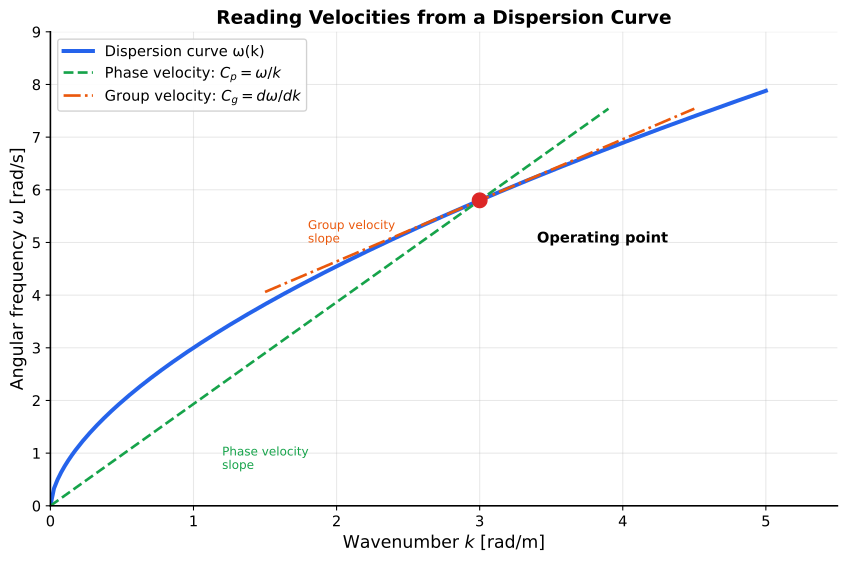
The Dispersion Relation
The mathematical relationship between angular frequency $\omega$ and wavenumber $k$ is called the dispersion relation:
$$\omega = \omega(k) \quad \text{or equivalently} \quad k = k(\omega)$$
| Property | Symbol | Definition | Physical Meaning |
|---|---|---|---|
| Frequency | $\omega$ | $2\pi f$ | Oscillations per unit time |
| Wavenumber | $k$ | $2\pi/\lambda$ | Oscillations per unit length |
| Wavelength | $\lambda$ | Spatial period | Distance between wave crests |
Non-Dispersive vs. Dispersive Media
| Type | Dispersion Relation | Wave Behavior | Example |
|---|---|---|---|
| Non-dispersive | $\omega = c_0 k$ (linear) | Pulse shape preserved | Rods (longitudinal), Air |
| Dispersive | $\omega = \alpha k^2$ (quadratic) | Pulse spreads/distorts | Beams (bending) |
Mathematical intuition: In a simple elastic rod, the restoring force is proportional to strain ($\partial u/\partial x$), leading to a standard wave equation. In a bending beam, the restoring force depends on curvature ($\partial^2 u/\partial x^2$), creating a fourth-order PDE. This higher-order spatial derivative introduces the nonlinear $k^2$ dependence, causing high-frequency components to travel faster.
In free air, sound waves are essentially non-dispersive—the speech you hear from across the room arrives intact because all frequency components travel at the same speed (~340 m/s). But confine those waves in a duct, or let them travel through a solid plate, and dispersion becomes significant.
Phase Velocity vs. Group Velocity
Understanding the two types of velocity in dispersive systems is crucial for any practical application.
Phase Velocity
The phase velocity $C_p$ describes how fast individual wave crests move:
$$C_p = \frac{\omega}{k}$$
Geometric interpretation: On a dispersion diagram, the phase velocity at any point equals the slope of a line drawn from the origin to that point (the secant).
Group Velocity
The group velocity $C_g$ describes how fast the wave envelope—and hence the energy—propagates:
$$C_g = \frac{d\omega}{dk}$$
Geometric interpretation: The group velocity is the tangent slope of the dispersion curve at the point of interest.
Why the Distinction Matters
| Scenario | Key Velocity | Reason |
|---|---|---|
| Signal timing | $C_g$ | Energy arrives at group velocity |
| Interference patterns | $C_p$ | Phase determines constructive/destructive interference |
| Pulse distortion | Both | Difference between $C_p$ and $C_g$ causes spreading |
Key insight: In dispersive media, you may observe wave crests “sliding through” a wave packet. If $C_p > C_g$, crests appear at the back of the packet and disappear at the front—like ripples on a moving water droplet.
Special Case: Zero Group Velocity
In some dispersion curves, there exist frequencies where $C_g = 0$ but $C_p \neq 0$. At these Zero Group Velocity (ZGV) points:
- Energy does not propagate outward
- A strong local resonance builds up
- High sensitivity to local material property changes
ZGV modes are exploited in precision thickness measurements and material characterization.
Acoustic Dispersion Scenarios
Let’s examine three important scenarios where acoustic dispersion plays a central role.
Acoustic Waveguides
When sound propagates in a confined geometry (ducts, pipes, underwater channels), the boundary conditions create waveguide modes, each with a characteristic cutoff frequency.
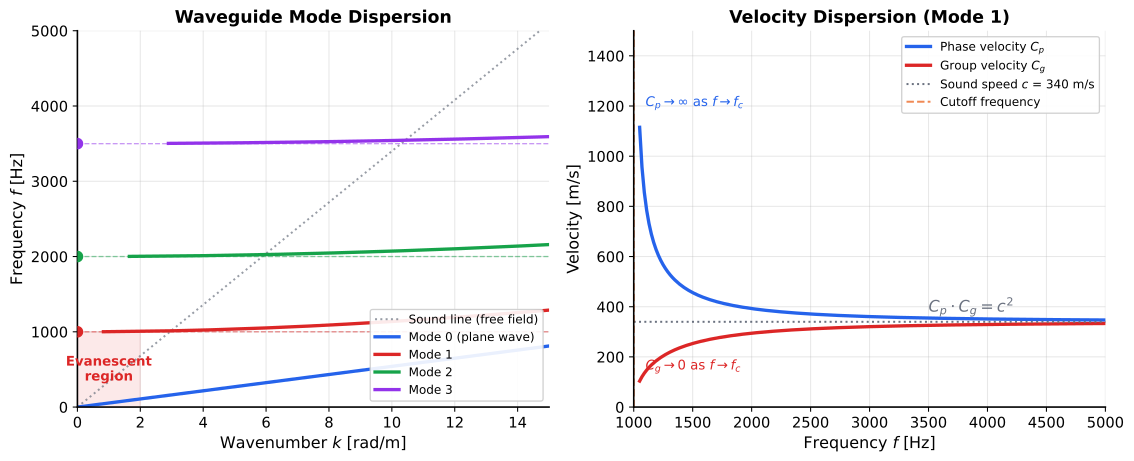
Key features:
| Property | Below Cutoff | Above Cutoff |
|---|---|---|
| Wave type | Evanescent (decaying) | Propagating |
| Phase velocity | Undefined | $C_p > c$ |
| Group velocity | Zero | $C_g < c$ |
The remarkable relationship $C_p \cdot C_g = c^2$ holds for simple waveguide geometries. This means:
- Near cutoff: $C_p \to \infty$ and $C_g \to 0$
- Far above cutoff: Both approach the free-field sound speed $c$
Practical applications:
- Muffler and silencer design (exploit cutoff for low-frequency attenuation)
- SONAR channel characterization
- Optical fiber acoustic sensing
Lamb Waves in Plates
Lamb waves are elastic waves in thin plates and represent one of the most complex—and useful—dispersion scenarios in structural acoustics.
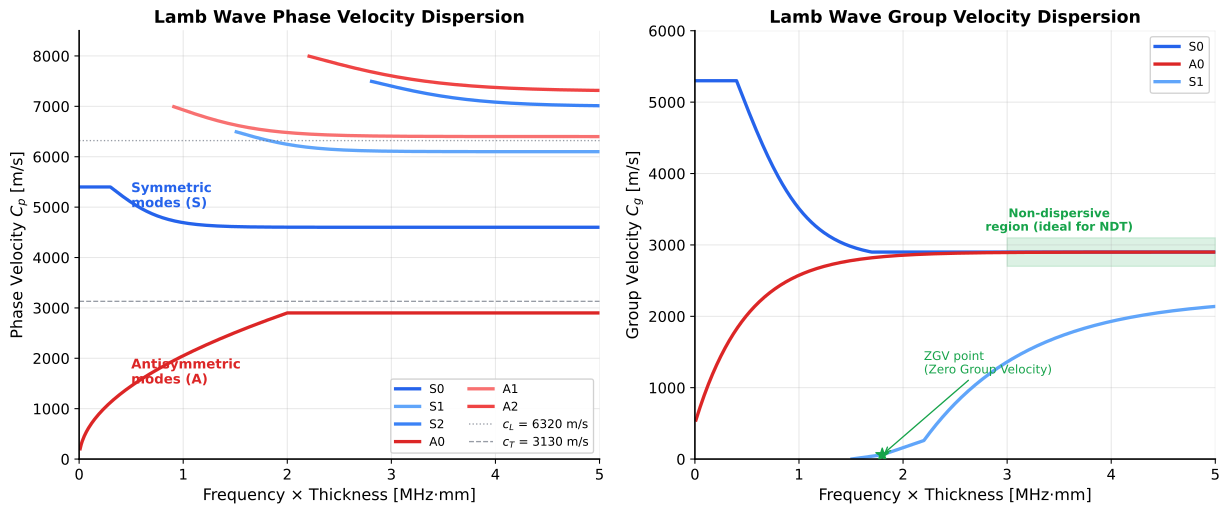
Mode classification:
| Mode Type | Motion | Low-Frequency Behavior |
|---|---|---|
| Symmetric (S) | In-plane stretching | S0 starts at plate velocity |
| Antisymmetric (A) | Out-of-plane bending | A0 starts from zero velocity |
Why Lamb waves matter for NDT:
Long propagation distances: Unlike bulk waves, Lamb waves travel along the plate surface, enabling inspection of large areas from a single sensor location.
Mode selection challenge: At any frequency, multiple modes may coexist with different velocities. Engineers must carefully choose operating points where:
- Only one mode is significantly excited
- The group velocity curve is flat (minimal dispersion)
ZGV applications: The ZGV points in higher Lamb wave modes provide extremely localized measurements—useful for detecting subtle material degradation or thickness variations.
Phononic Crystals and Metamaterials
Phononic crystals are periodic structures where the dispersion relation contains bandgaps—frequency ranges where no wave modes exist.
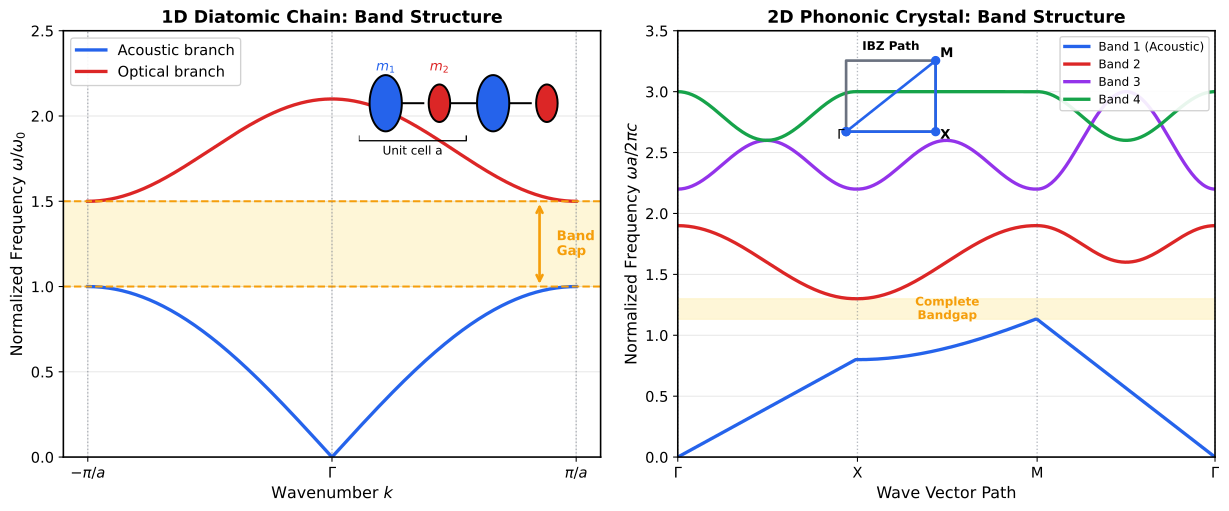
Physical origin of bandgaps:
In a periodic structure (e.g., alternating layers of different materials), waves undergo Bragg reflection at each interface. When the wavelength is comparable to the periodicity, destructive interference creates forbidden frequency bands.
| Branch Type | Frequency Limit ($k \to 0$) | Microscopic Motion | Physical Interpretation |
|---|---|---|---|
| Acoustic | $\omega \to 0$ | In-phase: Atoms move in unison. | macroscopic wave (sound) |
| Optical | $\omega = \omega_{cut} > 0$ | Out-of-phase: Atoms move oppositely. | Localized internal resonance |
Engineering perspectives:
| Goal | Dispersion Feature | Design Strategy |
|---|---|---|
| Noise isolation | Wide bandgap | Maximize impedance contrast |
| Waveguiding | Defect mode in gap | Introduce line defects |
| Slow sound | Flat bands | Heavy local resonators |
| Negative refraction | Negative group velocity | Near Brillouin zone edge |
NDT vs. Metamaterials mindset:
- NDT engineers view dispersion as a problem to minimize—they seek flat regions.
- Metamaterial designers view dispersion as a tool to exploit—they engineer gaps and anomalous bands.
How to Read Dispersion Diagrams
Different representations of dispersion emphasize different physical aspects. The figure below compares the specific features visible in each type of plot.
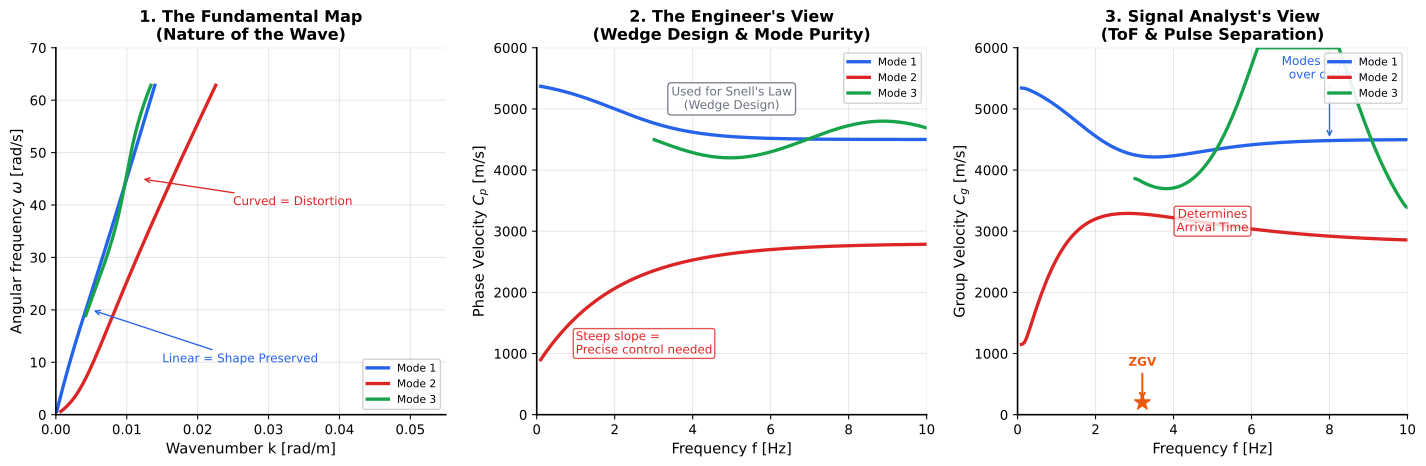
The Fundamental Map (ω-k)
This plot reveals the nature of the wave. A straight line indicates a non-dispersive medium where signals remain sharp. Any curvature serves as a warning: your pulse will distort and spread over distance. Gaps in the spectrum immediately identify “stop-bands” where propagation is forbidden.
The Engineer’s View (Phase Velocity)
Consult this plot for wedge design and angle calculations. Since Snell’s law relies on phase velocity, this is your lookup table for determining refraction angles. Pay close attention to mode purity: steep slopes imply that even a tiny frequency shift will cause a massive change in velocity, making consistent inspection difficult.
The Signal Analyst’s View (Group Velocity)
This is your guide for timing and packets. It predicts exactly when a wave packet will arrive (Time-of-Flight) and how different modes will separate over distance—like runners with different paces. It also highlights ZGV points (Zero Group Velocity), which are distinct “sweet spots” for local resonance testing where energy trapped locally.
Pro Tip: How do we measure this experimentally? In the real world, we don’t measure “dispersion curves” directly. We measure time-domain signals $u(x,t)$ at multiple points along a line. By performing a 2D Fourier Transform (2D-FFT)—transforming time to frequency ($t \to \omega$) and space to wavenumber ($x \to k$)—the dispersion curve naturally emerges as the bright ridges in the resulting colormap. This is the gold standard for experimental validation.
Summary
Dispersion curves provide the roadmap for wave propagation in complex media. Whether you are designing a noise-canceling metamaterial or inspecting an aircraft wing, these curves reveal:
| Concept | Physical Meaning | Key Insight |
|---|---|---|
| Dispersion relation | $\omega = \omega(k)$ | Defines allowed propagation states |
| Phase velocity | $C_p = \omega/k$ | Governs refraction (Snell’s Law) |
| Group velocity | $C_g = d\omega/dk$ | Governs signal timing and energy flow |
| Cutoff frequency | Threshold | Boundary between propagating and decaying |
| Bandgap | Forbidden zone | Frequency range with zero transmission |
Mastering these representations allows you to move beyond assuming “sound speed is constant” and harness the full complexity of wave physics.
What’s Next?
In Part 9, we dive deeper into Brillouin Zones—the geometric framework that organizes dispersion information for periodic structures. Understanding Brillouin zones is essential for designing phononic crystals, interpreting band structures, and connecting real-space geometry to wave behavior.
References
- Gopalakrishnan, S. (2023). Elastic Wave Propagation in Structures and Materials. CRC Press.
- Rose, J. L. (2014). Ultrasonic Guided Waves in Solid Media. Cambridge University Press.
- Brillouin, L. (1953). Wave Propagation in Periodic Structures. Dover Publications.