EWPS-09: Brillouin Zones and Band Structure Analysis
Welcome to Part 9 of our Elastic Wave Propagation Series. We explored acoustic dispersion curves and how to read them. Now we take a deeper step: understanding the Brillouin zone—the geometric framework that organizes dispersion information for periodic structures.
If you work with phononic crystals, acoustic metamaterials, or even ultrasonic inspection of polycrystalline materials, the Brillouin zone is unavoidable. It’s the “map” on which all band structure diagrams are drawn.
Why Do We Need Brillouin Zones?
The Problem: Infinite Wavenumbers
Consider a wave propagating through a periodic structure with lattice constant $a$. The wave can be described by:
$$u(x, t) = A e^{i(kx - \omega t)}$$
Here is the crucial insight: Periodicity creates aliases. In a periodic medium, a wave with wavenumber $k$ is physically indistinguishable from a wave with wavenumber $k + \frac{2\pi n}{a}$. The atoms move in exactly the same way, meaning these are not different physical states—they are just different labels for the same vibration.
Analogy: The Origami Map Imagine an infinite sheet of paper representing all possible wavenumbers. Because the physics repeats every $2\pi/a$, we don’t need the whole sheet. We can fold the infinite paper onto itself like an accordion. The entire universe of wave physics is contained in the single top fold—this fold is the First Brillouin Zone.
The Solution: Fold into the First Brillouin Zone
Instead of tracking infinite possible wavenumbers, we strictly limit our view to this unique range:
$$k \in \left[ -\frac{\pi}{a}, \frac{\pi}{a} \right]$$
This is the First Brillouin Zone (FBZ). It is the “fundamental domain” of reciprocal space.
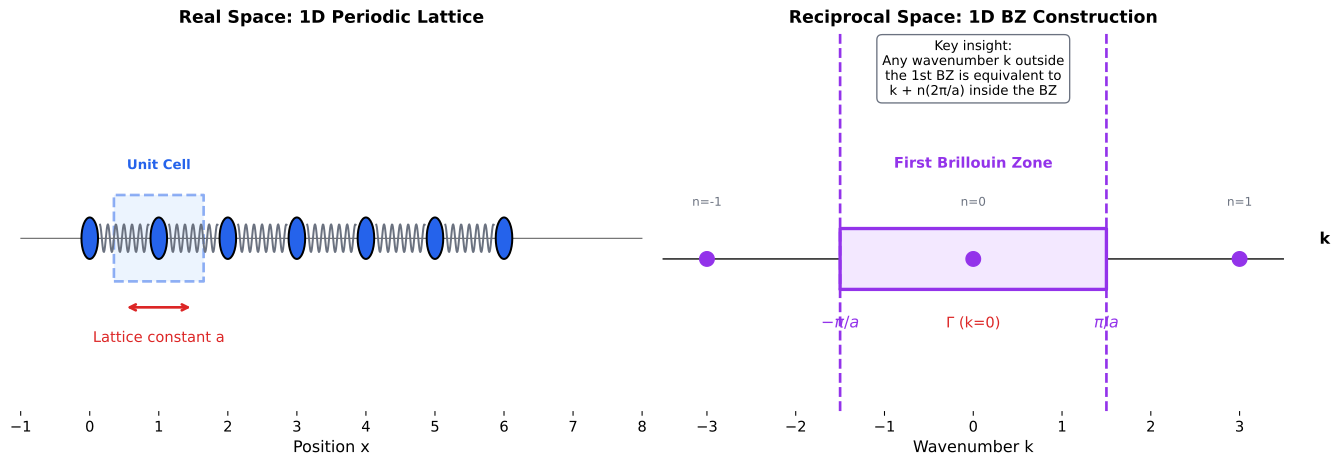
Constructing Brillouin Zones
The Reciprocal Lattice
The Brillouin zone lives in reciprocal space (k-space). It is the map logic for the frequency domain.
| Real Space | Reciprocal Space |
|---|---|
| Lattice constant $a$ | Reciprocal lattice vector $G = 2\pi/a$ |
| Position $x$ | Wavenumber $k$ |
| Unit cell | First Brillouin Zone |
The Wigner-Seitz Construction
The FBZ is simply the Wigner-Seitz cell of the reciprocal lattice. To construct it:
- Start at the origin ($\Gamma$ point).
- Draw lines to all nearest reciprocal lattice points.
- Bisect these lines with perpendicular planes.
- The smallest enclosed volume is the First Brillouin Zone.
Intuition: This is a Voronoi diagram for momentum. It defines the territory of “unique physics” around the origin before Bragg reflection mirrors everything back.
2D Brillouin Zones
In two dimensions, the territory shape depends on the lattice symmetry.
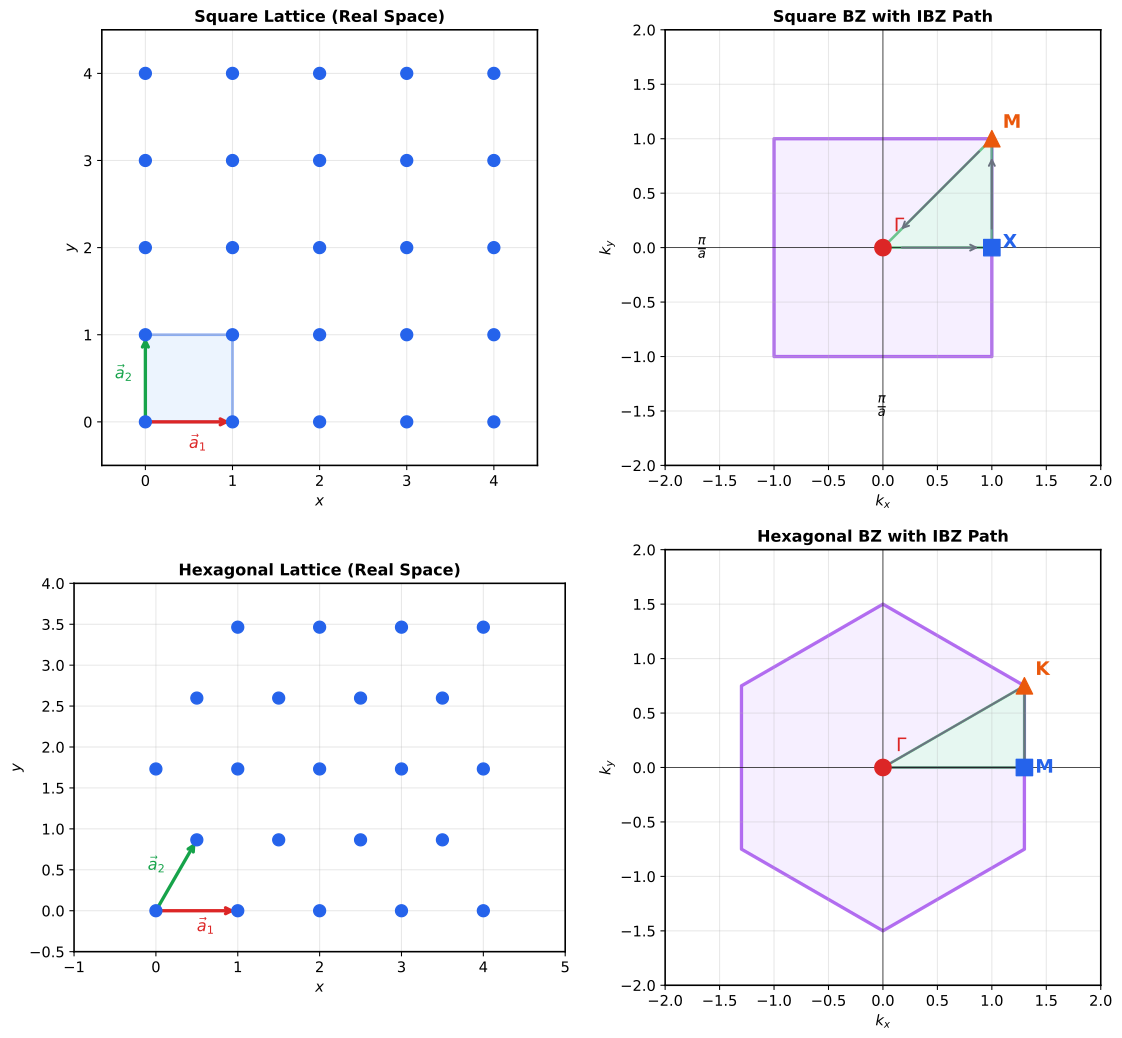
The Irreducible Brillouin Zone (IBZ)
We rarely scan the full zone. Because of symmetry, we only need the Irreducible Brillouin Zone (IBZ)—the smallest slice required to reconstruct the whole picture. For a square lattice, this is just a 1/8th triangular slice.
Common 2D Lattices
| Lattice Type | Real Space | Brillouin Zone Shape | IBZ Fraction |
|---|---|---|---|
| Square | 90° angles, equal sides | Square | 1/8 |
| Rectangular | 90° angles, unequal sides | Rectangle | 1/4 |
| Hexagonal | 60° angles | Hexagon | 1/12 |
| Oblique | General angles | Parallelogram | 1/2 |
High-Symmetry Points
When computing band structures, we trace a specific path connecting high-symmetry points. These are the “landmarks” (corners and edge centers) where the dispersion relation hits its extrema.
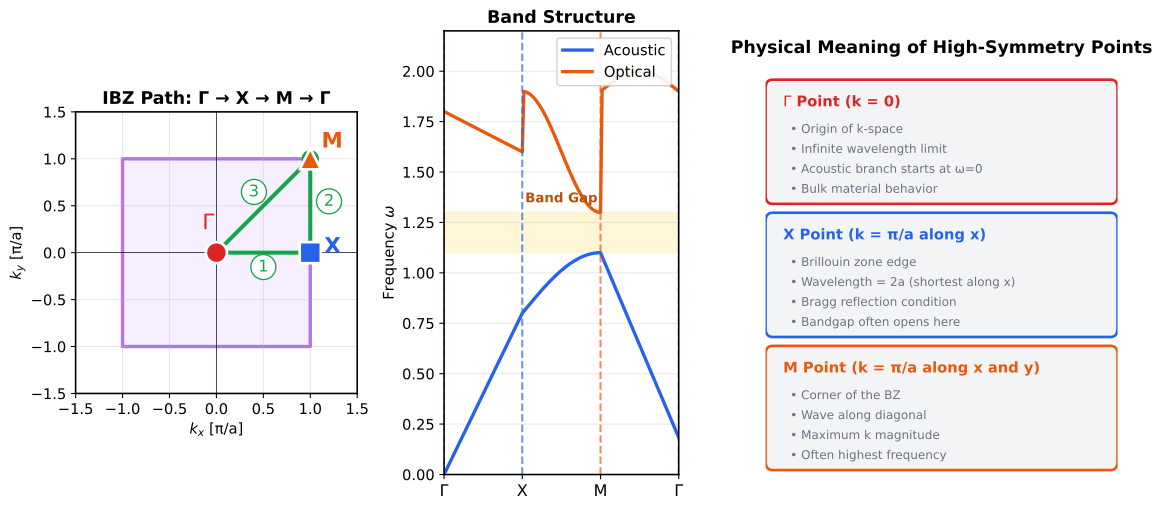
Standard Notation
| Symbol | Location | Physical Meaning |
|---|---|---|
| Γ (Gamma) | Origin $(0, 0)$ | Long wavelength limit ($k \to 0$); Rigid body motion |
| X | Edge center $(π/a, 0)$ | Standing wave along x-axis |
| M | Corner $(π/a, π/a)$ | Standing wave along diagonal; max wavenumber |
| K (hexagonal) | Corner | Six-fold symmetry point |
Why These Points Matter
At the Γ point ($k = 0$):
- Wavelength is infinite.
- The acoustic branch starts here at $\omega = 0$ because the whole crystal moves as a rigid body.
At zone boundaries (X, M, K):
- Wavelength matches the lattice periodicity ($2a$).
- Brillouin Zone Edge = Bragg Reflection. The wave cannot propagate further and forms a standing wave.
- This is physically where bandgaps usually open.
Key insight: Why do we only scan the edges? Because the “action”—the minimums, maximums, and gap openings—almost always happens at these high-symmetry boundaries. Scanning the interior is usually redundant.
Reading Band Structure Diagrams
Think of a band structure diagram as the elevation profile of a hike along the IBZ path.
- Horizontal Axis: Your position on the path (e.g., walking from $\Gamma$ to X).
- Vertical Axis: The frequency (energy) of the wave at that point.
- Slope: The Group Velocity ($C_g$). Steep path = fast wave. Flat path = slow wave.
Anatomy of a Band Diagram
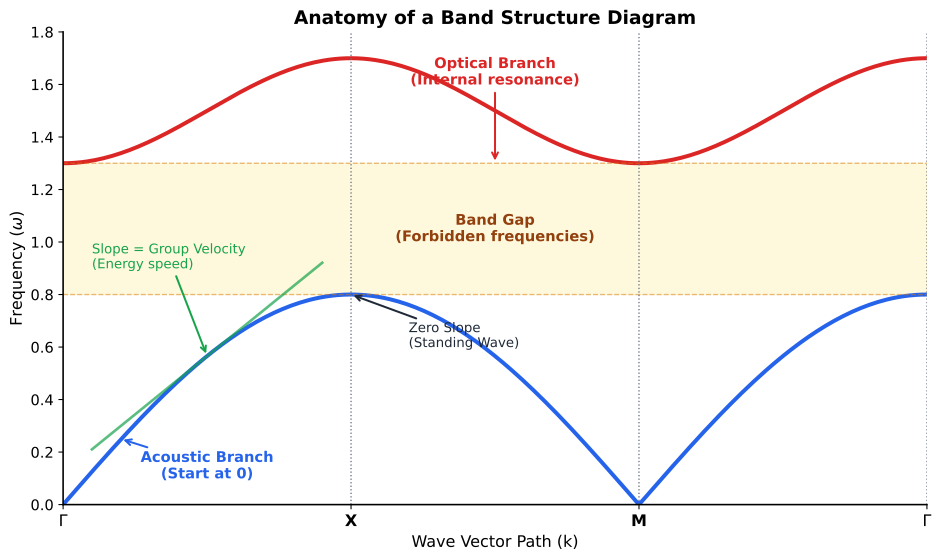
Where to look first:
- At Γ ($\Gamma$): How steep is the slope? Steeper = faster sound speed.
- At X/M Boundaries: Is there a gap? This is where Bragg reflection happens.
- Flat Bands: Do you see horizontal lines? These are “deaf bands” or localized resonances.
What to Look For
| Feature | Visual Signature | Physical Meaning |
|---|---|---|
| Acoustic branch | Starts from Γ at ω=0, linear slope | Long-wavelength sound waves |
| Optical branch | Does not pass through (Γ, 0) | Internal resonances |
| Bandgap | Frequency range with no curves | Forbidden propagation |
| Flat bands | Horizontal sections | Slow group velocity, localized modes |
| Band crossing | Two curves intersect | Mode coupling, possible Dirac cone |
| Anti-crossing | Curves repel each other | Hybridization, avoided crossing |
Complete vs. Partial Bandgaps
| Bandgap Type | Definition | Requirement |
|---|---|---|
| Partial (directional) | Gap exists along some k-directions | Gap at specific BZ boundary |
| Complete (omnidirectional) | Gap exists for ALL k-directions | Gap spans entire IBZ path |
Warning: A gap that appears on a Γ-X-M-Γ diagram might be a partial gap. To confirm a complete bandgap, you must verify the gap exists along ALL directions—which in 3D requires checking interior points, not just the boundary.
2D vs. 3D Brillouin Zones
The complexity of band structure analysis increases dramatically in three dimensions.
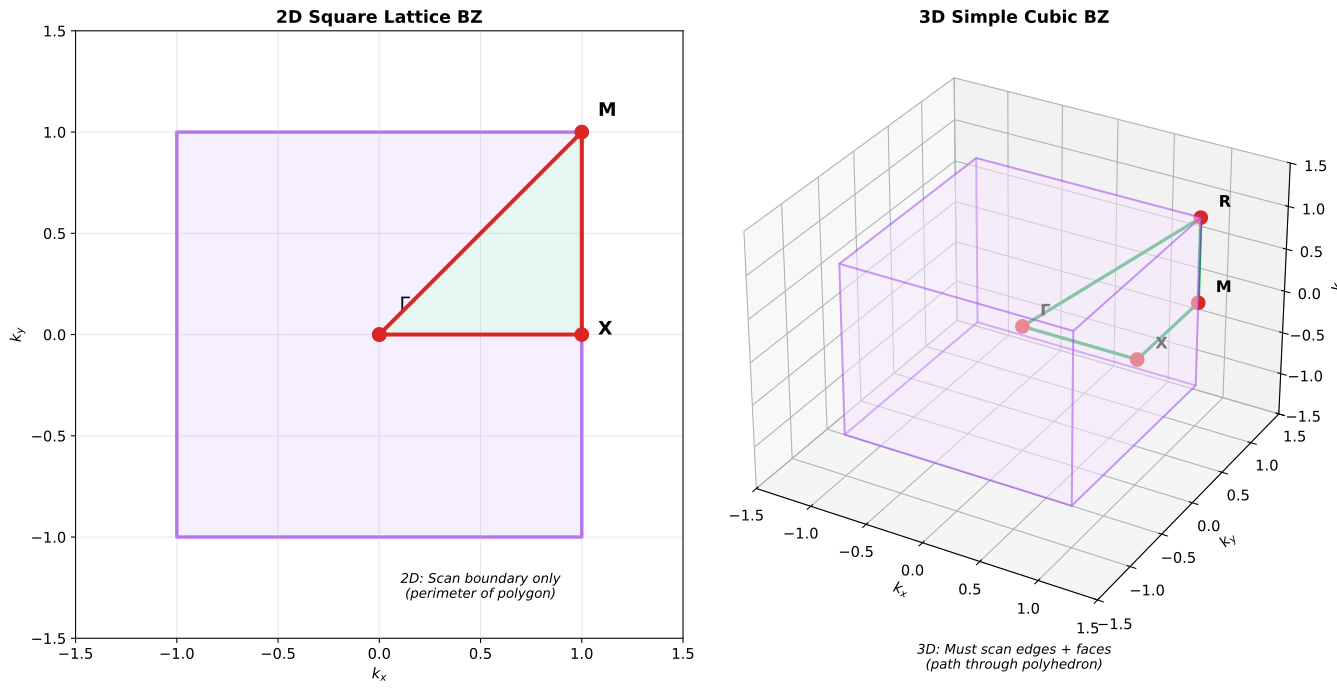
Key Differences
| Aspect | 2D | 3D |
|---|---|---|
| BZ shape | Polygon | Polyhedron |
| Scan region | Perimeter (1D curve) | Edges + faces (2D surface) |
| Visualization | Direct band plot | “Spaghetti” plot (projected) |
| Computation time | Minutes | Hours to days |
| Extrema location | Vertices, edges | Vertices, edges, face centers, interior |
Common 3D Brillouin Zones
| Lattice | BZ Shape | High-Symmetry Path |
|---|---|---|
| Simple Cubic | Cube | Γ-X-M-R-Γ |
| FCC | Truncated octahedron | Γ-X-W-K-L-Γ |
| BCC | Rhombic dodecahedron | Γ-H-N-P-Γ |
Common Pitfalls in Band Structure Analysis
| Pitfall | Description | Consequence |
|---|---|---|
| The “Partial Gap” Trap | Seeing a gap on the Γ-X path and assuming it’s a complete gap. | Design fails because waves leak through M-direction. |
| The “Empty Lattice” Confusion | Mistaking band folding for physical resonance. | Creating complex designs that are actually just homogeneous media. |
| Incorrect Unit Cell | Using a non-primitive unit cell. | Bands “fold” unnecessarily, making the diagram unreadable. |
| Ignoring 3D Effects | Simulating a plate as 2D infinite media. | Missing out-of-plane modes that might close the bandgap. |
Practical Applications
Dimensionality Checklist: 2D vs. 3D
Choosing the right analysis dimension is critical for both accuracy and computational efficiency.
| Scenario | Recommended Analysis | Why? |
|---|---|---|
| Extruded Structures (Rods, Fibers) | 2D | Geometry is invariant along z-axis. |
| Thin Plates | 2D | Plane stress/strain assumptions apply. |
| Initial Design Scoping | 2D | Fast iterations to find promising geometries. |
| Sphere Packings / Lattices | 3D | Geometry varies in all directions. |
| Oblique Incidence | 3D | Off-axis waves break 2D symmetry. |
| Final Bandgap Validation | 3D | Must verify gap closes in all spatial directions. |
Computational Tools
| Application | Recommended Tool | Notes |
|---|---|---|
| 2D phononic crystals | COMSOL, MPB | Floquet BC + eigenfrequency study |
| 3D band structures | MPB, COMSOL HPC | Memory-intensive; use symmetry |
| Quick visualization | Python + matplotlib | Generate path coordinates automatically |
| Path generation | SeeK-path library | For complex/custom lattices |
Summary
The Brillouin zone is the master map for wave physics in periodic media. It transforms an infinite problem (all possible waves) into a finite, manageable one (the First Brillouin Zone).
Key Takeaways:
- Efficiency: By scanning only the edges of the Irreducible Brillouin Zone (IBZ), you capture 90% of the critical physics (bandgaps, extrema) with <1% of the computational cost.
- Interpretation: Acoustic branches reveal effective properties; optical branches reveal internal resonances.
- Caution: A clean gap in a 2D plot guarantees nothing in 3D. Always validate your final designs with a full 3D scan if true omnidirectional isolation is required.
References
- Brillouin, L. (1953). Wave Propagation in Periodic Structures. Dover Publications.
- Kittel, C. (2005). Introduction to Solid State Physics (8th ed.). Wiley.
- Hussein, M. I., Leamy, M. J., & Ruzzene, M. (2014). Dynamics of phononic materials and structures: Historical origins, recent progress, and future outlook. Applied Mechanics Reviews, 66(4), 040802.
- Symmetry: Brillouin Zone Models - Video visualization of 3D Brillouin zones.