EWPS-06: Granular Media and Non-Local Nanostructures
In Part 5, we explored materials with complex properties (anisotropy and inhomogeneity) but simple structure. We still assumed they were continuous solids.
But what happens when the discrete nature of matter ignores our continuum assumptions? What if the wave interacts with individual sand grains or atomic lattices?
In this post, we leave the continuum behind to explore two scale-dependent extremes:
- Macroscopic Granularity: Why waves in sand behave like a “fluidized solid,” crucial for designing blast-proof bunkers.
- Microscopic Non-Locality: Why waves in nanotubes sense their neighbors’ neighbors, creating a forbidden “escape frequency.”
Granular Media: The Physics of Sand
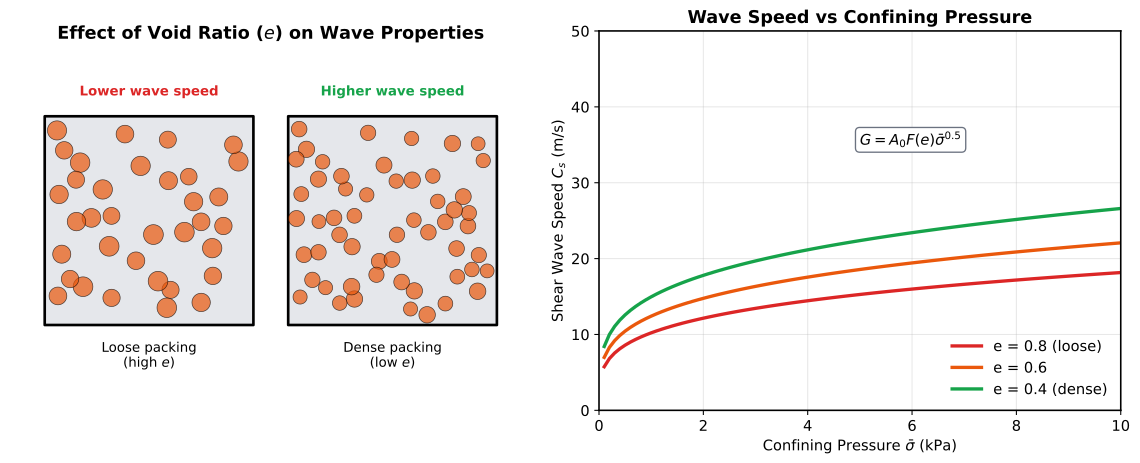
Sand is not a solid in the traditional sense. It’s a collection of discrete particles that can flow, compact, and even liquefy under vibration. Unlike a steel beam where atoms are rigidly bonded, energy in sand travels by hopping from grain to grain through contact points. This makes wave speed sensitive to how tightly grains are packed.
The Two Control Knobs
Wave speed in granular media is controlled by two state variables:
| Parameter | Analogy | Effect on Wave Speed |
|---|---|---|
| Void Ratio ($e$) | A jar of marbles vs. a jar of sand. More void = fewer contacts. | Higher $e$ → Lower Speed |
| Confining Pressure ($\bar{\sigma}$) | Squeezing the jar lid tighter. More pressure = stiffer contacts. | Higher $\bar{\sigma}$ → Higher Speed |
The Empirical Stiffness Model
The shear modulus $G$ (and thus wave speed $C_s = \sqrt{G/\rho}$) follows a well-established empirical law:
$$ G = A_0 \cdot F(e) \cdot \bar{\sigma}^n $$
- $F(e) = \frac{(2.17 - e)^2}{1 + e}$ penalizes high void ratios.
- $n \approx 0.5$ for most dry sands.
Takeaway: Wave speed is not a material constant—it’s a state function.
Depth-Varying Wave Speed: Gravity-Induced Inhomogeneity
Here’s a critical consequence: In a natural soil deposit, the confining pressure $\bar{\sigma}$ increases with depth simply due to the weight of overlying soil:
$$ \bar{\sigma}(z) = K_0 \gamma z \implies C_s(z) \propto z^{n/2} $$
This means wave speed increases with depth, creating a natural gradient similar to the FGMs in Part 5, but here the gradient is caused by gravity rather than by intentional manufacturing.
Application: The Sand Bunker
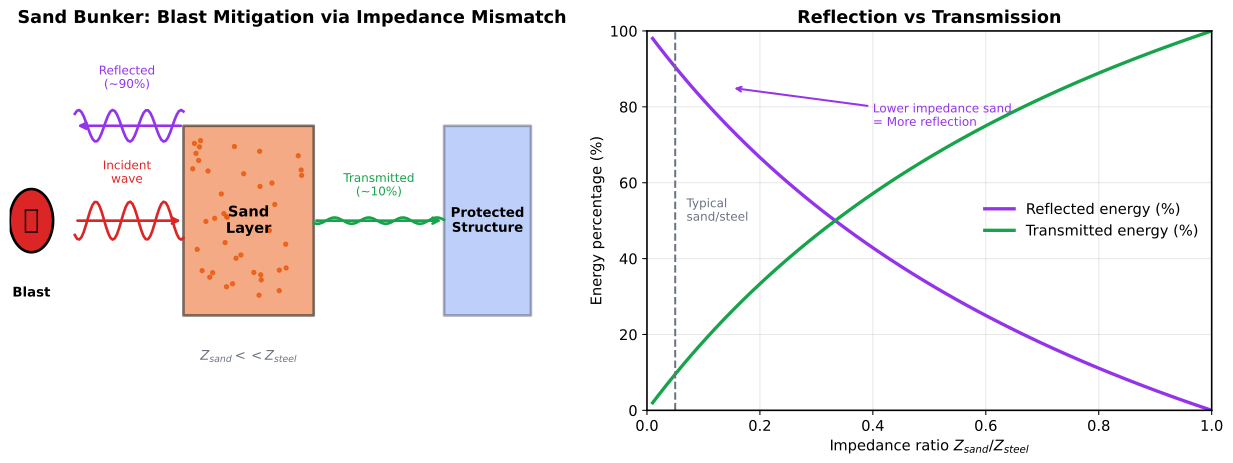
Why study wave propagation in sand? Blast mitigation. Sand acts as a shock absorber, protecting structures from high-intensity explosions. The secret is impedance mismatch.
The Physics: Reflection via Mismatch
Think of punching a soft pillow vs. punching a brick wall.
- The pillow (low impedance) is too soft to effectively resist your hand, but it also cannot transfer your punch’s energy effectively to the bed behind it.
- The energy is “decoupled” because of the huge difference in stiffness (impedance).
- Sand behaves like the pillow.
For a sand layer protecting steel ($Z_{sand} \ll Z_{steel}$), the efficiency of energy transfer is extremely low.
- Reflection: $\sim 90%$ of the blast energy bounces back because the steel interface acts like a rigid wall to the soft sand wave.
- Transmission: Only a tiny fraction enters the structure.
Design Trade-offs
| Parameter | Effect | Trade-off |
|---|---|---|
| Thicker Sand Layer | More cycles to dissipate energy | Heavy and bulky |
| Denser Packing | Slightly higher transmission (less mismatch) | Harder to maintain in field |
| Confining Pressure | Increases stiffness (changing frequency response) | Requires strong containment |
Non-Local Waveguides: When “Local” Theory Fails
In all previous chapters, we assumed local elasticity.
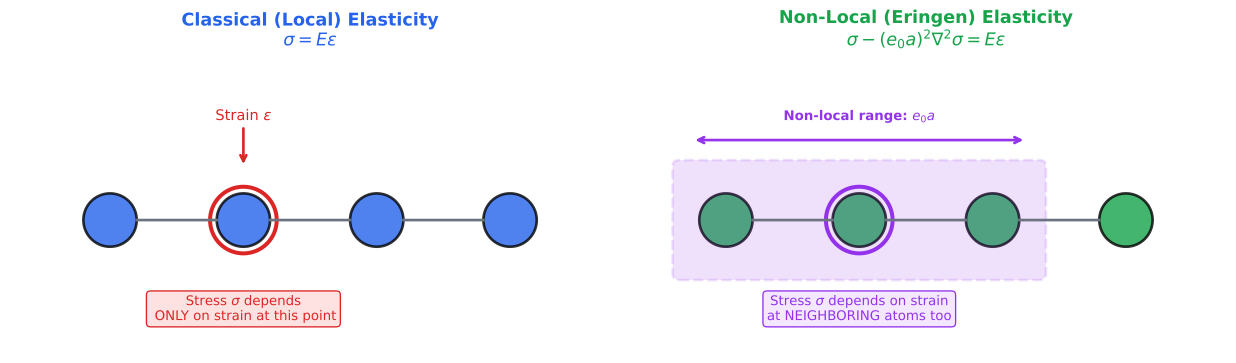
- The Assumption: Stress at a point depends only on strain at that exact point ($\sigma = E\varepsilon$).
- The Analogy: Think of a digital image. In “local” theory, each pixel is independent. Changing color at coordinate $(x,y)$ doesn’t affect $(x+1, y)$.
But what happens at the nanoscale? In Carbon Nanotubes (CNT) or Graphene, the concept of a “continuum point” vanishes because we are zooming in until we see individual atoms.
The Physics: Information Leakage
At atomic scales, the forces between atoms have a range.
- Atom A pulls on Atom B and Atom C.
- Therefore, the stress state at point $x$ is influenced by the strain at all points $x’$ within a certain radius.
- It’s like applying a Gaussian Blur to the stress field—sharp changes are smoothed out.
Eringen’s Solution: The Stress Gradient
Instead of simulating every atom (too slow), Eringen proposed a modified continuum equation:
$$ \sigma - (e_0 a)^2 \frac{\partial^2 \sigma}{\partial x^2} = E \varepsilon $$
| Term | Physical Meaning |
|---|---|
| $\sigma$ | The local stress we are used to |
| $-(e_0 a)^2 \nabla^2 \sigma$ | The Neighbor Effect. High stress gradients “leak” influence to neighbors. |
| $(e_0 a)$ | Scale Parameter. The “radius of influence” (approx 0.39 $\times$ bond length). |
The Consequence: Escape Frequency
This small change radically alters wave propagation:
| Aspect | Classical Theory | Non-Local Theory |
|---|---|---|
| Wavelength | Can be infinitely small | Limited by atomic spacing ($\lambda > e_0 a$) |
| Dispersion | Linear ($c_0$ is constant) | Nonlinear ($c$ drops as $\omega$ increases) |
| High Frequency | Waves always propagate | Escape Frequency: Above $\omega_{max}$, waves stop! |
The Escape Frequency: Nature’s Nyquist Limit
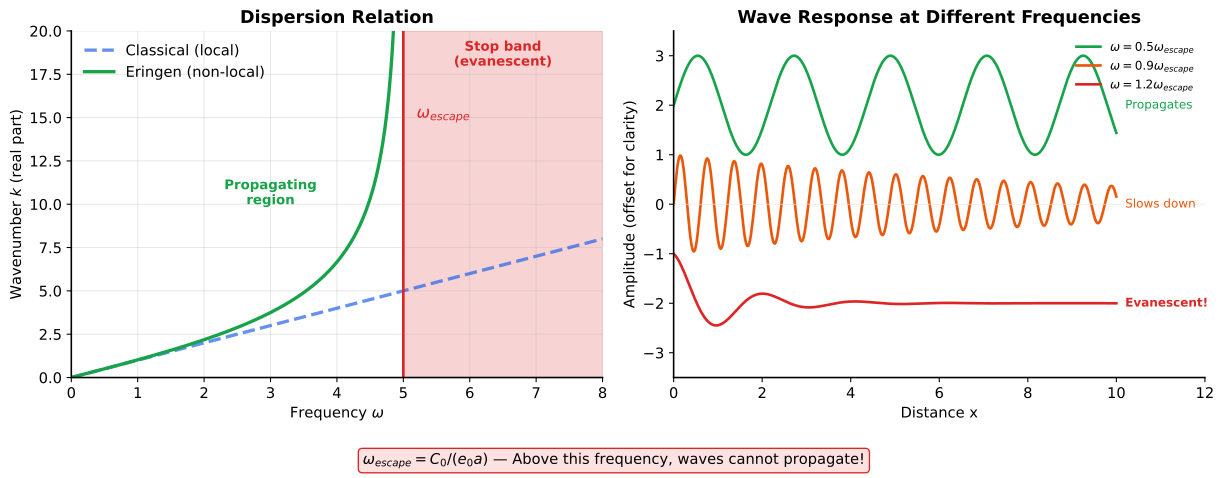
The most remarkable prediction of non-local theory is that ultra-high frequency waves simply cannot exist.
The Mathematical Singularity
The dispersion relation for a non-local rod is:
$$ k^2 = \frac{\omega^2}{C_0^2 - (e_0 a \omega)^2} $$
Look at the denominator. As frequency $\omega$ increases, the denominator shrinks. When it hits zero, wavenumber $k \to \infty$.
What does infinite wavenumber mean? Since wavelength $\lambda = \frac{2\pi}{k}$, this implies Wavelength $\to$ 0.
The Physical “Why”: The Atomic Limit
Classic continuum math says you can slice space infinitely small. Physics says no. You cannot have a vibration mode smaller than the atoms themselves.
- The Analogy: Think of “Nature’s Nyquist Limit”. Just as a 1080p screen cannot display an image with more detail than its pixels allow, a material cannot support a wave shorter than its atomic spacing.
- The Result: The material imposes a hard “Escape Frequency” ($\omega_{esc} \approx 60$ THz for CNTs). Frequencies above this limit are strictly forbidden from propagating.
It’s Not Damping, It’s a Wall
This is fundamentally different from normal attenuation:
| Phenomenon | Mechanism | Result |
|---|---|---|
| Viscous Damping | Friction / Heat Loss | Wave travels but gets weaker (Amplitude $\downarrow$) |
| Non-Local Cutoff | Discrete Geometry | Wave cannot exist (Propagation = 0) |
The material acts as a perfect mechanical low-pass filter.
The Danger of Bad Math: Causality
When deriving these theories, you might ask: Does the gradient term add or subtract? The choice is critical.
The Causality Violation If you choose the wrong sign (Positive Gradient Elasticity), mathematical analysis predicts that Group Velocity $\to \infty$ at high frequencies.
- Physics says: Information travels faster than light (or sound).
- Reality says: Impossible. The wave arrives before it is sent.
Thus, we must strictly use Negative Gradient Elasticity (matching Eringen’s theory) to ensure the wave speed remains bounded and physical.
Summary
We have now seen how the “Continuum Assumption” fails at two extremes:
| Scale | Material | Physical Driver | Wave Phenomenon |
|---|---|---|---|
| Macro | Sand | Contact Mechanics | Speed depends on pressure (Gravity) |
| Micro | Nanotube | Atomic Spacing | Frequency Cutoff (Escape Freq) |
Key Takeaways:
- Sand is a “Fluidized Solid”: Gravity creates a natural waveguide where speed increases with depth.
- Atoms are the Limit: You cannot wave faster than the lattice. The atomic spacing sets a hard “Nyquist limit” (Escape Frequency).
- Non-Locality = Low Pass Filter: These materials inherently reject high-frequency energy.
What’s Next? (The Grand Unifier)
We have traveled a long road:
- Part 4: Simple Isotropic 2D waves.
- Part 5: Anisotropic Composites & Inhomogeneous FGMs.
- Part 6: Non-Local Microstructures.
The math has become a nightmare. Analytical solutions are breaking down. We need a numerical tool powerful enough to handle all these complexities—layering, anisotropy, gradients, and non-locality—without the crushing cost of standard Finite Element Analysis.
In the Final Part (Part 7), we introduce the Spectral Finite Element Method (SFEM)—the frequency-domain super-weapon that unifies everything we’ve learned into one elegant computational framework.
References
Gopalakrishnan, S. (2023). Elastic Wave Propagation in Structures and Materials. CRC Press.