EWPS-07: Spectral Finite Element Method (SFEM)
Throughout this series, time and again we faced the same Analytical Bottleneck. Whether it was a rod (Part 1), a beam (Part 2), or a composite (Part 5), we solved everything by hand—assuming wave potentials, matching boundary conditions, and deriving coefficients.
This is fine for a single textbook component. But what about a real-world structure?
- A 3D Truss with hundreds of welded joints.
- A 100-layer Composite Laminate with complex coupling.
- A Pipeline Network spanning kilometers.
Tracking thousands of reflection coefficients manually is impossible. We need a computational framework that is as systematic as Finite Element Analysis but retains the physical exactness of wave theory.
Enter the Spectral Finite Element Method (SFEM).
What is SFEM? (And Why Does it Beat Conventional FEM?)
If you’re an engineer, you likely use the Finite Element Method (FEM). Conventional FEM approximates displacement using polynomial shape functions. This works great for static loads and low-frequency vibrations.
However, for wave propagation (high frequencies), FEM hits a wall.
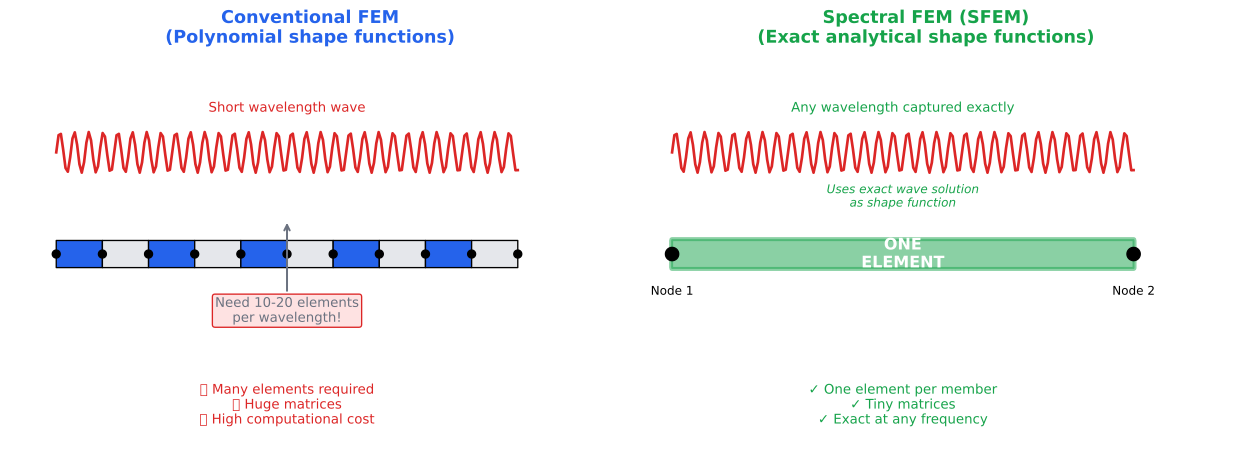
The High-Frequency Wall
The problem is wavelength ($\lambda$):
- To capture a wave, FEM needs at least 10–20 elements per wavelength.
- The Nightmare Scenario: Simulating a 1 MHz wave in a 1-meter aluminum rod ($\lambda \approx 6$ mm).
- FEM: Requires ~1,700 elements.
- SFEM: Requires 1 element.
As frequency rises, FEM system matrices become astronomically large, making computation impossibly slow.
SFEM’s Game-Changing Approach
SFEM works in the frequency domain:
- Transform time-domain problem via FFT.
- Use exact analytical wave solutions as shape functions (instead of polynomials).
- One element accurately models any length at any frequency.
- Inverse FFT to get time-domain response.
| Aspect | Conventional FEM | SFEM |
|---|---|---|
| Shape Functions | Simple Polynomials ($x, x^2, \dots$) | Exact Wave Solutions ($e^{-ikx}$) |
| Grid Requirement | 10-20 elements per $\lambda$ | 1 element per member |
| Frequency Limit | Mesh-dependent (Low Freq only) | Unlimited |
| Computational Cost | Explosive at high frequencies | Minimal & Constant |
The Core: Dynamic Stiffness Matrix ($\hat{K}$)
The heart of SFEM is the Dynamic Stiffness Matrix (DSM). Think of it as combining static stiffness and mass inertia into a single complex entity.
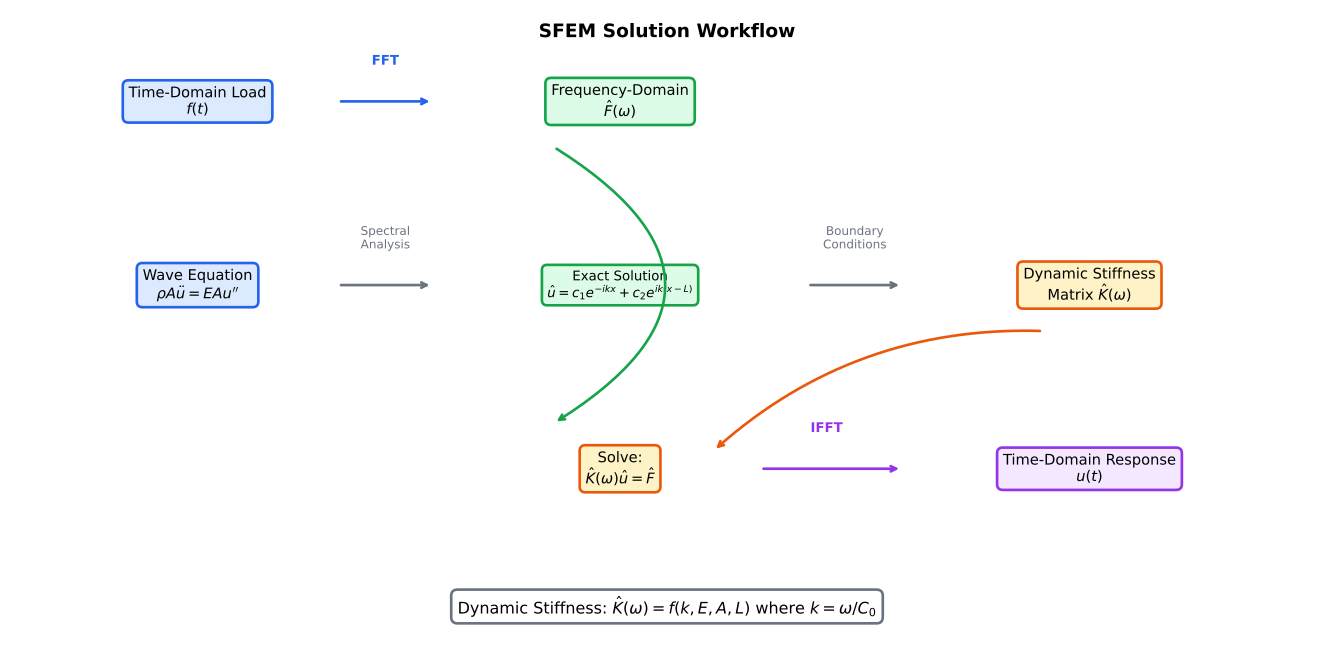
From FEM to SFEM
Conventional FEM separates stiffness ($K$) and mass ($M$): $$ M\ddot{u} + Ku = F(t) \quad \xrightarrow{\text{Freq Domain}} \quad (K - \omega^2 M)\hat{u} = \hat{F} $$ But $M$ and $K$ are approximations.
SFEM derives the exact relationship directly: $$ \hat{K}(\omega) \cdot \hat{u}(\omega) = \hat{F}(\omega) $$ Here, $\hat{K}(\omega)$ acts as a frequency-dependent stiffness that implicitly contains all inertia terms perfectly.
Rod Element: The Physics Inside the Math
For a rod of length $L$, the exact wave solution is: $$ \hat{u}(x, \omega) = A e^{-ikx} + B e^{ikx} $$ (Forward wave + Backward wave)
By enforcing boundary conditions at nodes 1 and 2, we get the exact DSM:
$$ \hat{K}_{rod} = \frac{EA \cdot ik}{1 - e^{-2ikL}} \begin{bmatrix} 1 + e^{-2ikL} & -2e^{-ikL} \\ -2e^{-ikL} & 1 + e^{-2ikL} \end{bmatrix} $$
Physical Decoding:
- $ik$ term: Represents spatial derivative (strain).
- $e^{-ikL}$ terms: Represent the exact phase delay of a wave traveling from node 1 to 2.
- Complex Value: The imaginary part handles the time delay (inertia) exactly.
Beyond Rods: Element Library
| Element Type | Physics Captured | Wave Types |
|---|---|---|
| Rod | Axial dynamics | Longitudinal (Non-Dispersive) |
| Euler-Bernoulli Beam | Bending stiffness | Flexural (Dispersive) |
| Timoshenko Beam | Bending + Shear deformation + Rotary Inertia | High-Freq Bending + Shear |
| Composite Laminate | Anisotropy + Layer coupling | Generalized Coupled Waves |
The Throw-Off Element: A Mathematical Black Hole
How do you model a structure that extends to infinity (like the ground or a long pipeline)?
- FEM: Needs a huge mesh or complex “absorbing boundaries” that often reflect energy back.
- SFEM: Uses a Throw-Off Element.
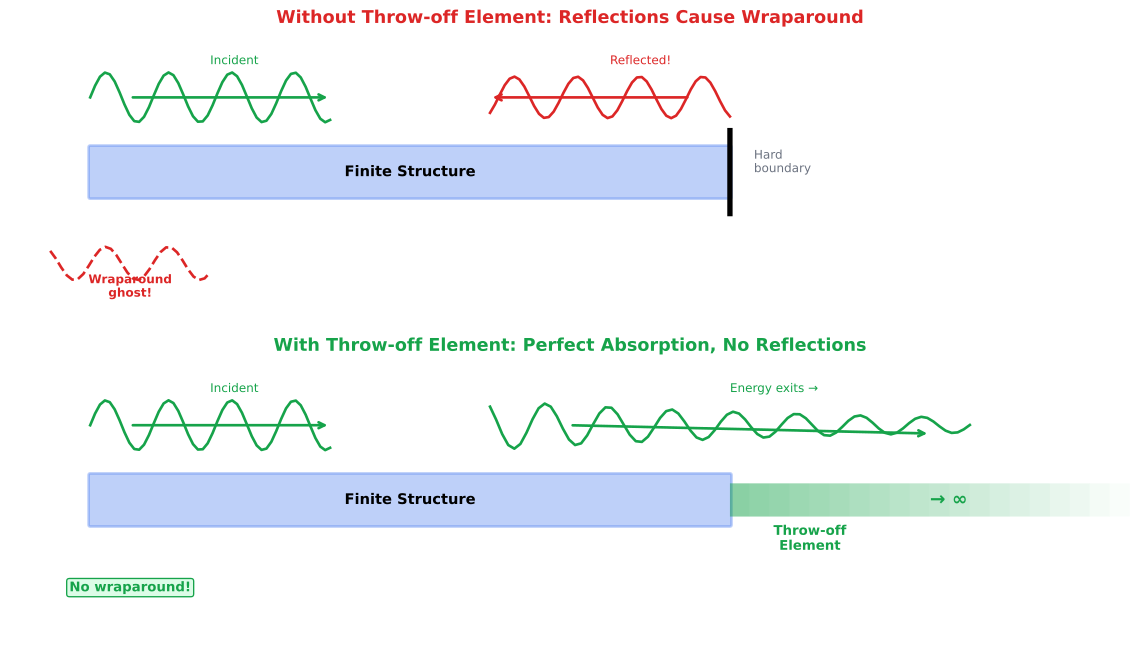
The “Infinite Sponge”
Think of the Throw-Off element as a Perfect Mechanical Sponge or a Black Hole. It is attached to the boundary of your structure and sucks all incoming energy out, preventing any reflection.
The Mathematical Magic
In the frequency domain, we simply delete the backward-traveling wave:
$$ \hat{u} = \underbrace{c_1 e^{-ikx}}_{\text{Forward}} + \underbrace{c_2 e^{ik(x-L)}}_{\text{Reflected} \to 0} $$
By forcing $c_2 = 0$, the element is mathematically defined as “Semi-Infinite”.
- No Reflection: It is impossible for energy to bounce back.
- No Wraparound: Solves the signal aliasing problems we saw in Part 3.
- Simple: It looks like a single node, but it represents an infinite expanse.
Dynamic Stiffness
For a rod throw-off element: $$ \hat{K}_{throwoff} = -ikEA $$ Just one complex number acts as a perfect boundary condition for infinity.
2D Elements and Lamb Waves
SFEM extends to two-dimensional structures using a semi-analytical approach:
- Fourier series in one spatial direction ($y$)
- FFT in time to frequency domain
- This reduces 2D PDEs to ODEs in $x$
- Solve ODEs analytically → spectral layer elements
Spectral Layer Elements
For laminated composites:
- Each ply is one spectral layer element
- Stack elements to model full laminate
- Solve for Lamb wave dispersion curves efficiently
This is critical for Structural Health Monitoring (SHM):
- Aircraft wing panels
- Pressure vessel walls
- Pipeline inspection
SFEM Applications
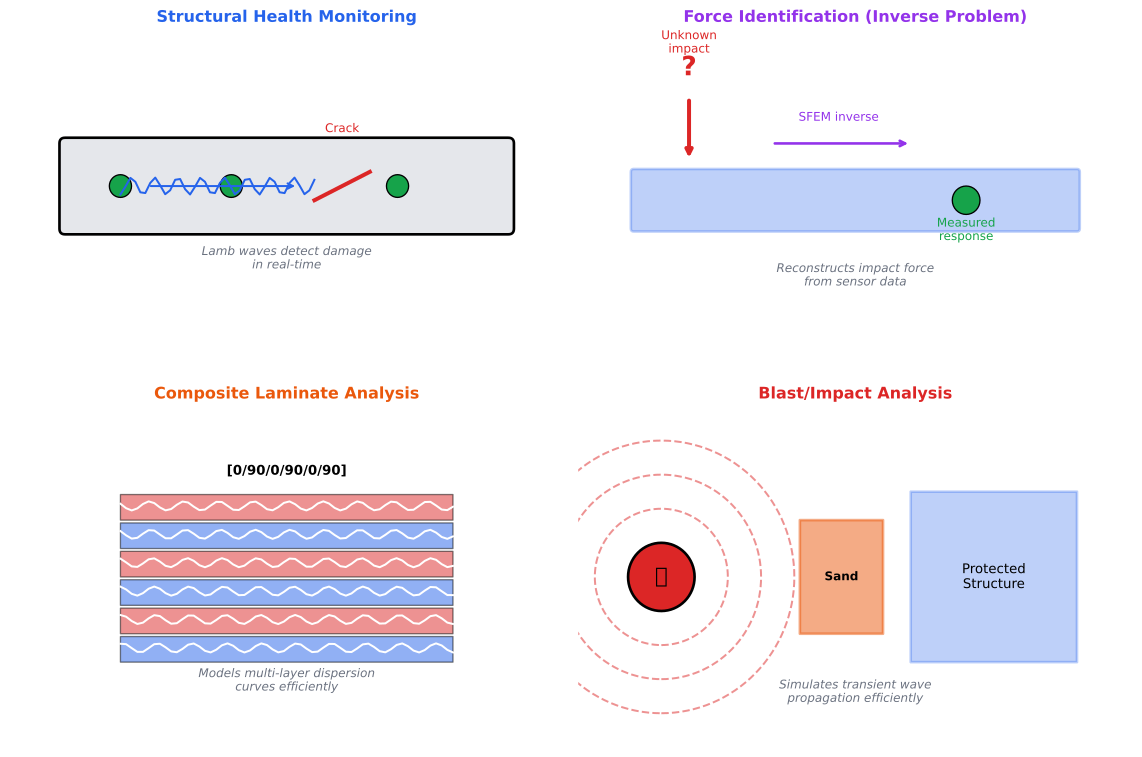
Structural Health Monitoring (SHM)
- Generate Lamb waves from piezoelectric actuators
- Detect damage from wave scattering/reflection
- SFEM efficiently models wave-damage interaction
Force Identification (Inverse Problem)
Given: Sensor response $\hat{u}(\omega)$ Find: Unknown impact force $\hat{F}(\omega)$
$$ \hat{F} = \hat{K}(\omega) \cdot \hat{u} $$
SFEM’s frequency-domain formulation makes inversion straightforward.
Blast Mitigation
- Model sand bunkers (impedance mismatch)
- Calculate transmitted vs reflected energy
- Optimize protective layer thickness
Pros and Cons of SFEM
Merits ✓
| Advantage | Description |
|---|---|
| Extreme accuracy | Uses exact wave solutions, no discretization error |
| Speed | 100-member truss = 100 elements, regardless of frequency |
| Natural damping | Handles frequency-dependent viscoelasticity inherently |
| Inverse problems | Frequency-domain formulation ideal for force ID |
| Infinite domains | Throw-off elements trivially model semi-infinite media |
Limitations ✗
| Limitation | Description |
|---|---|
| Geometric complexity | Best for uniform cross-sections (rods, beams, plates) |
| 3D solids | Complex 3D shapes (engine blocks) better suited for FEM |
| Wraparound | Must manage time window carefully |
| Learning curve | Frequency-domain thinking differs from time-domain FEM |
Summary: The Complete SFEM Workflow
Series Conclusion: The Grand Unification
We have journeyed from simple 1D waves in Part 1 to the mind-bending physics of non-local nanotubes in Part 6. Along the way, the complexity became overwhelming.
SFEM is the Grand Unifier.
It is the “Missing Link” that bridges the gap:
- It has the Exactness of Theory: Like Parts 1-6, it solves the wave equation exactly.
- It has the Power of FEM: It handles complex 3D assembly, layers, and boundaries systematically.
| Problem | The SFEM Solution |
|---|---|
| Complex 100-Layer Composites (Part 5) | Stack 100 Spectral Layer Elements. Exact solution. |
| Infinite Ground/Deep Soil (Part 4) | Attach a Throw-Off Element. No reflections. |
| Nanostructures (Part 6) | Use the Non-Local Dynamic Stiffness. No extra mesh needed. |
By stepping into the frequency domain, we finally have a tool powerful enough to describe the symphony of waves flowing through the world around us.
References
Gopalakrishnan, S. (2023). Elastic Wave Propagation in Structures and Materials. CRC Press.