EWPS-05: Composites and Functionally Graded Materials (FGM)
In Part 4, we analyzed wave propagation in 2D isotropic media, where properties are uniform in all directions. This symmetry allowed us to use Helmholtz decomposition to neatly separate motion into independent P-waves and S-waves.
But modern engineering often demands materials that are stronger in specific directions or tailored to withstand extreme thermal gradients. What happens to wave propagation when materials are no longer simple?
In this post, we step beyond isotropy to explore two classes of advanced materials:
- Laminated Composites: Where properties depend on direction (Anisotropy).
- Functionally Graded Materials (FGM): Where properties vary with position (Inhomogeneity).
Laminated Composites: The Challenge of Anisotropy
Composite materials are built by stacking layers (laminae) of fibers. By varying the fiber direction in each layer, we create anisotropic behavior—properties that depend on direction.
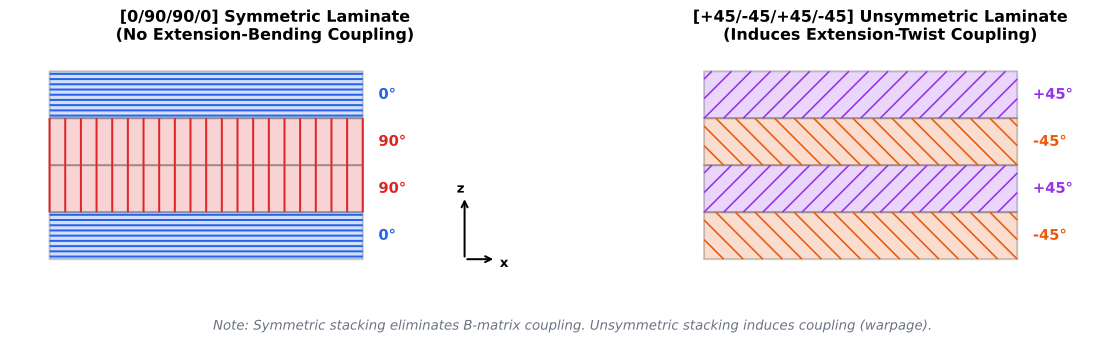
The Physics of the ABD Matrix
The laminate’s behavior is governed by the ABD stiffness matrix, which relates applied loads to deformations:
$$ \begin{pmatrix} \mathbf{N} \\ \mathbf{M} \end{pmatrix} = \begin{bmatrix} \mathbf{A} & \mathbf{B} \\ \mathbf{B} & \mathbf{D} \end{bmatrix} \begin{pmatrix} \boldsymbol{\varepsilon}^0 \\ \boldsymbol{\kappa} \end{pmatrix} $$
- [A] Extension: Stretching behavior.
- [D] Bending: Flexural behavior.
- [B] Coupling: The “troublemaker.” It links in-plane forces ($\mathbf{N}$) to out-of-plane curvatures ($\boldsymbol{\kappa}$). This means pulling a plate can make it bend!
The Complexity of Coupling
In unsymmetric laminates ($\mathbf{B} \neq 0$), wave modes lose their purity because motions are physically coupled:
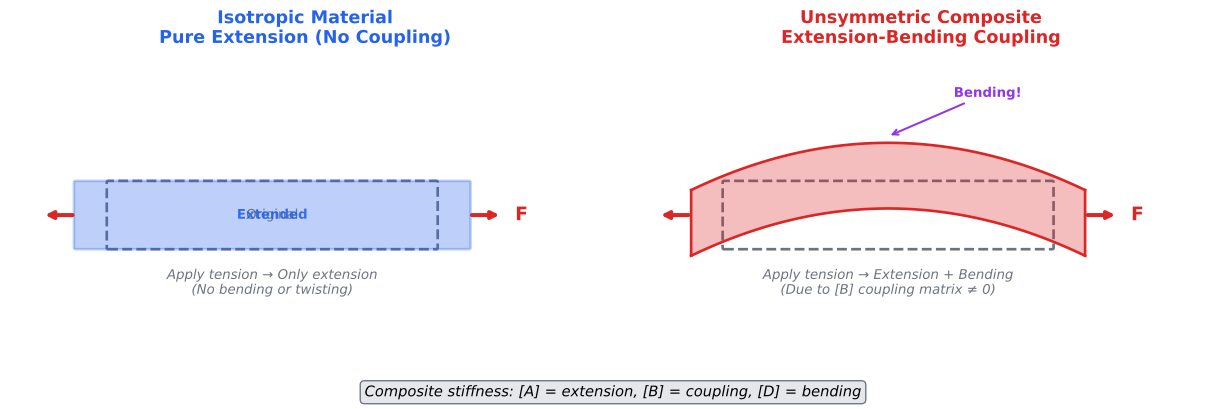
| Excitation | Isotropic Response | Unsymmetric Composite Response |
|---|---|---|
| Pulling | Stretches only | Stretches AND Bends |
| Bending | Bends only | Bends AND Stretches |
| Twisting | Twists only | Twists + Bends + Extends |
Consequence: You cannot launch a “pure” extensional wave. It will instantly trigger flexural and torsional motion.
Why Helmholtz Decomposition Fails
In Part 4, we split waves into P (longitudinal) and S (transverse) potentials. This fails in composites because:
- No Pure Modes: Particle motion is neither purely parallel nor purely perpendicular to propagation.
- Quasi-Waves: Instead, we have Quasi-P (qP) and Quasi-S (qS) waves, where the polarization vector is “mostly” longitudinal or transverse but skewed by anisotropy.
- Non-Separable: The equations of motion cannot be decoupled into scalar and vector potentials.
The Solution: Partial Wave Technique (PWT)
To solve this, we abandon potentials and solve the equations directly using the Partial Wave Technique:
- Assume Solution: Propose a sum of 6 partial waves (3 upward, 3 downward) traveling through the thickness.
- Eigenvalue Problem: Substitute into the motion equations to find the allowed vertical wavenumbers ($k_z$) for a given frequency and horizontal wavenumber.
- Boundary Conditions: Enforce Traction-Free conditions at the top and bottom surfaces.
- Dispersion Curves: Find the combinations of frequency and wavenumber that satisfy all conditions (where the determinant of the boundary matrix is zero).
Dispersion in Composites
Unlike isotropic plates where dispersion curves depend only on frequency-thickness product, composite dispersion curves are highly sensitive to stacking sequence:
| Layup | Character | Typical Application |
|---|---|---|
| [0]ₙ (Unidirectional) | Extreme anisotropy, fast axial waves | Tension members |
| [0/90]ₛ (Cross-ply) | Balanced in-plane, moderate coupling | Skins, panels |
| [±45]ₛ (Angle-ply) | High shear stiffness, strong twist-bend coupling | Torsion boxes |
| Quasi-isotropic | Near-isotropic in-plane | General purpose |
Higher-Order Effects in Thick Composites
Thin laminate theories (like Classical Laminate Theory, CLT) assume that “plane sections remain plane.” This works for thin skins but fails disastrously for thick composites or high-frequency waves.
Why? Because soft matrix layers allow stiff fiber layers to slide relative to each other, leading to clear violations of simple theory:
- Shear Lag & Zig-Zag Deformation: Cross-sections do not remain straight lines. Instead, they warp into a “zig-zag” pattern as layers deform unevenly.
- Thickness Stretch: The plate does not just bend; it breathes. The thickness changes dynamically ($\varepsilon_{zz} \neq 0$) due to Poisson’s effects, creating a “breathing” mode resonance.
- Rotary Inertia: At high frequencies, the rotational mass of the cross-section cannot be ignored.
The Four-Way Coupling
In these thick waveguides, wave modes are no longer simple. You encounter a four-way coupling where a single wave pulse simultaneously triggers:
- Axial extension
- Flexural bending
- Shear deformation
- Thickness contraction/expansion
This means energy constantly exchanges between these modes, creating complex dispersion patterns and new “cut-off” modes that only appear above certain frequencies.
Functionally Graded Materials (FGM)
Nature hates sharp interfaces. Look at a bamboo stalk or a human bone—you won’t find a distinct line where material A stops and material B starts. Instead, properties change gradually.
Functionally Graded Materials (FGM) mimic this biological wisdom. Instead of bonding discrete layers, we engineer a continuous variation of potential properties through the thickness.
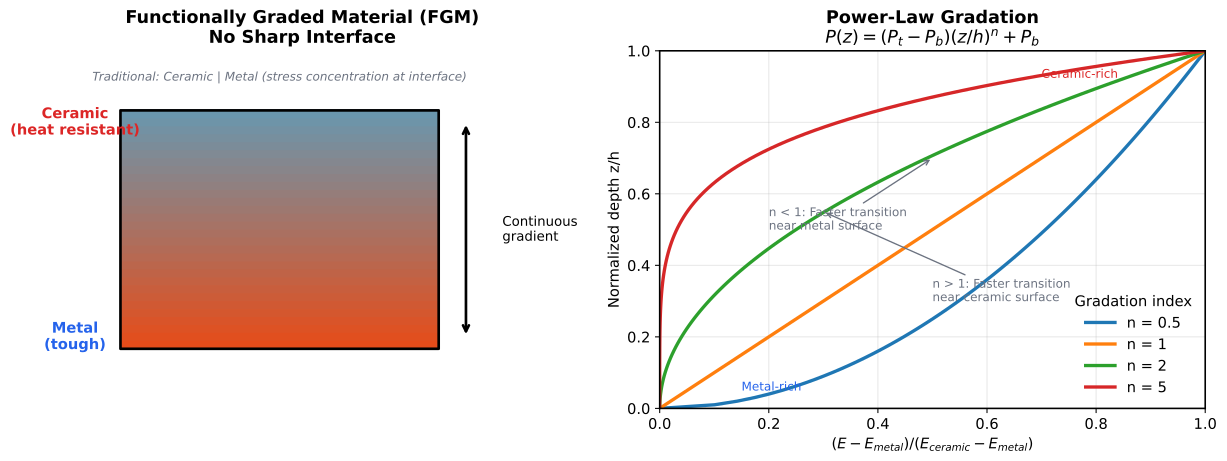
The Physics: Solving Impedance Mismatch
Why go through the trouble of manufacturing gradients?
- Traditional Overlay: Bonding Ceramic to Metal creates an Acoustic/Mechanical Impedance Mismatch. Waves reflect at the boundary, and thermal stress concentrates there, leading to delamination.
- FGM Approach: By smoothing the transition, we eliminate the impedance discontinuity. Waves pass through without sharp reflections, and thermal stresses are distributed over the whole volume.
Applications
- Spacecraft Heat Shields: Ceramic surface ($100%$) for heat resistance $\to$ gradual mix $\to$ Metal structure ($100%$) for toughness.
- Biomedical Implants: Titanium core (strong) $\to$ Hydroxyapatite surface (bone-like) for osseointegration.
Mathematical Models: Mixing Laws
To model this, we define the Volume Fraction of the ceramic phase, $V_c(z)$, which varies from 0 to 1.
Power Law (The Standard Model): $$ V_c(z) = \left(\frac{z}{h} + \frac{1}{2}\right)^n $$
The material property $P(z)$ (like Stiffness $E$ or Density $\rho$) is then a weighted average: $$ P(z) = (P_c - P_m) V_c(z) + P_m $$
where $n$ is the Volume Fraction Index:
| Index $n$ | Composition Integration | Physical Result |
|---|---|---|
| $n < 1$ | Ceramic-Rich | Hard, brittle surface dominates |
| $n = 1$ | Linear | Balanced transition |
| $n > 1$ | Metal-Rich | Tough, ductile core dominates |
The Inhomogeneous Wave Phenomenon
The most fascinating aspect of wave propagation in FGM is the inhomogeneous wave.
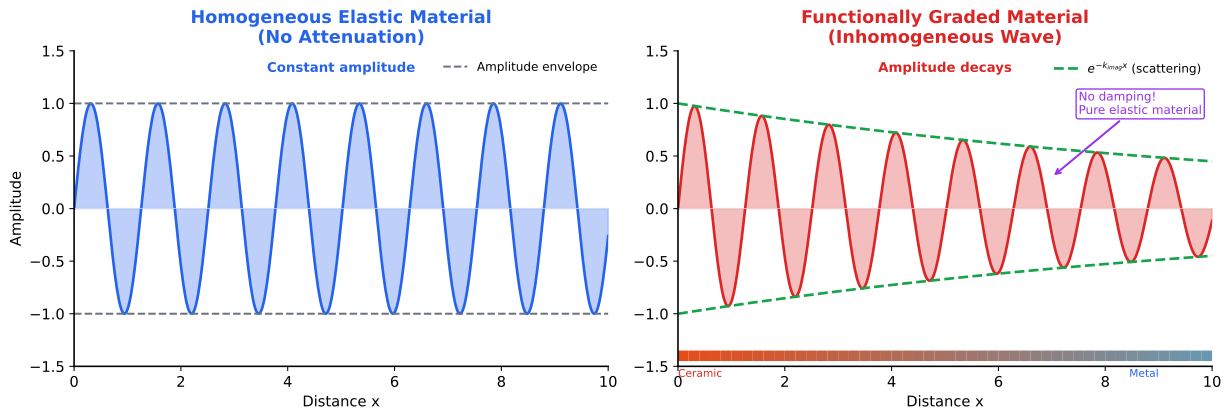
Geometric Attenuation (Not Damping!)
In a material with continuously varying properties, waves attenuate even if the material is purely elastic (no viscosity or heat loss).
$$ u(x,t) = A e^{i(\omega t - kx)} \cdot e^{-\alpha x} $$
This decay ($\alpha$) is not due to energy loss. It is Geometric Attenuation. As the wave travels, the continuously changing impedance ($Z=\rho c$) causes infinitesimal back-reflections at every point. The forward-traveling energy is continuously “eroded” and redistributed backward.
The FGM as a High-Pass Filter
This phenomenon creates a critical physical effect: Cut-off Frequency.
- Below Cut-off ($\omega < \omega_c$): The wave cannot propagate. It becomes evanescent, decaying exponentially. The gradient acts like a wall.
- Above Cut-off ($\omega > \omega_c$): The wave propagates but with modified speed and amplitude.
| Regime | Behavior | Analogy |
|---|---|---|
| Low Frequency | Strong Attenuation / Evanescent | Trying to drive a car over huge speed bumps—momentum is lost. |
| High Frequency | Propagating (Scattering) | Driving over small pebbles—bumpy but you keep moving. |
Consequence: FGMs effectively act as mechanical high-pass filters, selectively blocking low-frequency energy while letting high frequencies pass.
Summary
We can classify materials by the symmetries they possess (or lack), which dictates the complexity of wave propagation:
| Material Class | Physical Architecture | Mathematical Consequence |
|---|---|---|
| Isotropic | Properties same in all directions | Decoupled: Independent P & S waves via Helmholtz |
| Composite | Direction-dependent (Anisotropic) | Coupled: Mixed “Quasi-waves” via PWT |
| FGM | Position-dependent (Inhomogeneous) | Attenuated: Geometric reflection / Filtering |
Key Takeaways: The Price of Complexity
- Symmetry Breaking = Coupling: When you break directional symmetry (Isotropy $\to$ Anisotropy), P and S movements tangle together. Measuring one requires measuring them all.
- Inhomogeneity = Reflection: When you break positional symmetry (Homogeneity $\to$ Inhomogeneity), forward momentum is lost to back-scattering.
- No Free Lunch: Advanced materials (CFRP, FGM) offer incredible static performance (strength/weight, heat resistance) but make dynamic inspection significantly harder.
What’s Next?
We have pushed Continuum Mechanics to its limit—assuming materials are continuous matter, just with complex properties.
But what if the wave is smaller than the material’s grain size?
In Part 6, we break the final barrier. We will enter the world of Microstructured Materials (like sand, polycrystals, and locally resonant metamaterials). We will discover what happens when the “Continuum Assumption” itself collapses and waves begin to see the discrete atoms of the structure.
References
Gopalakrishnan, S. (2023). Elastic Wave Propagation in Structures and Materials. CRC Press.