EWPS-03: Viscoelastic Damping and FFT Signal Processing Pitfalls
In Parts 1 and 2, we explored wave propagation in ideal elastic materials—where energy travels indefinitely and simulations assume infinite time windows. Reality, however, imposes two constraints:
- Materials dissipate energy — waves attenuate as they propagate
- Computers have finite memory — we can only simulate finite time windows
This post addresses both challenges: Viscoelasticity models how waves lose energy, while FFT signal processing techniques prevent numerical artifacts from corrupting our results.
Viscoelasticity: When Stiffness Becomes Complex
Real materials don’t just store energy—they also dissipate it. Viscoelastic constitutive relations capture this dual behavior by combining elastic (spring-like) and viscous (dashpot-like) responses.
From Time Domain to Frequency Domain
In the time domain, viscoelastic models involve convolution integrals and derivatives. The Kelvin-Voigt model relates stress to both strain and strain rate:
$$ \sigma(t) = E \varepsilon(t) + \eta \frac{d\varepsilon}{dt} $$
where $\sigma$ is stress, $\varepsilon$ is strain, $E$ is Young’s modulus (Pa), and $\eta$ is viscosity (Pa·s).
The power of spectral analysis: in the frequency domain, time derivatives become multiplications by $i\omega$, transforming this differential equation into an algebraic one:
$$ \hat{\sigma}(\omega) = \underbrace{(E + i\omega\eta)}_{\hat{E}(\omega)} \hat{\varepsilon}(\omega) $$
Young’s modulus becomes a complex modulus $\hat{E} = E’ + iE’’$, where:
- $E’(\omega)$ = Storage modulus — elastic energy stored per cycle
- $E’’(\omega)$ = Loss modulus — energy dissipated per cycle
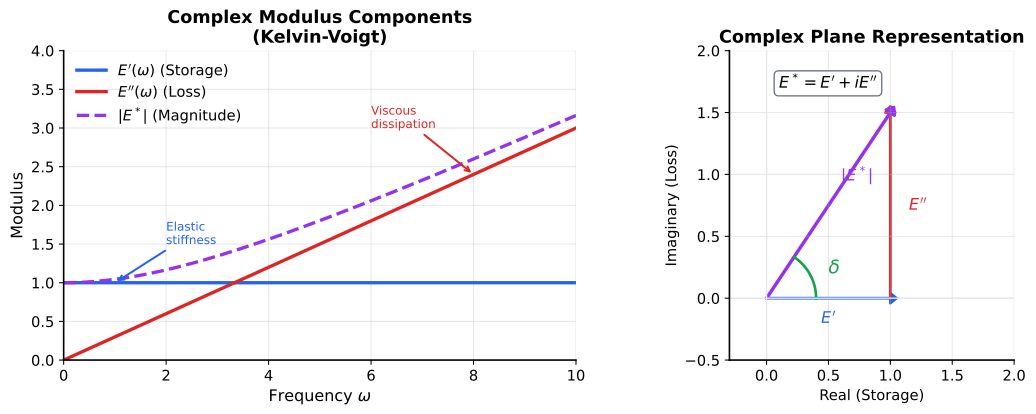
Interpreting the figure:
- Left: Storage modulus $E’$ (blue) is constant; loss modulus $E’’$ (red) grows linearly with frequency. The dashed purple line shows $|E^*| = \sqrt{E’^2 + E’’^2}$—the total stiffness felt by a wave.
- Right: Stress leads strain by loss angle $\delta$. Elastic: $\delta = 0°$; viscous: $\delta = 90°$. The damping ratio $\tan\delta = E’’/E’$ quantifies energy dissipation efficiency.
The Complex Wavenumber
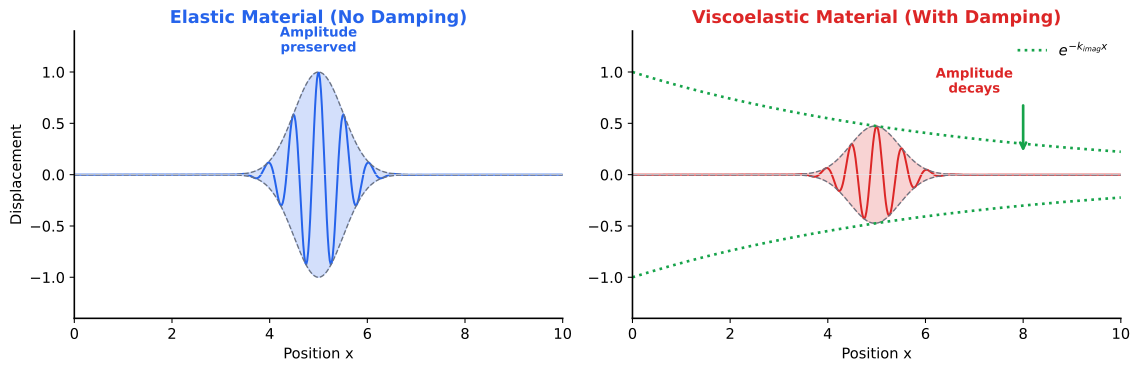
For purely elastic materials, the wavenumber $k = \omega/c$ is real—waves propagate indefinitely without losing energy. But when the modulus becomes complex, so does the wavenumber:
$$ k = k_{real} + i , k_{imag} $$
What does this mean physically? Substituting into the wave solution $e^{i(\omega t - kx)}$:
$$ e^{i(\omega t - kx)} = e^{i(\omega t - k_{real}x)} \cdot e^{-k_{imag} x} $$
The first term is an oscillating wave traveling at phase velocity $C_p = \omega/k_{real}$. The second term is an exponential decay that attenuates the amplitude with distance.
| Component | Physical Meaning | Effect |
|---|---|---|
| $k_{real}$ | Propagation (phase) | Wave crests travel at $C_p = \omega / k_{real}$ |
| $k_{imag}$ | Attenuation (damping) | Amplitude decays as $e^{-k_{imag} x}$ |
Thus, after traveling distance $x$, wave amplitude becomes:
$$ A(x) = A_0 e^{-k_{imag} x} $$
Physical intuition: Higher $k_{imag}$ means faster energy dissipation. Materials with high loss modulus $E’’$ produce large $k_{imag}$, causing waves to die out quickly.
Viscoelastic Models
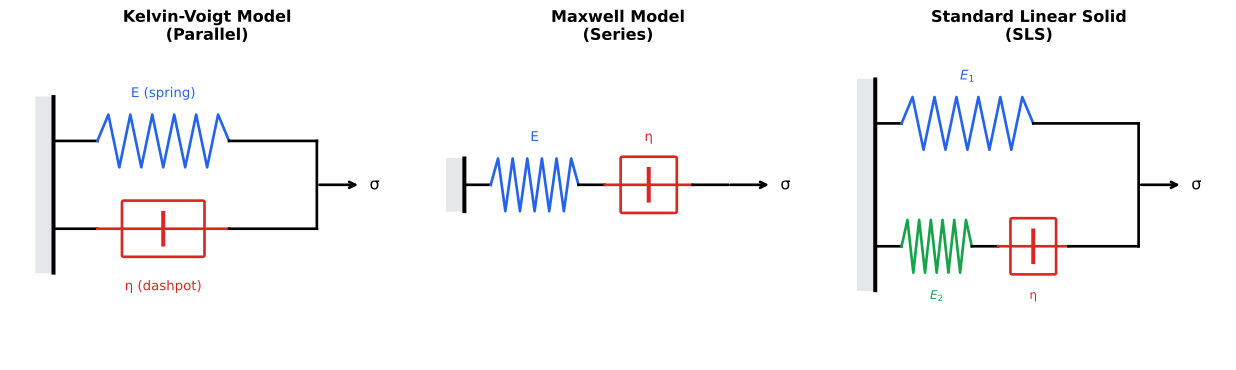
Three classical spring-dashpot models capture different aspects of viscoelastic behavior. Each combines elastic (spring) and viscous (dashpot) elements in different configurations, leading to distinct mechanical responses.
Kelvin-Voigt Model
Configuration: Spring and dashpot in parallel—both elements experience the same strain.
Complex modulus: $$ \hat{E}(\omega) = E + i\omega\eta $$
Physical behavior:
- Under sudden load, the dashpot resists instantaneous deformation → no instant elastic response
- Over time, strain gradually increases but reaches a bounded limit (creep stops)
- Loss modulus $E’’ = \omega\eta$ increases linearly with frequency
- Use case: Solid polymers, rubber, biological tissues
Maxwell Model
Configuration: Spring and dashpot in series—both elements carry the same stress.
Complex modulus: $$ \hat{E}(\omega) = \frac{i\omega\tau E}{1 + i\omega\tau}, \quad \text{where } \tau = \frac{\eta}{E} $$
Physical behavior:
- Under sudden load, the spring deforms instantly → immediate elastic response
- Over time, stress gradually relaxes to zero as the dashpot flows
- Under constant stress, strain increases indefinitely (unbounded creep)
- Use case: Viscoelastic fluids, asphalt, glass at high temperature
Standard Linear Solid (SLS)
Configuration: Spring $E_1$ in parallel with a Maxwell element ($E_2$ and $\eta$ in series)
Complex modulus: $$ \hat{E}(\omega) = E_1 + \frac{i\omega\tau E_2}{1 + i\omega\tau} $$
Physical behavior:
- Combines the best of both: instant elastic response (from $E_1$) + gradual relaxation (from Maxwell branch)
- Bounded creep and partial stress relaxation
- Use case: Most structural materials—metals, composites, engineering polymers
Model Comparison
| Model | Instant Response | Creep Response | Stress Relaxation | Best For |
|---|---|---|---|---|
| Kelvin-Voigt | None | Bounded | None | Solid polymers |
| Maxwell | Full | Unbounded | Full | Fluids |
| SLS | Partial | Bounded | Partial | General structures |
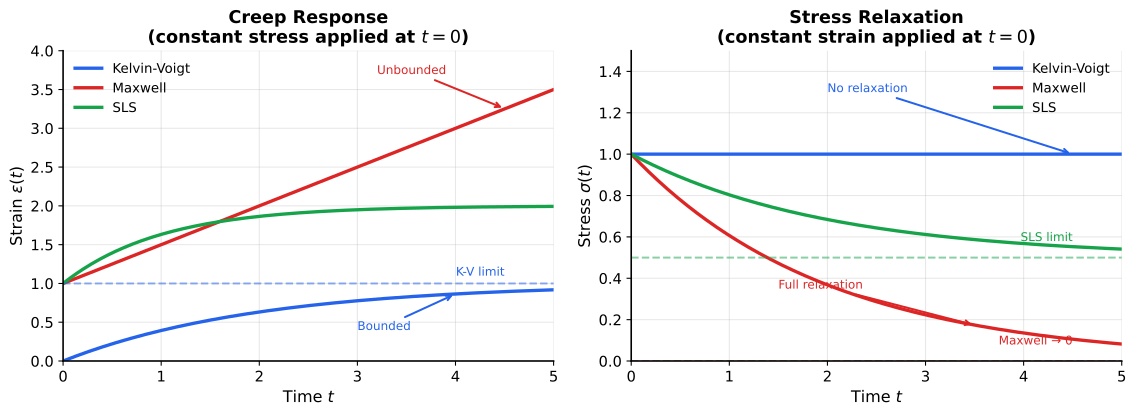
Interpreting the curves & choosing a model: Kelvin-Voigt (blue) captures materials that stop deforming under load—suitable for solid polymers. Maxwell (red) describes fluids that flow indefinitely—use for viscoelastic fluids. SLS (green) bridges both behaviors and is the best choice for general structural analysis.
Signal Processing: The Art of FFT
Since we use the Fast Fourier Transform (FFT) to solve wave equations, we must navigate the inherent limitations of digital signal processing. Three pitfalls commonly corrupt simulation results.
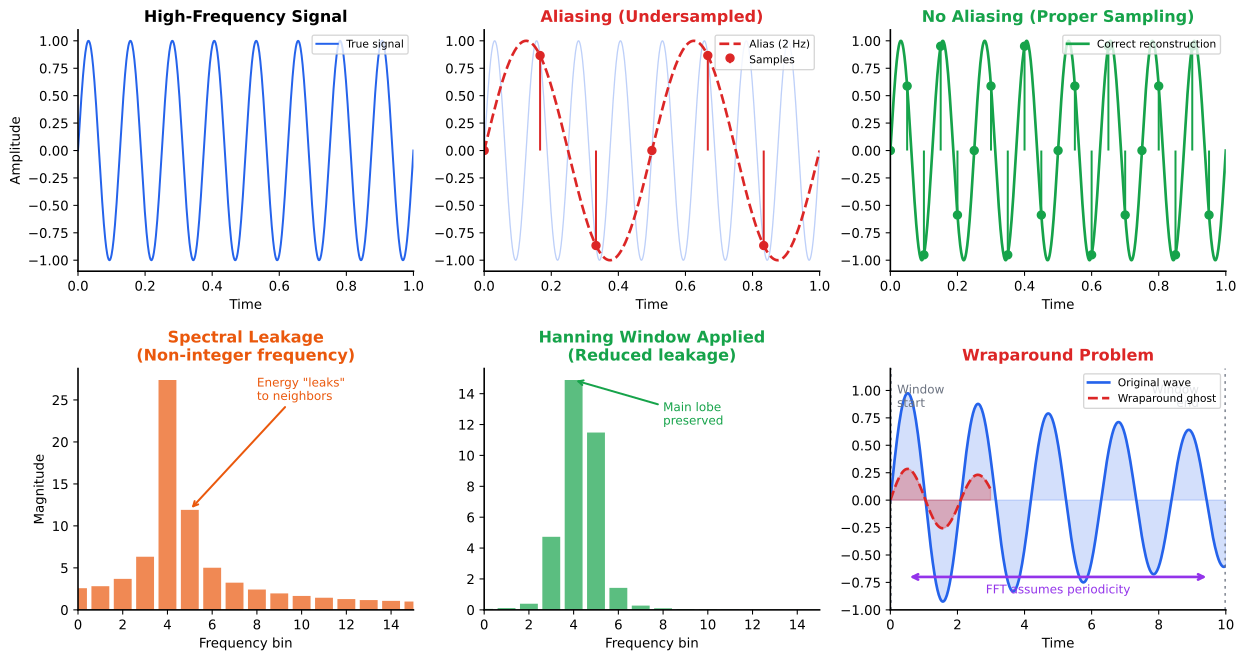
Interpreting the figure: Top-left shows a correctly sampled signal; top-right shows aliasing when sampling is too slow. Bottom-left demonstrates leakage from a truncated sine; bottom-right shows wraparound where the signal “re-enters” from the left edge.
Pitfall #1: Aliasing
Problem: If you sample too slowly (time step $\Delta t$ is too large), high-frequency content appears as spurious low frequencies.
Cause: The Nyquist theorem requires: $$ f_s \geq 2 f_{max} $$
where $f_s = 1/\Delta t$ is the sampling frequency and $f_{max}$ is the highest frequency in the signal.
Solution: Ensure your sampling rate is at least twice the highest frequency present. In practice, use 5–10× oversampling for safety.
Pitfall #2: Spectral Leakage
Problem: The FFT assumes your signal is perfectly periodic within the time window. If it’s not (e.g., a truncated sine wave), energy “leaks” into neighboring frequency bins.
Cause: Discontinuity at window edges creates artificial high-frequency content.
Solution: Apply window functions that smoothly taper the signal to zero at both ends:
| Window | Sidelobe Level | Main Lobe Width | Use Case |
|---|---|---|---|
| Rectangular | -13 dB | Narrow | Never (baseline) |
| Hanning | -31 dB | Medium | General purpose |
| Hamming | -42 dB | Medium | Spectral analysis |
| Blackman | -58 dB | Wide | High dynamic range |
The Hanning window is particularly recommended for generating tone burst signals in dispersion analysis.
Pitfall #3: The Wraparound Problem
Problem: The FFT treats your finite signal as one period of an infinite periodic sequence. If a wave doesn’t die out before the end of the time window, its remaining energy “wraps around” and appears at the beginning as a ghost signal.
Cause: Reflections in finite structures with low damping bounce back and forth, persisting beyond the simulation window.
Solutions:
Add viscoelastic damping — Causes the wave to attenuate naturally before reaching the window boundary
Increase window size — Extend the simulation time ($T = N \Delta t$) so waves have time to dissipate
- Trade-off: More computation time and memory
Absorbing boundary conditions — Attach a “throw-off element” (matched-impedance semi-infinite rod) to the structure’s end: $$ Z_{absorber} = \rho c A $$ This allows energy to propagate away rather than reflecting back.
Practical Tip: Combining moderate damping ($\eta \approx 0.01E$) with a throw-off element is often the most robust approach for eliminating wraparound artifacts.
Putting It All Together
A realistic wave propagation simulation requires:
Summary
| Topic | Key Concept | Practical Impact |
|---|---|---|
| Viscoelasticity | Complex modulus $\hat{E} = E’ + iE’'$ | Wave amplitude decays with distance |
| Aliasing | Sample rate ≥ 2× max frequency | Prevents false low-frequency artifacts |
| Leakage | Window functions (Hanning) | Clean spectral estimates |
| Wraparound | Damping + absorbing boundaries | Eliminates ghost reflections |
By combining viscoelastic material models with rigorous signal processing practices, we transform idealized equations into robust simulations that match real-world experiments.
What’s Next?
In Part 4, we expand from 1D lines to 2D surfaces. We will explore wave propagation in 2D isotropic waveguides, discussing P-waves, S-waves, and the famous Rayleigh surface waves found in earthquakes.
References
Gopalakrishnan, S. (2023). Elastic Wave Propagation in Structures and Materials. CRC Press.