EWPS-02: 1D Waveguides – Rods, Beams, and Higher-Order Theories
In Part 1, we left the time domain behind and embraced the frequency domain. We learned that by using the Fast Fourier Transform (FFT), we can convert complex partial differential equations (PDEs) into simpler ordinary differential equations (ODEs).
Now we apply this mathematical engine to the most fundamental structural elements: 1D Waveguides. We will explore why a pulse travels cleanly through a rod but gets garbled in a beam—and why “elementary” theories fail us when frequencies get high.
The Non-Dispersive World: Longitudinal Waves in Rods
The simplest waveguide is the isotropic rod under axial loading. The governing equation is a second-order PDE:
$$ \rho A \frac{\partial^2 u}{\partial t^2} = EA \frac{\partial^2 u}{\partial x^2} $$
When we apply spectral analysis (assuming $u = \hat{u}e^{i(\omega t - kx)}$), we find a linear relationship between wavenumber and frequency:
$$ k = \frac{\omega}{C_0}, \quad \text{where } C_0 = \sqrt{\frac{E}{\rho}} $$
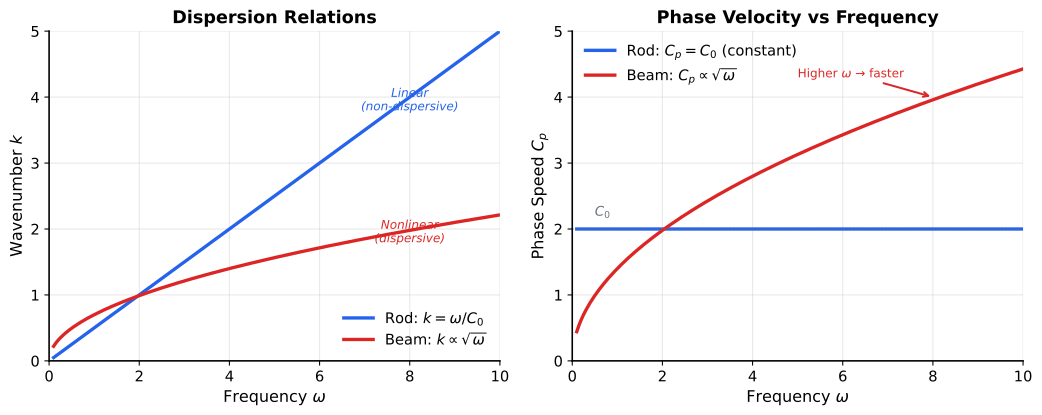
Because this relationship is linear, both the Phase Speed ($C_p = \omega/k$) and Group Speed ($C_g = d\omega/dk$) are identical and constant:
$$ C_p = C_g = C_0 = \sqrt{\frac{E}{\rho}} $$
Physical Interpretation
This describes non-dispersive wave propagation. If you strike one end of a long rod with a specific pulse shape (like a Gaussian pulse), that pulse will travel down the rod without changing its shape.
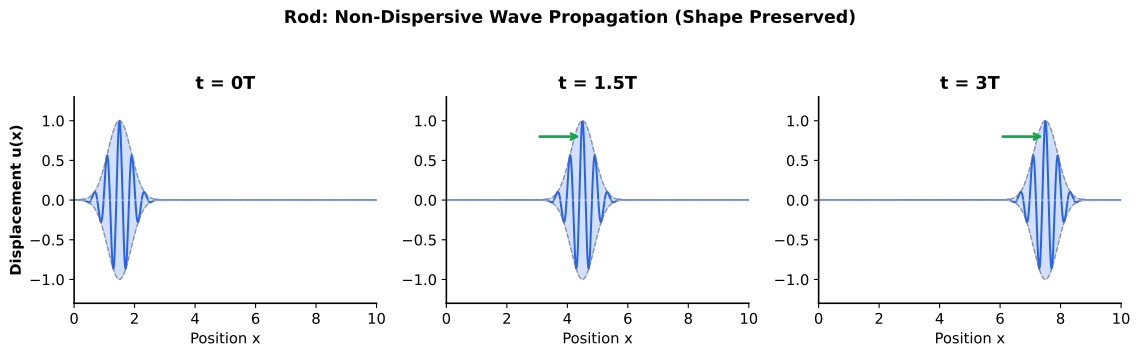
Key Insight: For rods, all frequency components travel at the same speed. The pulse remains coherent indefinitely—ideal for transmitting signals over long distances.
The Dispersive World: Flexural Waves in Beams
Things get complicated when we move to beams. The elementary Euler-Bernoulli beam theory assumes plane sections remain plane and perpendicular to the neutral axis. This results in a fourth-order PDE:
$$ \rho A \frac{\partial^2 w}{\partial t^2} + EI \frac{\partial^4 w}{\partial x^4} = 0 $$
Spectral analysis yields a nonlinear dispersion relation:
$$ k = \left( \frac{\rho A}{EI} \right)^{1/4} \sqrt{\omega} $$
The Consequence: Dispersion
Since $k \propto \sqrt{\omega}$, the phase speed becomes frequency-dependent:
$$ C_p = \frac{\omega}{k} \propto \sqrt{\omega} $$
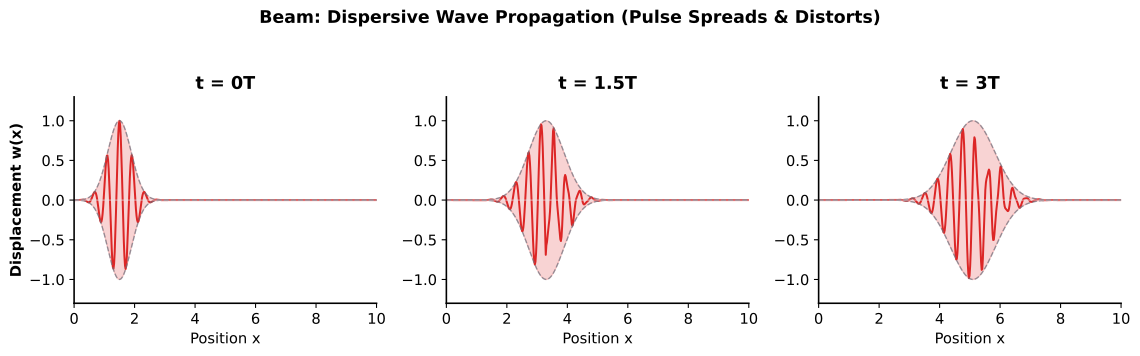
High-frequency components travel faster than low-frequency ones. As a result:
- A sharp pulse spreads out as it propagates
- The leading edge becomes oscillatory
- The original shape is irreversibly lost
Rod vs. Beam: A Direct Comparison
| Property | Rod (Axial) | Beam (Flexural) |
|---|---|---|
| PDE Order | 2nd in space | 4th in space |
| Dispersion Relation | $k \propto \omega$ (linear) | $k \propto \sqrt{\omega}$ (nonlinear) |
| Phase Speed | Constant $C_0$ | $\propto \sqrt{\omega}$ |
| Pulse Behavior | Shape preserved | Spreads and distorts |
When Elementary Theories Fail: The Cut-Off Frequency
Elementary theories (simple rod and Euler-Bernoulli beam) work well at low frequencies—when wavelengths are much longer than lateral dimensions. However, wave propagation problems often involve high-frequency impacts, acoustic emissions, or ultrasonic testing. At these scales:
- Wavelengths become comparable to structural thickness
- Shear deformation and rotary inertia become significant
- Elementary assumptions break down
We need higher-order theories that account for these effects.
The Cut-Off Frequency Concept
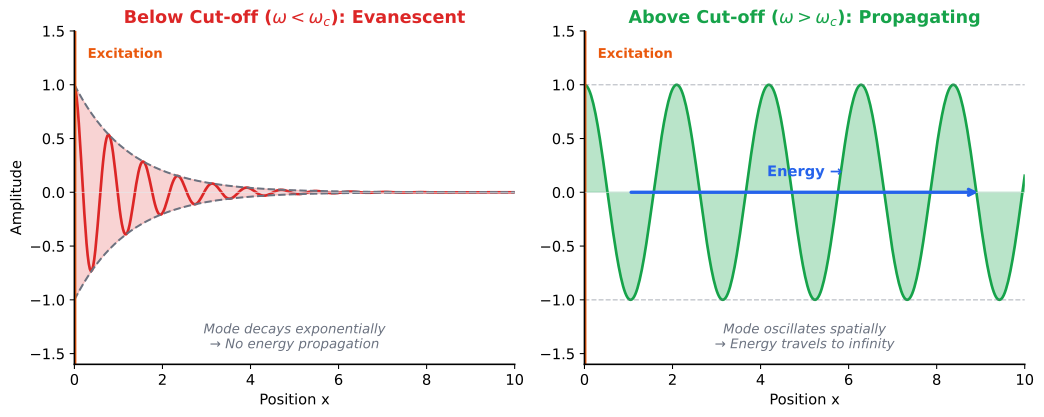
Higher-order theories introduce a critical threshold called the cut-off frequency $\omega_c$. Below this frequency, certain wave modes are evanescent (they decay exponentially and carry no energy). Above it, they become propagating modes.
$$ \omega_c = \frac{\pi C_s}{h} $$
where $C_s$ is the shear wave speed and $h$ is a characteristic thickness. This frequency sets the boundary between:
- Evanescent regime ($\omega < \omega_c$): Modes decay, no propagation
- Propagating regime ($\omega > \omega_c$): True wave motion
Higher-Order Theories
The Timoshenko Beam
At high frequencies, we cannot ignore shear deformation and rotary inertia. The Timoshenko beam theory adds two additional terms to the governing equations:
$$ \rho A \frac{\partial^2 w}{\partial t^2} = \kappa GA \left( \frac{\partial^2 w}{\partial x^2} - \frac{\partial \phi}{\partial x} \right) $$ $$ \rho I \frac{\partial^2 \phi}{\partial t^2} = EI \frac{\partial^2 \phi}{\partial x^2} + \kappa GA \left( \frac{\partial w}{\partial x} - \phi \right) $$
where $\phi$ is the cross-section rotation and $\kappa$ is the shear correction factor.
Key Features:
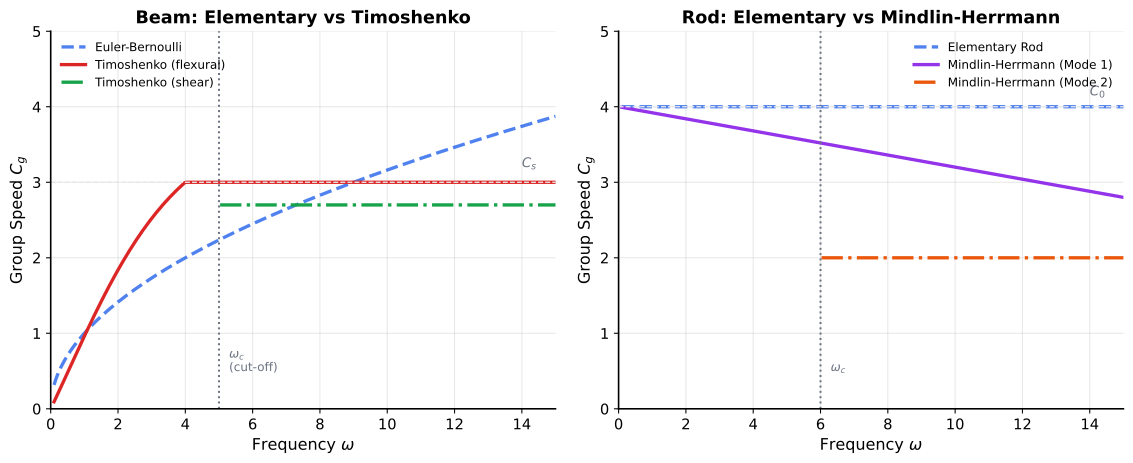
- Cut-off frequency appears: Below $\omega_c$, the shear mode is evanescent
- Two propagating modes at high frequencies: flexural-dominant and shear-dominant
- Group speed saturates at the shear wave speed (doesn’t grow unbounded like Euler-Bernoulli)
The Mindlin-Herrmann Rod
Elementary rod theory ignores lateral contraction due to Poisson’s effect. When you compress a rod axially, it expands laterally—and at high frequencies, this coupling matters.
The Mindlin-Herrmann theory accounts for lateral inertia:
$$ \rho A \frac{\partial^2 u}{\partial t^2} = EA \frac{\partial^2 u}{\partial x^2} - \nu \rho A \frac{\partial^2 v}{\partial t^2} $$
Key Features:
- Second frequency spectrum appears at high frequencies
- Group speed decreases compared to elementary theory
- More accurate for short-wavelength, high-frequency loading
Extended Topics: Variable Geometry
Real structures rarely have uniform cross-sections. Two important extensions:
Tapered Waveguides
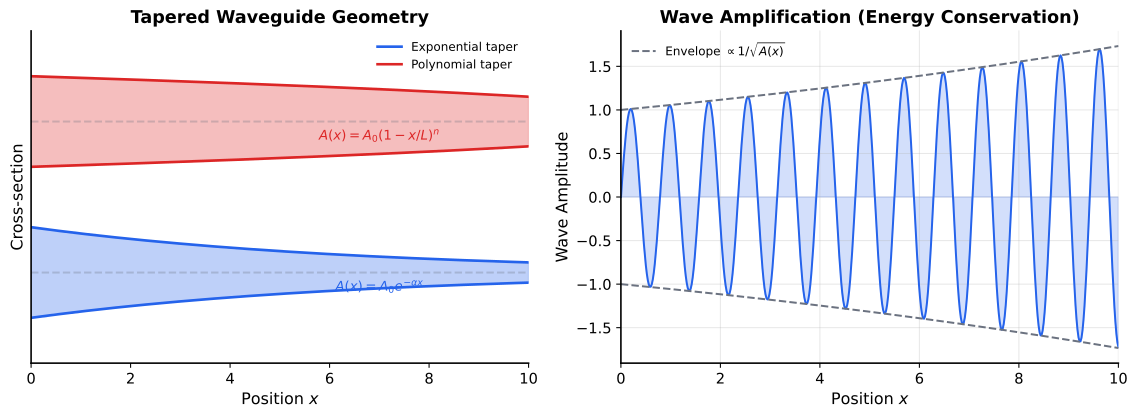
When geometry varies along the length (e.g., conical horns, aircraft wing spars), the PDE coefficients become position-dependent:
$$ \frac{\partial}{\partial x}\left[ EA(x) \frac{\partial u}{\partial x} \right] = \rho A(x) \frac{\partial^2 u}{\partial t^2} $$
- Exponential taper ($A(x) = A_0 e^{\alpha x}$): Exact analytical solutions exist; wave amplitude scales as $1/\sqrt{A(x)}$
- Polynomial taper: Solutions often involve Bessel functions or require numerical methods
Rotating Beams
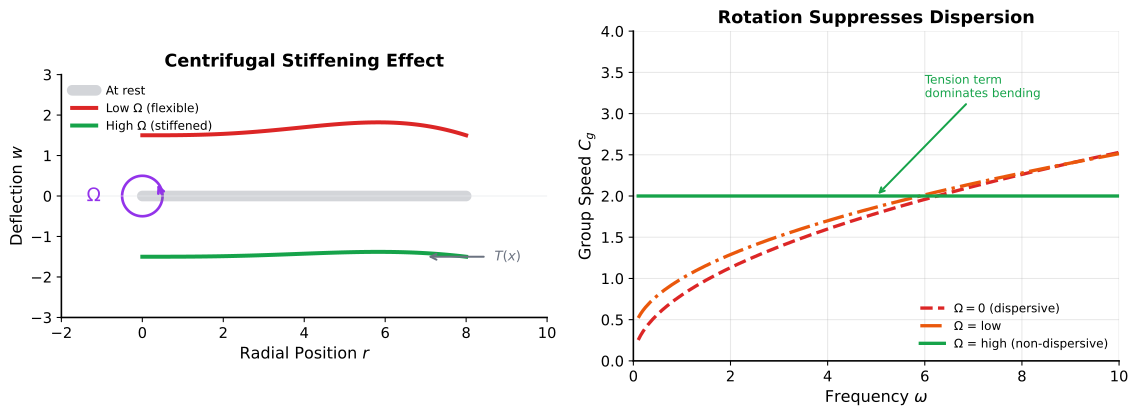
For helicopter blades and turbine rotors, rotation introduces centrifugal stiffening:
$$ T(x) = \int_x^L \rho A \Omega^2 r , dr $$
where $\Omega$ is the rotation speed. At high rotation rates:
- Centrifugal tension dramatically increases effective stiffness
- Flexural waves can become nearly non-dispersive—the tension term dominates over bending
- Natural frequencies shift upward significantly
Summary
| Element | Theory | Key Behavior |
|---|---|---|
| Rod | Elementary | Non-dispersive ($C_p = C_g = C_0$) |
| Rod | Mindlin-Herrmann | Second spectrum, reduced $C_g$ at high $\omega$ |
| Beam | Euler-Bernoulli | Highly dispersive ($C_p \propto \sqrt{\omega}$) |
| Beam | Timoshenko | Cut-off frequency, $C_g$ saturates at $C_s$ |
Key Takeaways:
- Rods are generally non-dispersive (easy to model)
- Beams are highly dispersive (pulse spreading)
- High frequencies require higher-order theories (Timoshenko/Mindlin-Herrmann)
- Cut-off frequencies determine propagating vs evanescent modes
What’s Next?
In Part 3, we will face the realities of the physical world. We will introduce viscoelasticity (damping) and tackle signal processing challenges—solving the “wraparound” problems inherent in FFT-based simulation.
References
Gopalakrishnan, S. (2023). Elastic Wave Propagation in Structures and Materials. CRC Press.