EWPS-01: Introduction to Spectral Analysis for Wave Propagation
Welcome to the first entry in our deep-dive series on “Elastic Wave Propagation in Structures and Materials” by Professor Srinivasan Gopalakrishnan.
If you have a background in traditional structural dynamics, concepts like mode shapes, natural frequencies, and standing waves are familiar territory. But when faced with high-frequency impacts, blast loading, or Structural Health Monitoring (SHM), classical modal analysis often falls short. These problems demand a different lens: Wave Propagation.
In this post, we lay the groundwork for understanding wave behavior in structures. We’ll explore why shifting from the time domain to the frequency domain unlocks powerful insights—and how Spectral Analysis becomes our primary analytical tool.
Dynamics vs. Wave Propagation: What’s the Difference?
At first glance, structural dynamics and wave propagation appear to describe the same thing—structures responding to external loads. Yet they belong to fundamentally different regimes, distinguished primarily by time scale and frequency content.
| Aspect | Structural Dynamics | Wave Propagation |
|---|---|---|
| Frequency | Low (Hz–kHz) | High (kHz–MHz) |
| Duration | Long / Steady-state | Short / Transient |
| Wave behavior | Standing waves (modes) | Traveling waves |
| Key quantity | Amplitude (modes superposition) | Phase + Amplitude (energy transport) |
| Typical applications | Earthquake response, machinery vibration | Impact, blast loading, SHM |
As Gopalakrishnan notes, “traditional structural designers will not be interested in the behavior of structures beyond certain frequencies… However, in recent times, structures are required to sustain very complex and harsh loading conditions.” In these scenarios, phase information becomes as critical as amplitude, and we must track how energy propagates through the medium—not just how the structure vibrates as a whole.
The Mathematical Engine: Fourier Transforms
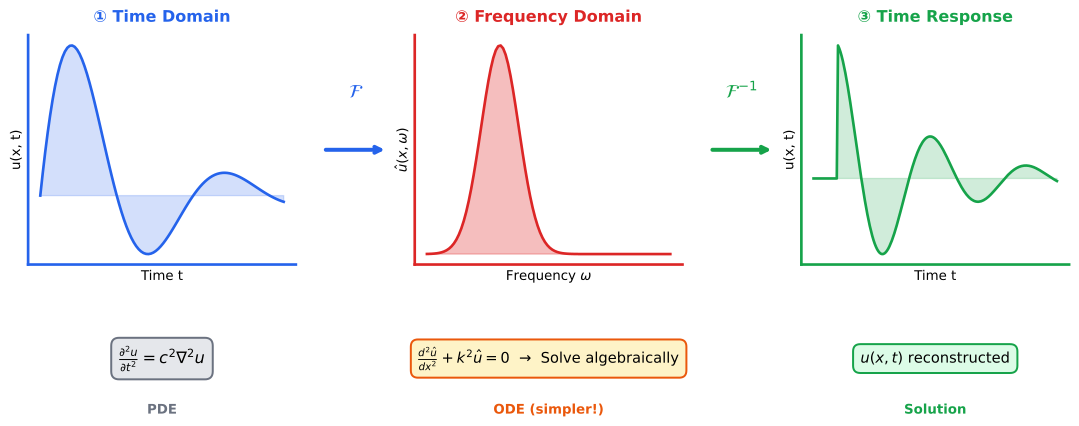
Wave propagation is governed by Partial Differential Equations (PDEs) that depend on both space $x$ and time $t$. Solving these equations directly in the time domain—via FEM time-marching, for example—can be computationally expensive and numerically unstable at high frequencies.
The elegant solution: transform to the frequency domain.
Why Does the Frequency Domain Simplify Things?
The key insight is that differentiation in time becomes multiplication in frequency. Under the Fourier Transform:
$$ \frac{\partial u}{\partial t} \xrightarrow{\mathcal{F}} i\omega \hat{u}, \quad \frac{\partial^2 u}{\partial t^2} \xrightarrow{\mathcal{F}} -\omega^2 \hat{u} $$
This transformation converts the wave equation from a PDE with mixed derivatives to an ODE in space only:
| Domain | Equation Type | Time Dependence | Solution Method |
|---|---|---|---|
| Time | $\displaystyle \frac{\partial^2 u}{\partial t^2} = c^2 \frac{\partial^2 u}{\partial x^2}$ | Explicit | Time-stepping (expensive) |
| Frequency | $\displaystyle \frac{d^2 \hat{u}}{dx^2} + k^2 \hat{u} = 0$ | Parameterized by $\omega$ | Algebraic/closed-form |
In the frequency domain, we solve a family of simpler problems—one for each frequency $\omega$—and then superpose the results. This “divide and conquer” strategy is especially powerful for linear systems, where superposition holds exactly.
Three Flavors of Fourier Representation
| Representation | Signal Type | Use Case |
|---|---|---|
| Continuous Fourier Transform (CFT) | Aperiodic, continuous | Theoretical derivations, analytical solutions |
| Fourier Series (FS) | Periodic, continuous | Closed-form analysis of repeating signals |
| Discrete Fourier Transform (DFT/FFT) | Sampled, finite-length | Numerical simulations, real-world data |
In practice, we almost always use the FFT (Fast Fourier Transform)—a computationally efficient algorithm for DFT—making spectral analysis feasible even for large-scale problems.
Common Input Signals
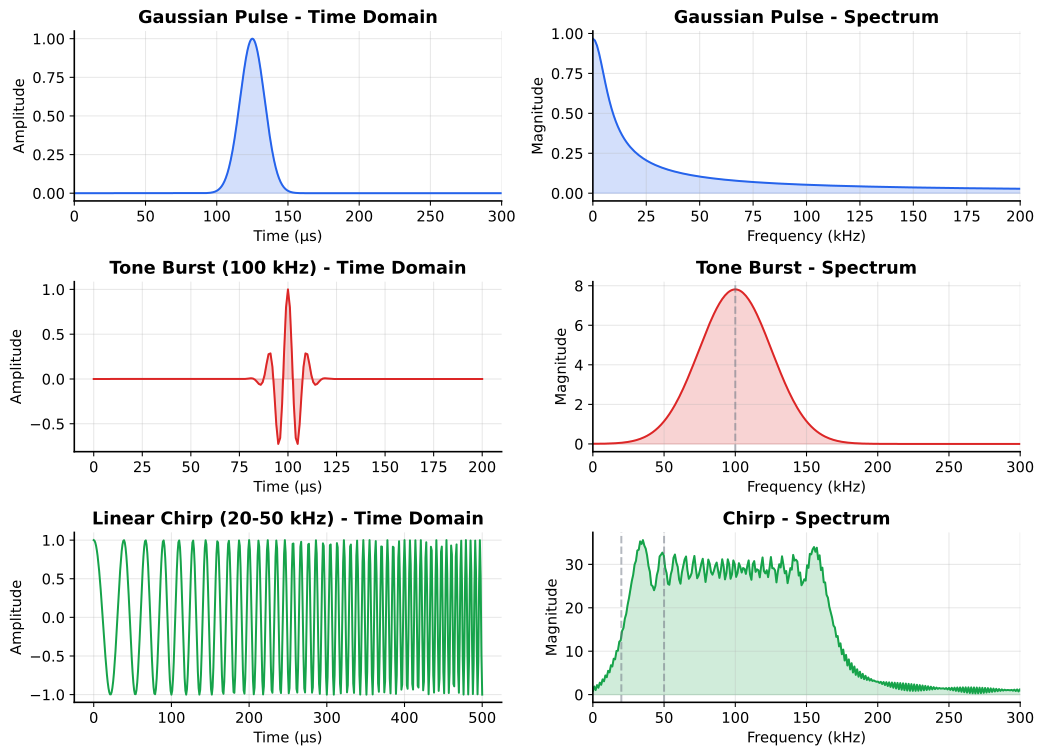
Three common excitation signals are widely used in wave propagation analysis: Gaussian pulse, tone burst, and linear chirp. Each has distinct time and frequency characteristics suited for different applications.
Spectral Analysis: Wavenumbers and Dispersion
With our equations in the frequency domain, we perform Spectral Analysis—the core technique for understanding wave behavior. Instead of solving for displacement $u(x,t)$ directly, we solve for the spectral amplitude $\hat{u}(x, \omega)$.
The key quantity that emerges is the Wavenumber $k$:
$$ k = \frac{2\pi}{\lambda} $$
Physical Intuition for Wavenumber
Think of wavenumber as the spatial counterpart to frequency:
| Quantity | Symbol | Describes | Large Value Means |
|---|---|---|---|
| Frequency | $\omega$ | Oscillations per unit time | Rapid temporal changes |
| Wavenumber | $k$ | Oscillations per unit length | Rapid spatial changes (short wavelength) |
From Wave Equation to Traveling Wave
The 1D wave equation $\frac{\partial^2 u}{\partial t^2} = c^2 \frac{\partial^2 u}{\partial x^2}$ admits a harmonic traveling wave solution:
$$ u(x,t) = A\cos(kx - \omega t) $$
This single expression encapsulates both spatial and temporal oscillation:
| Parameter | Definition | Physical Meaning |
|---|---|---|
| Wavelength | $\lambda = 2\pi/k$ | Distance between adjacent wave crests |
| Period | $T = 2\pi/\omega$ | Time for one complete oscillation at a point |
| Phase Speed | $c = \omega/k = \lambda/T$ | Speed at which a crest travels through space |
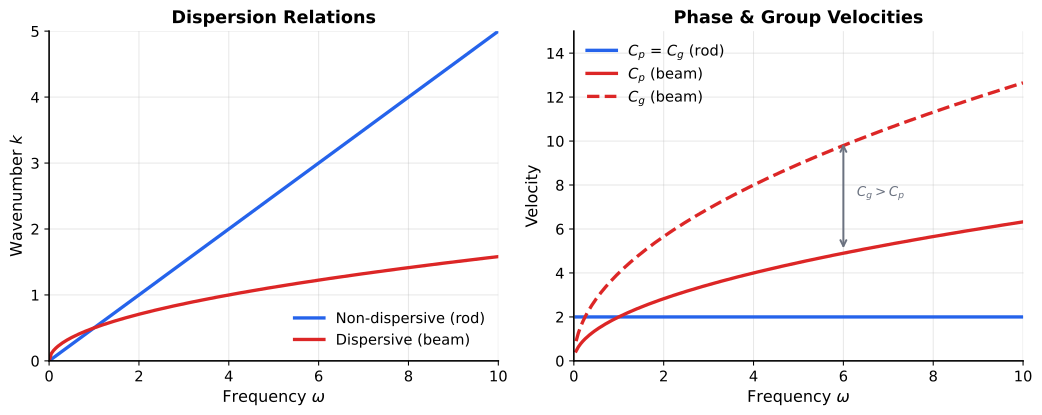
The three quantities $\omega$, $k$, and $c$ are interconnected through the dispersion relation $k(\omega)$. This relationship—derived by substituting the wave solution into the governing PDE—tells us: “For a wave oscillating at frequency $\omega$, what wavenumber (or wavelength) will it have, and how fast will it travel?”
Dispersion: The Shape-Shifter
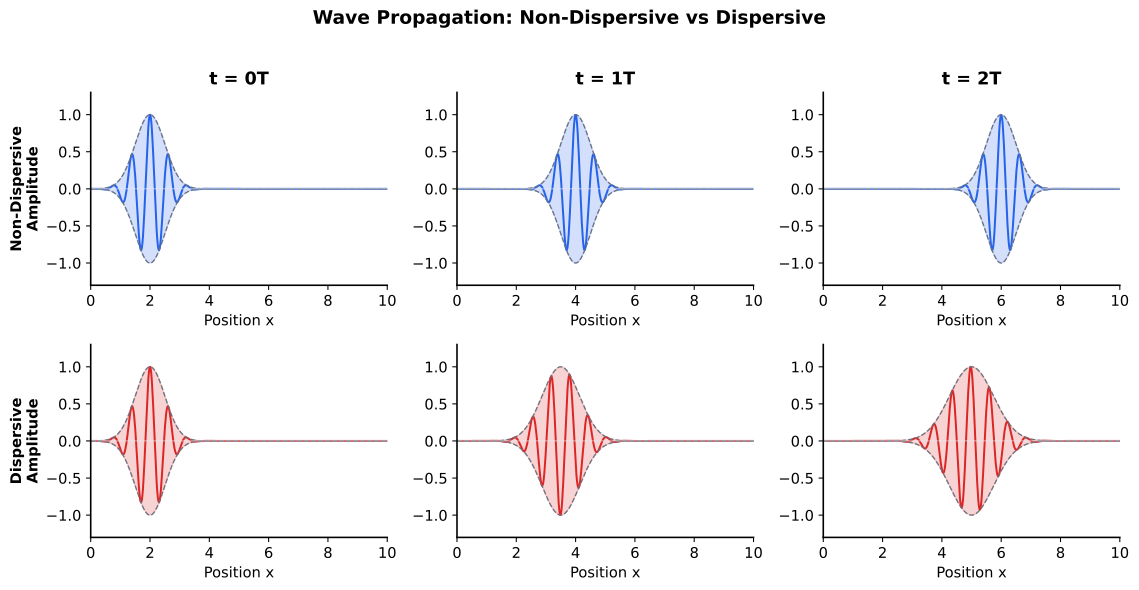
Dispersion determines whether a wave pulse retains or loses its shape as it propagates.
| Wave Type | Dispersion Relation | Phase Speed $C_p$ | Behavior |
|---|---|---|---|
| Non-Dispersive | $k \propto \omega$ (linear) | Constant | Pulse shape preserved |
| Dispersive | $k(\omega)$ nonlinear | Frequency-dependent | Pulse spreads / distorts |
Why Does Dispersion Occur?
Dispersion arises when the restoring force or inertia depends on wavelength. Consider two contrasting examples:
1. Axial waves in a rod (non-dispersive): The governing equation is $\rho A \ddot{u} = EA u’’$, yielding $k = \omega/c$ where $c = \sqrt{E/\rho}$. The wave speed depends only on material properties—not on frequency.
2. Flexural waves in a beam (dispersive): The Euler-Bernoulli beam equation includes a fourth spatial derivative: $\rho A \ddot{u} = -EI u’’’’$. This leads to $k \propto \sqrt{\omega}$, meaning:
- High-frequency (short-wavelength) components travel faster
- A sharp impact pulse “stretches out” as it propagates, with the leading edge becoming oscillatory
The physical reason: bending stiffness $EI$ provides stronger restoring forces for shorter wavelengths, accelerating high-frequency components relative to low-frequency ones.
Group Speed vs. Phase Speed
In dispersive media, we must distinguish two velocities:
| Velocity | Definition | Physical Meaning |
|---|---|---|
| Phase Speed $C_p$ | $\displaystyle \frac{\omega}{k}$ | Speed of individual wave crests |
| Group Speed $C_g$ | $\displaystyle \frac{d\omega}{dk}$ | Speed of the wave packet (energy) |
Why Two Speeds?
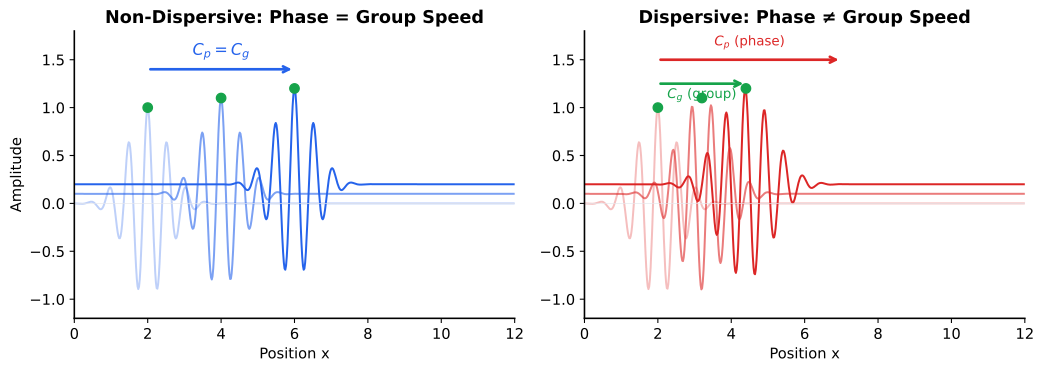
A wave packet consists of many frequency components superposed together. In dispersive media, each component travels at a different phase speed. The result:
- Phase speed $C_p$: If you track a single wave crest, it moves at $C_p$
- Group speed $C_g$: The envelope of the packet—where the energy is concentrated—moves at $C_g$
| Media Type | Relationship | Observable Behavior |
|---|---|---|
| Non-dispersive | $C_p = C_g$ | Crests and envelope move together; shape preserved |
| Dispersive | $C_p \neq C_g$ | Crests “slide through” the envelope |
When $C_p > C_g$ (common in flexural waves), individual crests appear to be born at the back of the wave packet, travel forward through it, and disappear at the front—like ripples on a moving water droplet.
Conversely, when $C_p < C_g$ (as in capillary waves dominated by surface tension), crests appear at the front of the packet and disappear at the back—the envelope outruns the individual oscillations.
Mathematical Proof: When Does $C_p = C_g$?
Recall the definitions: $$C_p = \frac{\omega}{k}, \quad C_g = \frac{d\omega}{dk}$$
For a linear dispersion relation $\omega = c \cdot k$ (as in rods), both expressions evaluate to the constant $c$—hence $C_p = C_g$.
For a nonlinear relation like $\omega = \alpha k^2$ (as in beams), we get $C_p = \alpha k$ but $C_g = 2\alpha k$—the group speed is twice the phase speed, causing the “sliding crest” phenomenon described above.
Key insight: The group velocity $C_g$ represents the speed of energy transport. This is the velocity that matters for signal transmission and cannot exceed the speed of light in any physical medium.
Evanescent Modes: The “Ghost” Waves
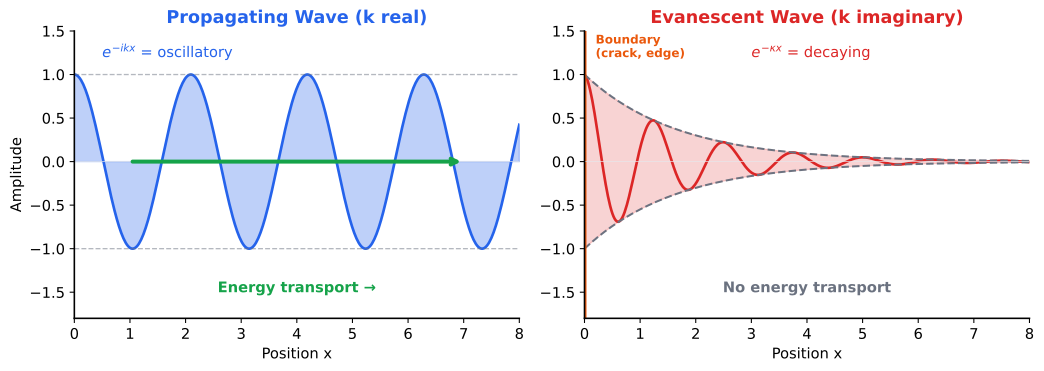
Spectral analysis sometimes yields a purely imaginary wavenumber: $k = i\kappa$ where $\kappa > 0$. The traveling-wave term $e^{-ikx}$ then becomes:
$$ e^{-ikx} = e^{-i(i\kappa)x} = e^{-\kappa x} $$
This is a decaying exponential, not a propagating wave.
| Wave Type | Wavenumber | Spatial Behavior | Energy Transport |
|---|---|---|---|
| Propagating | Real $k$ | Oscillatory $e^{-ikx}$ | Yes |
| Evanescent | Imaginary $k = i\kappa$ | Exponential decay $e^{-\kappa x}$ | No |
Evanescent modes carry no energy to infinity, but they are essential for satisfying boundary conditions near discontinuities (cracks, joints, edges). Think of them as localized “near-field” disturbances that stitch the solution together.
When Do Evanescent Waves Appear?
Evanescent modes arise in several important scenarios:
- Below cut-off frequency: In waveguides (pipes, plates), certain modes cannot propagate below a threshold frequency. Below cut-off, these modes become evanescent.
- Near boundaries and discontinuities: At a crack tip, joint, or free edge, evanescent modes are excited to satisfy local equilibrium. They decay rapidly away from the discontinuity but are crucial for accurate stress fields.
- Total internal reflection: When a wave hits an interface at a steep angle, the transmitted wave becomes evanescent in the second medium.
Practical Importance in SHM
In Structural Health Monitoring, evanescent waves matter because:
- Crack detection: Damage introduces local discontinuities that excite evanescent modes. Sensors placed close to suspected damage locations can detect these near-field signatures.
- Sensor placement: Evanescent modes decay over distances comparable to the wavelength. Sensors must be within this “near-field zone” to capture damage-induced signals.
- Mode conversion: At boundaries, evanescent modes can convert to propagating modes (and vice versa), creating complex wave patterns essential for damage characterization.
Solving for Wave Parameters
For simple structures like homogeneous rods or beams, dispersion relations can be derived analytically. But for complex structures—composites, sandwich panels, nanotubes—finding the wavenumber $k(\omega)$ requires numerical methods.
Why Do Polynomial Eigenvalue Problems Arise?
Consider a three-layer sandwich beam with a soft core between two stiff face sheets. The governing equations couple:
- Axial displacement of each layer
- Bending of the face sheets
- Shear deformation of the core
When we assume a wave solution $\hat{u}(x) \propto e^{-ikx}$ and substitute into the coupled equations, each spatial derivative $\partial/\partial x$ becomes $-ik$. The result is a system of equations that are polynomial in $k$:
$$ \left( \sum_{j=0}^{m} k^j \mathbf{A}_j(\omega) \right) \boldsymbol{\phi} = \mathbf{0} $$
Here:
- $\mathbf{A}_j(\omega)$ are coefficient matrices depending on frequency, material properties, and geometry
- $\boldsymbol{\phi}$ is the wave mode shape (how displacements vary across the thickness)
- $m$ is the polynomial degree (typically 2–6 for common structural elements)
This is a Polynomial Eigenvalue Problem (PEP): we seek values of $k$ for which non-trivial solutions $\boldsymbol{\phi}$ exist.
Numerical Solution Methods
| Method | Approach | Pros | Cons |
|---|---|---|---|
| Linearization | Transform to $\mathbf{Lx} = k\mathbf{Mx}$ | Uses standard eigensolvers | Matrix size grows $m\times$ |
| Newton iteration | Iterative refinement | Memory efficient | Needs good initial guess |
| Contour integration | Find roots in complex plane | Handles all root types | Computationally intensive |
Summary
This post introduced the foundational concepts for spectral analysis of wave propagation:
- Fourier Transforms convert time-domain PDEs into frequency-domain ODEs, enabling efficient algebraic solutions
- Wavenumber $k$ is the spatial counterpart to frequency $\omega$, linked through the dispersion relation $k(\omega)$
- Dispersion occurs when phase speed varies with frequency, causing pulse distortion
- Phase speed $C_p = \omega/k$ describes crest motion; group speed $C_g = d\omega/dk$ describes energy transport
- Evanescent waves (imaginary $k$) decay exponentially but are essential near boundaries and damage sites
By moving from the time domain to the frequency domain, we gain the ability to analyze complex wave behaviors—dispersion, mode conversion, and energy flow—much more elegantly than with time-stepping methods alone.
What’s Next?
In Part 2, we will take these mathematical tools and apply them to real structures. We will explore 1D Waveguides, looking at the physics of rods and beams, and discover why higher-order theories (like Timoshenko beam theory) are necessary when wavelengths get short.
References
Gopalakrishnan, S. (2023). Elastic Wave Propagation in Structures and Materials. CRC Press.