Acoustics-10: Frontiers – Nonlinear and Active Acoustics
Welcome to the final installment of The Shape of Sound. We have journeyed from the basics of wave equations to the engineering of mufflers and the holographic mapping of noise sources. Throughout this series, we have largely assumed that sound behaves “linearly”—that waves pass through each other without interacting, and that the air acts like a perfect, gentle spring.
But what happens when the sound is so loud that the air “breaks”? What happens when we use heat to generate sound, or sound to pump heat? And can we use computers to generate “anti-sound” to silence a room?
In this finale, we push beyond the limits of classical linear theory to explore the cutting-edge frontiers of acoustics.
Breaking the Speed Limit: Non-Linear Acoustics
In classical acoustics, we assume the speed of sound ($c_0$) is constant. However, the fundamental equations of fluid dynamics are inherently non-linear. Linearity is just a convenient approximation when sound pressure is very small compared to atmospheric pressure.
The Distorted Wave
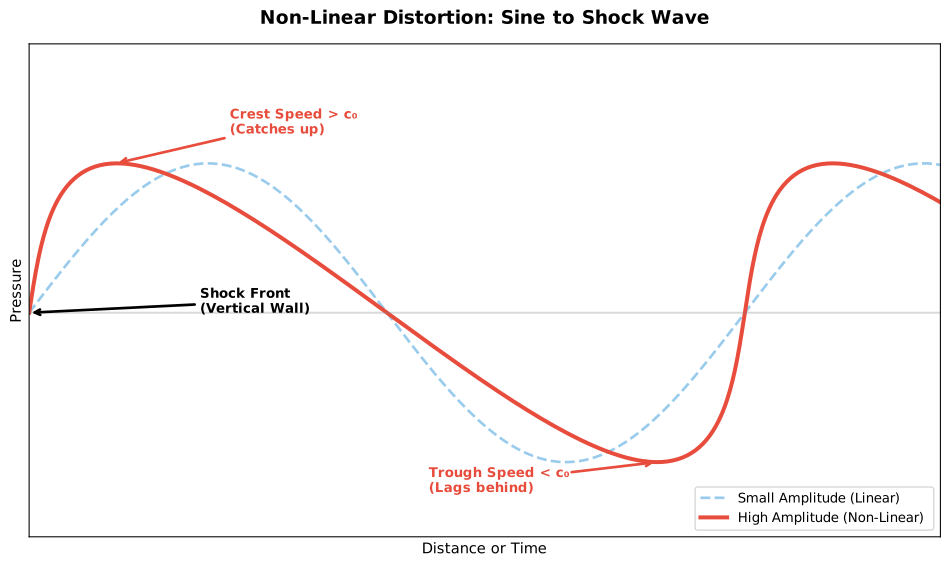
When sound becomes very intense (high amplitude), this approximation fails. The speed of propagation is no longer constant; it actually depends on the instantaneous particle velocity ($u$).
- The Physics: In regions of high pressure (compressions), the temperature rises (adiabatic heating), and the air moves forward with the wave. This causes the wave crests to travel faster than the speed of sound ($c > c_0$). Conversely, in low-pressure rarefactions, the wave travels slower.
- The Shock Wave: Because the crests travel faster than the troughs, they “catch up” to the front of the wave. The smooth sine wave distorts and steepens until it becomes a vertical wall of pressure—a Shock Wave or Sawtooth Wave. This is akin to an ocean wave cresting and crashing.
Applications: From Boom to Medicine
- Sonic Booms (N-Waves): Supersonic aircraft produce the “N-wave”—a sharp pressure rise (shock), a linear drop, and a recovery shock, forming the shape of the letter “N”.
- Lithotripsy (ESWL): We use this destructive power for good. Extracorporeal Shock Wave Lithotripsy uses focused acoustic shock waves to pulverize kidney stones inside the body without surgery. The high-intensity pulse shatters the stone (which is brittle) while passing relatively harmlessly through soft tissue.
Fire and Ice: Thermoacoustics
We usually think of sound as mechanical energy. But sound is also thermodynamic—compressing a gas heats it up; expanding it cools it down. Thermoacoustics explores the conversion between acoustic energy and heat energy.
Heat to Sound: The Rijke Tube
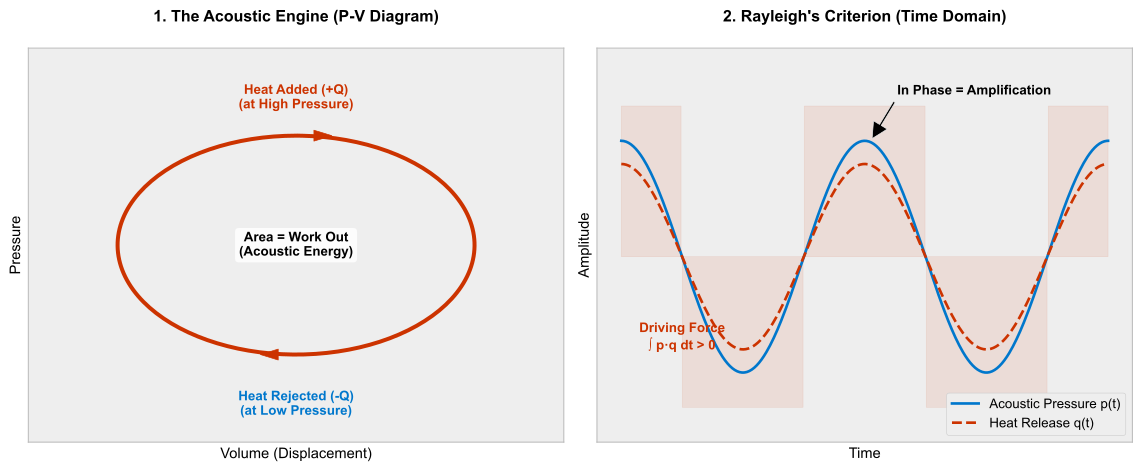
The discovery by Higgins (1777) and Rijke (1859) showed that heat applied to a tube can create a loud tone. In the Rijke Tube, a heated metal gauze placed in the lower half of a vertical tube amplifies air oscillations.
- Rayleigh’s Criterion: For heat to drive sound, the heat must be added at the moment of greatest compression (high pressure). If heat is added during expansion, it damps the sound. This phase relationship is critical for converting thermal energy into acoustic power.
Sound to Heat: The Thermoacoustic Refrigerator
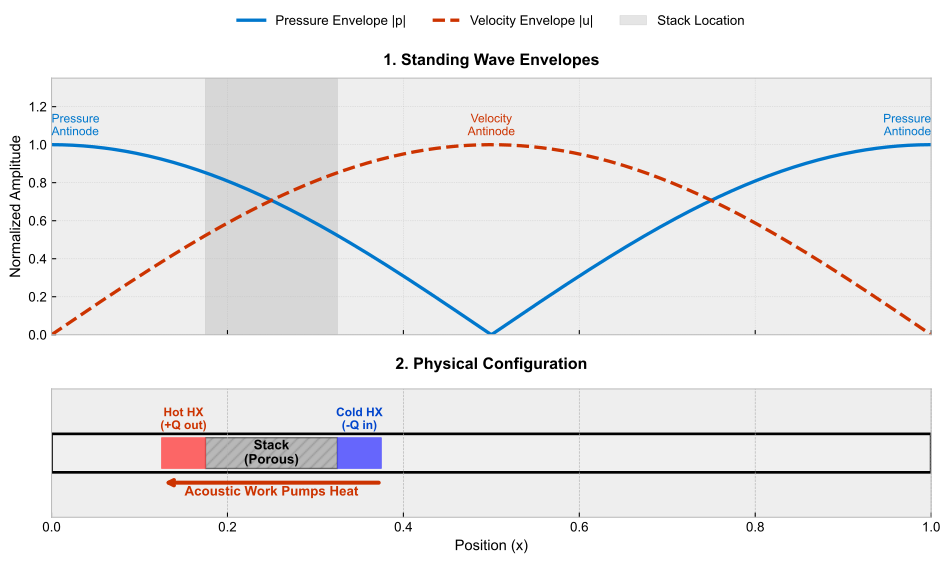
If heat can make sound (Rijke tube), can sound move heat? Yes. By applying a very loud standing wave inside a tube containing a “stack” of plates, we can pump heat from one end of the stack to the other.
- The Tech: This creates a Thermoacoustic Refrigerator. It has no moving pistons, no crank shafts, and requires no ozone-depleting refrigerants (CFCs). It uses only high-intensity sound waves and inert gases (like Helium) to produce cooling—a “green” alternative to traditional cooling.
Fighting Fire with Fire: Active Noise Control (ANC)
For centuries, the only way to stop noise was passive: heavy walls and fluffy materials. But for low-frequency hums (like transformers or ventilation), passive materials must be impractically thick. The solution is Active Noise Control (ANC).
The Concept: Anti-Noise
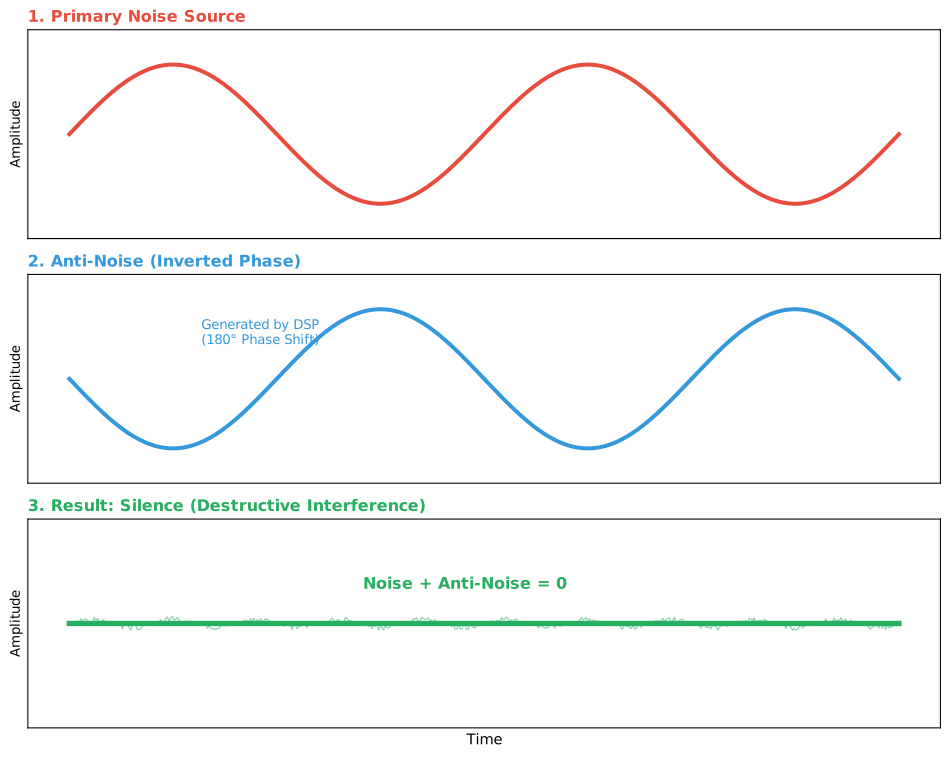
ANC is based on the principle of superposition. If you have a noise wave, and you generate a second wave with the same amplitude but opposite phase (180° shift), the two waves sum to zero.
The Evolution of Silence
- 1930s: Paul Lueg patents the concept of using a microphone and speaker to cancel sound in a duct.
- 1950s: Harry Olson develops the “electronic sound absorber.”
- Modern Era: With the advent of digital signal processing (DSP), ANC has become practical for headsets, air ducts, and automotive cabins.
How It Works
The setup for ANC in a duct is:
- Reference Microphone: Picks up the incoming noise.
- Controller: Calculates the “anti-noise” required.
- Secondary Source (Speaker): Plays the anti-noise.
- Error Microphone: Checks if the silence was achieved and adjusts the system.
While this works beautifully for plane waves in ducts (1D physics), controlling 3D space (like a bedroom or office) is much harder. ANC is unparalleled at creating small “zones of quiet” (like inside a headphone cup), but canceling noise throughout an entire room remains a significant physics challenge.
Conclusion: The Future of Sound
We have come a long way in this series. We started with the vibration of a simple string and ended with shock waves crushing kidney stones and computers canceling noise in real-time.
Acoustics is no longer just the study of music or theatre design. It has evolved into a central pillar of modern technology—spanning from the depths of the ocean to the micro-chips in our phones (via silicon microphones and surface acoustic waves).
Whether it is using micro-perforated panels to clean up our factories, holography to see invisible vibrations, or thermoacoustics to build greener refrigerators, the shape of sound is constantly changing. The physics remains the same, but our ability to manipulate it is only just beginning.
References:
- Ma Dayou, Modern Acoustics Theory Basis, Science Press, 2004.
- He Lin et al., Theoretical Acoustics and Engineering Applications, Science Press, 2006.