Acoustics-07: Mufflers – Reactive and Resistive Silencers
In Part 6, we learned how to block noise with heavy walls and double-pane windows. But what if the wall needs a hole in it? In many real-world scenarios, we must let air flow freely while preventing sound from tagging along.
Think of a car’s exhaust pipe or an office building’s ventilation duct. Sealing them with concrete would stop the noise, but the engine would choke and the building would suffocate. The challenge is to create a device that is transparent to airflow but opaque to sound waves.
This installment explores the engineering of the Silencer (also known as a Muffler). We’ll classify them into two families based on their working principle: Reactive Silencers (which bounce sound back) and Resistive Silencers (which absorb it).
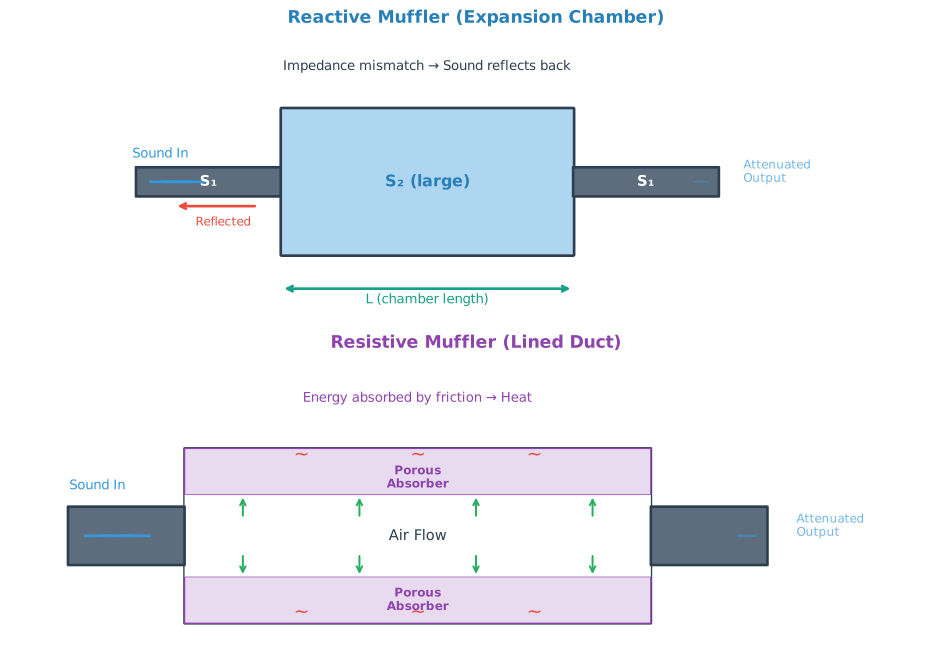
The Reactive Silencer: The Acoustic Mirror
When you see the large, bulbous metal can underneath a car, you are looking at a Reactive Silencer (specifically, an Expansion Chamber). Surprisingly, these devices often contain no stuffing or foam. They silence noise using geometry alone.
The Expansion Chamber Principle
Recall from Part 3 that when a sound wave hits a boundary where the medium’s properties change, some energy is reflected. Specifically, when sound traveling in a narrow pipe (area $S_1$) suddenly enters a much larger chamber (area $S_2$), it encounters a significant impedance mismatch.
At this junction, instead of flowing smoothly into the chamber, most of the sound wave reflects back toward the source (the engine). The expansion chamber acts like an acoustic mirror: it rejects the sound energy rather than absorbing it.
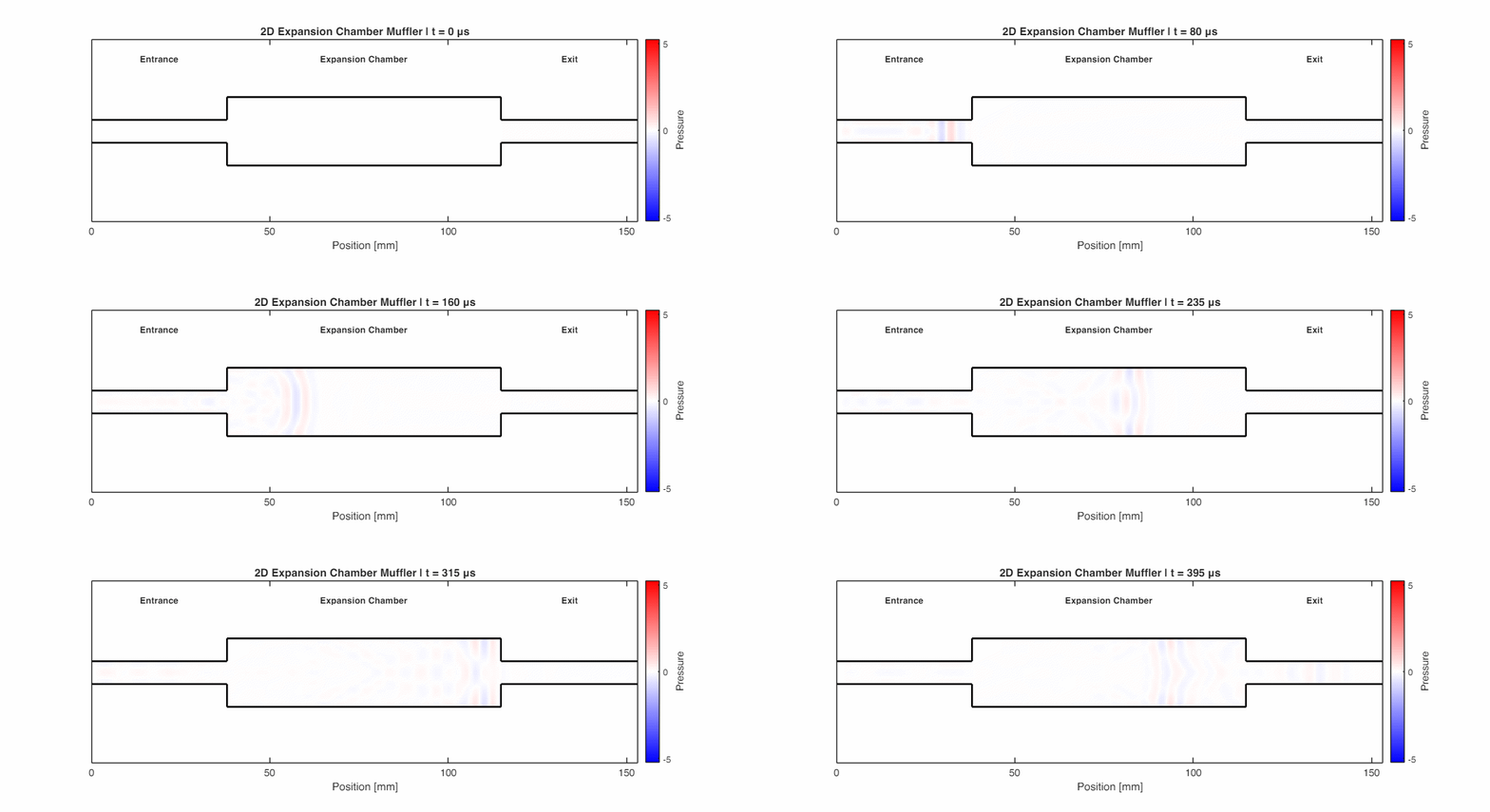
The Power of the Expansion Ratio
The effectiveness of this reflection depends on the Expansion Ratio ($m$), defined as the ratio of the chamber’s cross-sectional area to the pipe’s area ($m = S_2 / S_1$).
- The Rule: The larger the expansion ratio ($m$), the greater the sound attenuation. A fat chamber works better than a skinny one.
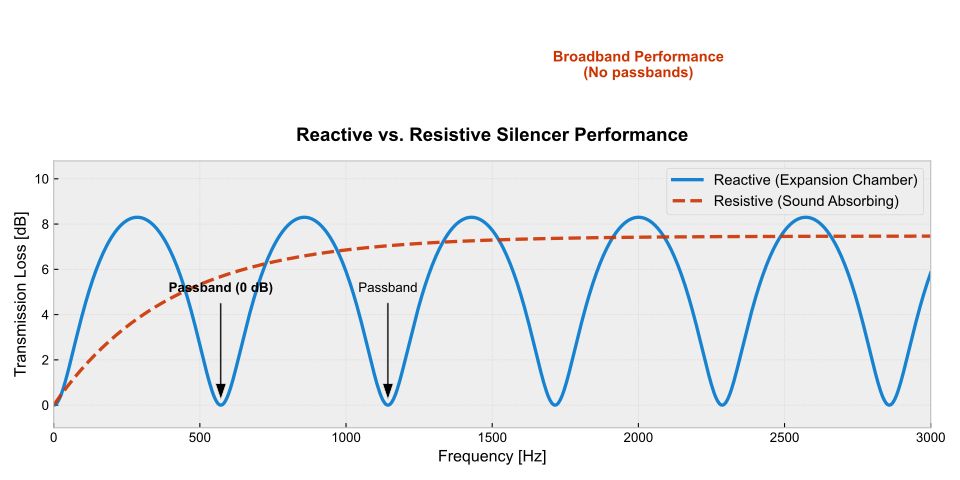
- The Formula: The Transmission Loss for a simple expansion chamber of length $L$ is: $$ TL = 10 \log_{10}\left[1 + \frac{1}{4}\left(m - \frac{1}{m}\right)^2 \sin^2(kL)\right] $$ where $k = 2\pi f/c$ is the wavenumber.
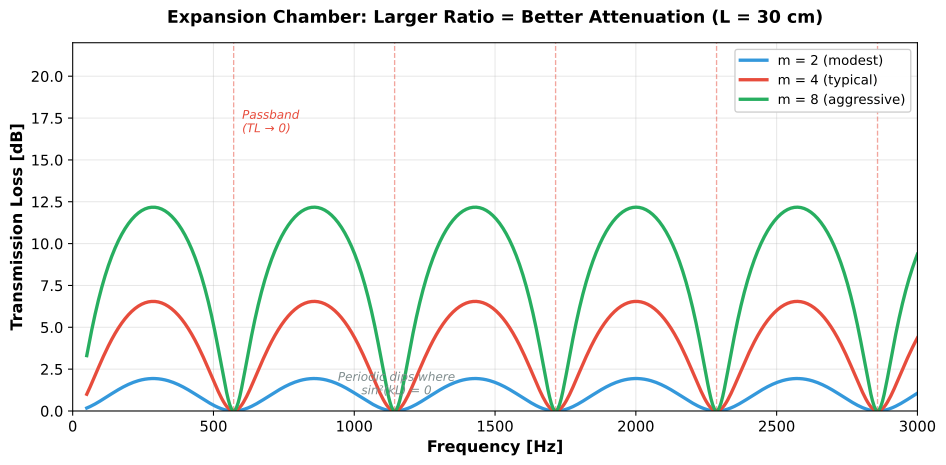
The Frequency Trap (Passbands)
Reactive silencers have a significant weakness: they are frequency-selective.
The chamber’s length ($L$) is critical. When $L$ equals a half-integer multiple of the wavelength ($L = n\lambda/2$, or equivalently $kL = n\pi$), the $\sin^2(kL)$ term in the TL formula becomes zero. At these specific frequencies, sound passes through the chamber completely unimpeded.
- Passbands: These “leaky” frequencies are called passbands. You can see them as the dips dropping to 0 dB in the Transmission Loss plots.
- The Fix: Engineers counter this by using inserted tubes (extending the inlet/outlet pipes into the chamber) or connecting multiple chambers in series to “scramble” these resonances and broaden the effective frequency range.
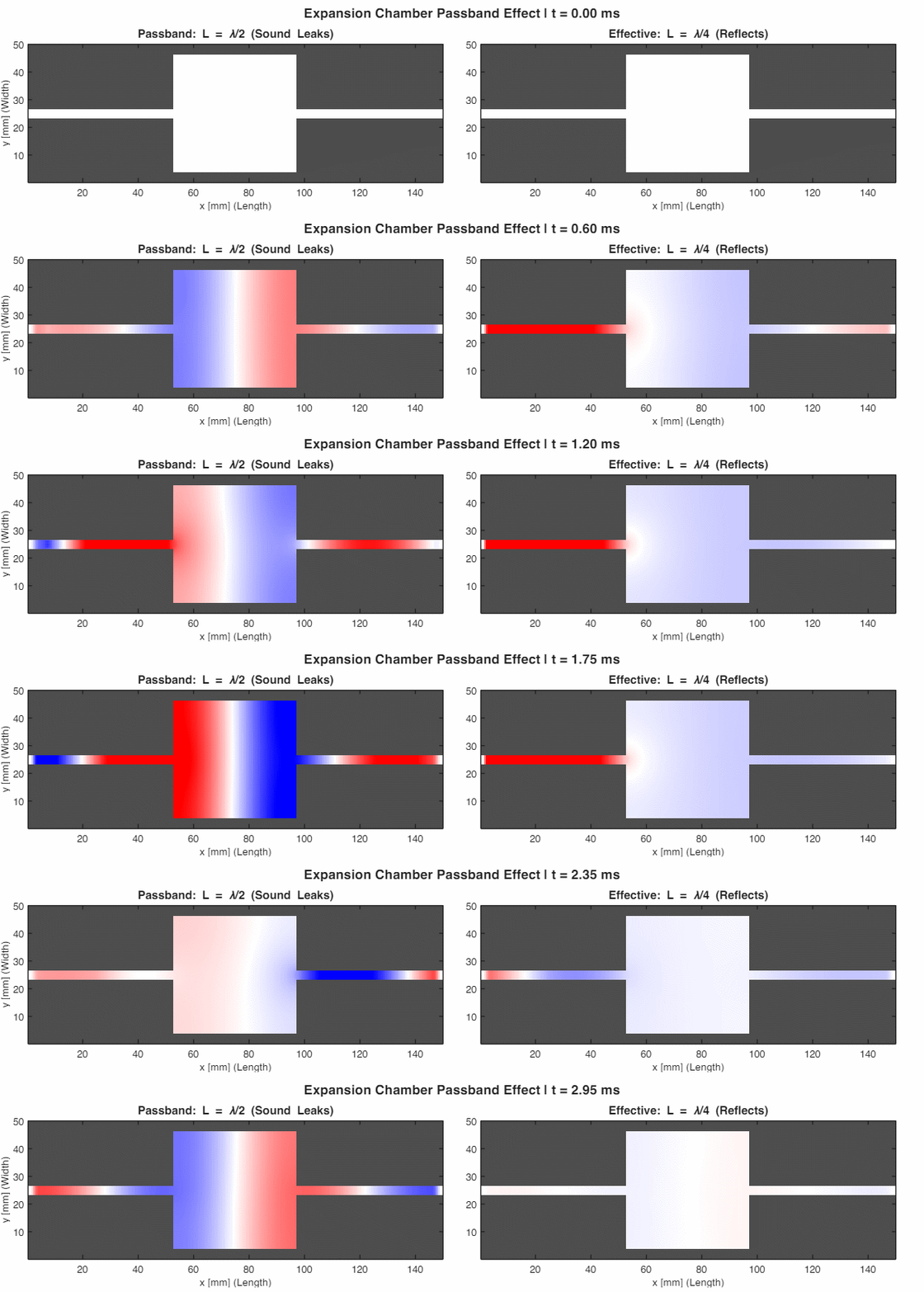
The Resistive Silencer: The Acoustic Sponge
If you look inside an air conditioning duct or a gun silencer, you might see a pipe lined with fiberglass, foam, or mineral wool. This is a Resistive (Dissipative) Silencer.
The Mechanism
Unlike the reactive type, which reflects energy, the resistive silencer absorbs it. The sound waves propagating down the duct expand into the porous lining. The air molecules oscillate within the pores of the material, and friction converts the acoustic energy into heat.
The High-Frequency Specialist
Resistive silencers behave differently than reactive ones:
- Broadband Performance: They do not suffer from the sharp “passbands” of expansion chambers. They provide smooth attenuation across a wide range of frequencies.
- High-Frequency Bias: They are exceptionally good at killing high-pitched hiss (where the wavelength is short and interacts well with the liner). However, they are generally poor at stopping low-frequency rumble unless the silencer is made impractically long.
The Airflow Problem
A specific engineering challenge for resistive silencers is Airflow:
- Erosion: High-speed air can blow the fibers out of the lining.
- Regenerated Noise: If the air moves too fast over the lining, turbulence creates new noise, defeating the purpose of the muffler. To solve this, modern designs often face the porous material with a perforated metal sheet or use micro-perforated panels (as discussed in Part 5) to protect the liner while letting sound in.
Engineering Compromises: The Hybrid Approach
In practice, complex noise problems often require a combination of both types:
- Car Exhausts: A typical automotive exhaust system uses a reactive expansion chamber to suppress the low-frequency “thump” of engine combustion, followed by a resistive section lined with fiberglass to absorb the high-frequency valve noise and airflow hiss.
- Targeted Resonators: Engineers may also attach Helmholtz Resonators (like a bottle connected to the side of a pipe, as discussed in Part 4 ) to target and eliminate one specific annoying tone, such as the drone at cruising RPM.
What’s Next?
We have now covered how sound behaves in fluids (air/water): how it propagates, reflects, is absorbed, and can be blocked. But sound doesn’t only travel through air; it can also travel through the structure of a building itself. A vibrating machine on the roof can send energy down steel beams and radiate noise into a basement far below.
In the next installment, “Vibration – Structure-Borne Sound,” we shift from fluid dynamics to solid mechanics. We’ll explore how vibration runs through steel and concrete, and learn how “floating floors” and vibration-isolating springs can break the transmission path.
References:
- He Lin et al., Theoretical Acoustics and Engineering Applications, Science Press, 2006.