Acoustics-09: Measurement – Holography and Intensity
In the previous installments, we’ve treated sound as something to be blocked, absorbed, or isolated . But before an engineer can fix a noise problem, they must answer a deceptively simple question: Where exactly is it coming from?
If a car engine is noisy, is it the valve cover, the oil pan, or a hairline crack in the exhaust manifold? A standard microphone can’t tell you. It measures only sound pressure—a scalar value that indicates how loud the sound is, but reveals nothing about where the acoustic energy originates or flows.
In this penultimate installment, we explore how modern acoustics allows us to “see” sound—like a thermal camera for noise—using Sound Intensity probes and Near-field Acoustic Holography (NAH).
The Vector of Noise: Sound Intensity
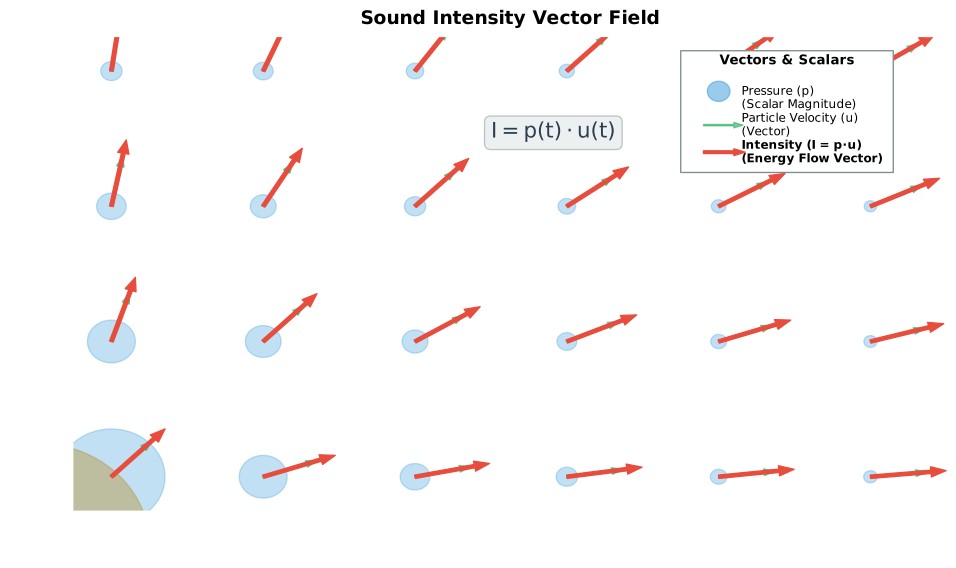
For decades, acousticians relied solely on measuring Sound Pressure ($p$). But pressure is only half the story. Sound is a form of energy transmission. To describe this energy flow completely, we need to know the Sound Intensity.
The Definition
Sound intensity ($I$) is the vector quantity representing the sound power passing through a unit area. Mathematically, it is the time-averaged product of instantaneous sound pressure ($p$) and instantaneous particle velocity ($u$): $$ I = p \cdot u $$ Unlike pressure, which is a scalar (just a magnitude), intensity is a vector—it has both magnitude and direction.
The Measurement Problem (The p-p Probe)
Measuring pressure is easy—just use a microphone. Measuring particle velocity ($u$) is harder.
The solution exploits Newton’s Second Law applied to fluids (Euler’s Equation): particle acceleration is proportional to the pressure gradient. By placing two well-matched microphones very close together (a “p-p probe”), we can measure the pressure difference ($\Delta p$) over a small known distance ($\Delta r$).
- The Approximation: The particle velocity is proportional to the time integral of this pressure gradient.
- The Result: By processing signals from two matched microphones, we can calculate the intensity vector. This allows engineers to scan a machine and generate a “heat map” of noise, showing exactly which parts are radiating energy and which are silent.
Acoustic Holography: Reconstructing the Field
Sound Intensity is powerful, but it requires scanning point-by-point. What if we want to take a “snapshot” of the entire sound field at once and reconstruct the vibration of the source in 3D? This is the domain of Near-field Acoustic Holography (NAH).
The Hologram
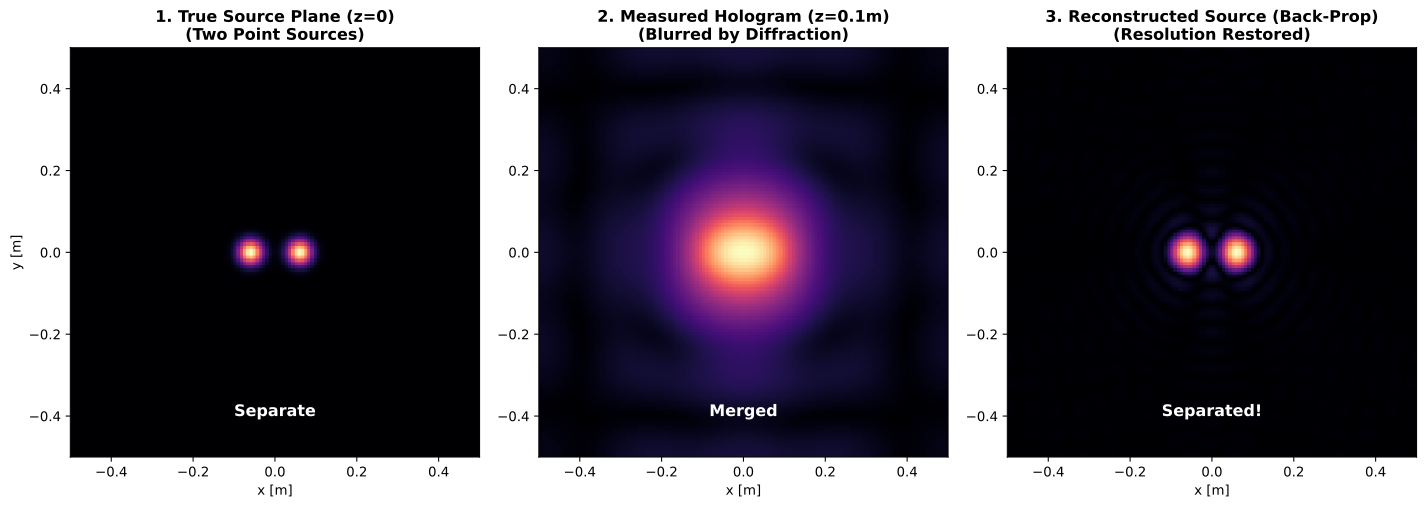
Just as optical holography records light interference to reconstruct a 3D image, acoustic holography records the complex sound pressure (magnitude and phase) on a 2D surface called the “hologram plane.” This is usually done using a microphone array placed close to the noise source.
The Backward Calculation
Once we have the data on the hologram plane, how do we figure out what’s happening on the source surface?
This is an inverse problem. The relationship between the sound field on the source surface and the measurement plane is governed by the Green’s function—essentially the acoustic “transfer function” describing how sound propagates from one point to another.
Using Spatial Fourier Transforms, the complex acoustic field is decomposed into a set of plane waves. These waves are then mathematically “back-propagated” from the measurement plane to the source plane, reconstructing the vibration velocity and surface pressure of the engine or structure.
The Secret of the Near Field: Evanescent Waves
Why must we measure in the “Near Field” (very close to the source)? Why can’t we just take a picture from far away?
The answer lies in the physics of Evanescent Waves.
When a structure vibrates, it produces two types of waves:
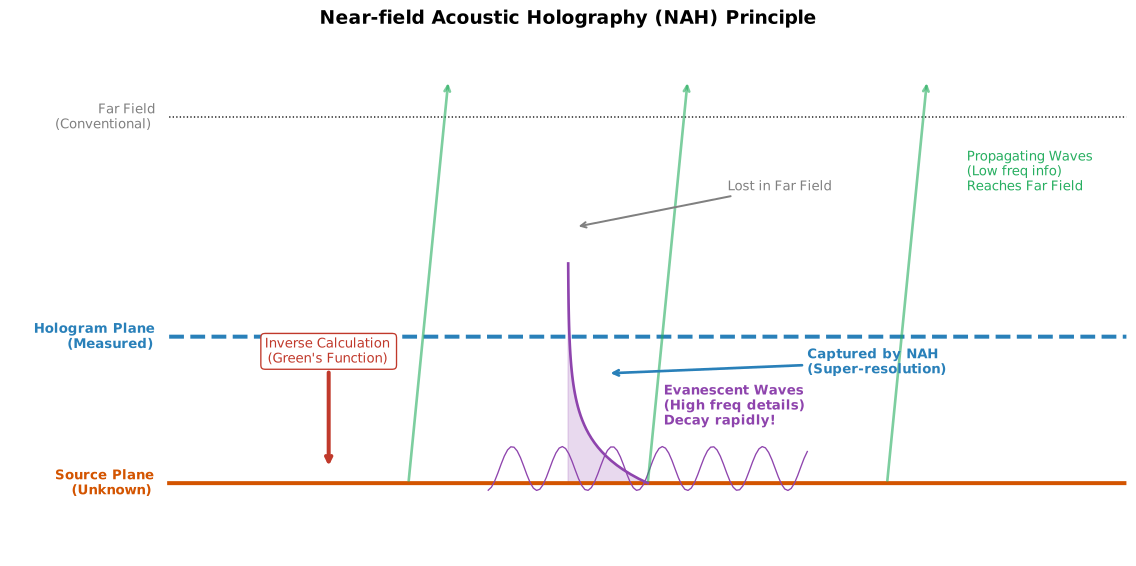
- Propagating Waves: These travel long distances (to the far field). They carry the low-frequency information.
- Evanescent Waves: These contain the high-frequency details of the source. However, they decay exponentially as they move away from the surface.
If you measure far away (conventional beamforming), the evanescent waves have already died out. You lose the “high-resolution” details. By measuring in the near field (NAH), we capture these evanescent waves before they vanish. This allows NAH to achieve super-resolution—locating noise sources smaller than the wavelength of the sound itself, a feat impossible with traditional far-field lens physics.
Applications: Seeing the Invisible
These technologies have revolutionized industrial noise control:
- Source Identification: Pinpointing a rattling gearbox bearing inside a sealed casing—without ever opening it.
- Vibration Mode Analysis: Reconstructing the vibration patterns of a ship’s hull or an aircraft fuselage to identify which structural modes radiate the most noise at specific frequencies.
- Automotive NVH: Identifying the dominant noise sources in a vehicle cabin during a road test, enabling targeted countermeasures.
- Underwater Acoustics: Mapping the noise signature radiated by submarines using vector hydrophones.
What’s Next?
We’ve journeyed from the basic wave equation to the complex mathematics of holographic reconstruction. We’ve learned how to absorb, block, isolate, and now visualize sound.
In the final installment of The Shape of Sound, “The Frontiers,” we’ll look ahead to cutting-edge topics: non-linear acoustics, thermoacoustics (using sound to cool refrigerators!), and active noise control—where sound is used to cancel itself in real-time.
References:
- He Lin et al., Theoretical Acoustics and Engineering Applications, Science Press, 2006.
- Ma Dayou, Modern Acoustics Theory Basis, Science Press, 2004.