Acoustics-08: Vibration – Structure-Borne Sound
In the previous installments, we treated sound primarily as a traveler in fluids—air or water. We learned to block it with heavy walls (Part 6) and trap it in muffler chambers (Part 7).
But in the real world, sound has a secret “backdoor” entry. You might seal a room perfectly against airborne noise, yet still hear the subway rumbling below or the elevator motor humming on the roof. This is Structure-Borne Sound—the wave is no longer swimming in air; it’s running through the steel beams and concrete floors of the building itself.
This installment explores how solids carry sound and how engineers use springs and damping materials to break the chain of vibration.
The Solid Highway: A Menagerie of Waves
In fluids (like air), sound is simple: it is a longitudinal compression wave. Fluids cannot resist a change in shape (shear), only a change in volume.
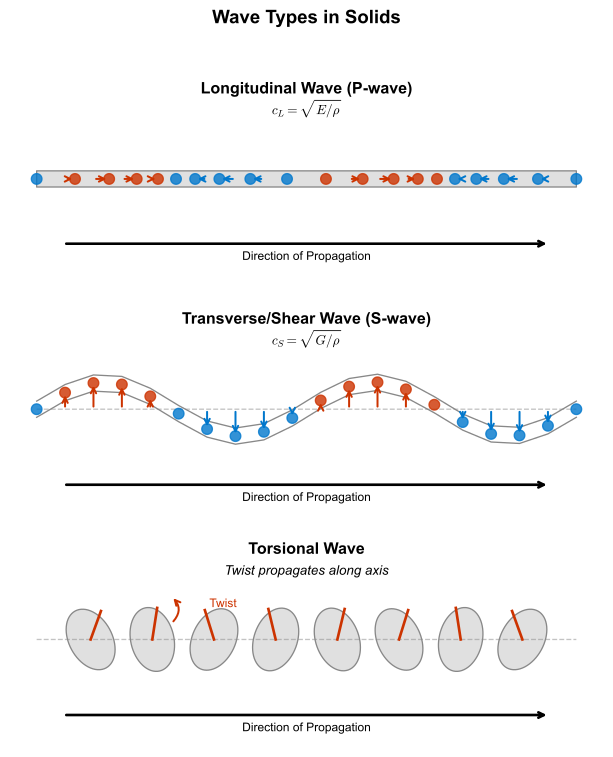
Solids, however, are stiff. They resist being compressed and being bent or twisted. This stiffness supports a complex zoo of wave types propagating simultaneously:
- Longitudinal Waves (P-waves): The particles push and pull along the direction of travel, just like in air. The speed depends on the material’s Young’s modulus ($E$) and density ($\rho$), calculated as $c_l = \sqrt{E/\rho}$ for thin bars.
- Transverse/Shear Waves (S-waves): The particles move side-to-side (perpendicular to travel). Because solids resist shear deformation, these waves travel slower than P-waves, with speed $c_s = \sqrt{G/\rho}$, where $G$ is the shear modulus.
- Torsional Waves: The structure twists as the wave propagates.
The Troublemaker: Flexural Waves
Among all these types, one stands out as the primary culprit for noise problems in buildings, ships, and cars: the Flexural Wave (also called Bending Wave).
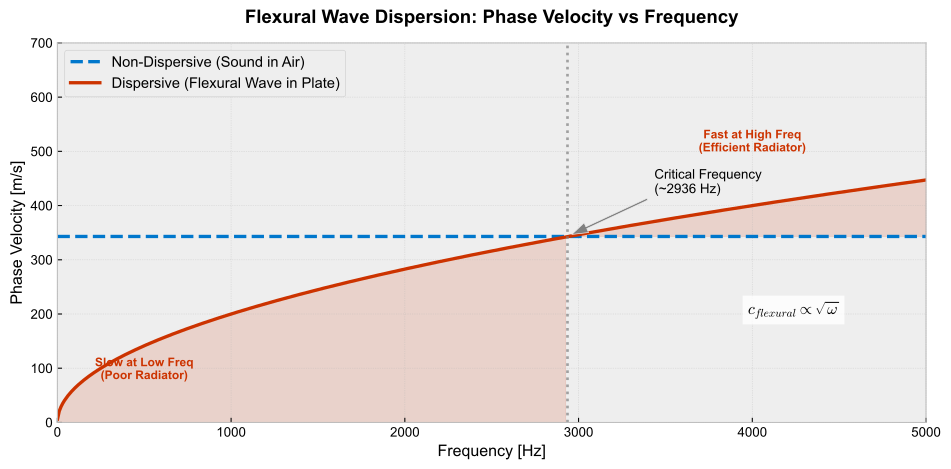
Imagine shaking a long rope or a ruler. The wave travels by bending the material. Flexural waves are unique because they are dispersive.
- Dispersion: In air, low bass and high treble travel at the same speed. In a flexural beam, speed depends on frequency. High-frequency flexural waves travel faster than low-frequency ones.
- The Equation: The phase velocity ($c_b$) is proportional to the square root of the frequency ($\omega$): $$ c_b = \left( \frac{EI}{\rho S} \right)^{1/4} \sqrt{\omega} $$ Where $EI$ represents the bending stiffness and $\rho S$ represents the mass per unit length.
Why do we care? Flexural waves cause significant displacement perpendicular to the surface of a plate or beam. This makes them excellent “loudspeakers.” A vibrating machine sends flexural waves racing down the floor; the floor then vibrates like a giant speaker cone, radiating noise into the room below. This is why you can hear your upstairs neighbor’s washing machine even through a solid concrete slab.
Cutting the Link: Vibration Isolation
We cannot stop a machine from vibrating internally, but we can prevent that vibration from shaking the building. This is the principle of Vibration Isolation. Think of HVAC units mounted on rooftops—they sit on rubber mounts or spring isolators specifically to prevent their rumble from traveling down through the structure.
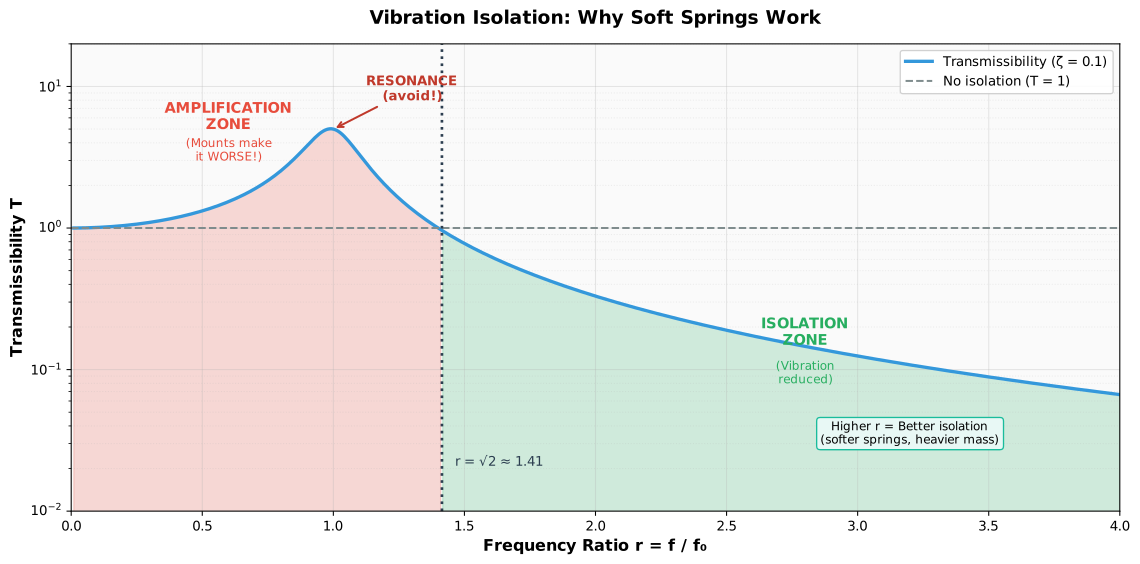
The goal is to reduce the Transmissibility ($T$)—the ratio of the force transmitted to the foundation versus the exciting force generated by the machine.
The Mass-Spring Model
This can be modeled as a single-degree-of-freedom system: a mass ($M$) sitting on a spring with stiffness ($K$) and damping ($C$). The system has a Natural Frequency ($f_0$): $$ f_0 = \frac{1}{2\pi} \sqrt{\frac{K}{M}} $$
The Isolation Rule
The effectiveness of the isolation depends entirely on the ratio of the machine’s operating frequency ($f$) to this natural frequency ($f_0$).
- Amplification Zone ($f < \sqrt{2}f_0$): If the machine runs slowly (near the spring’s natural resonance), the vibration is actually magnified. The mount makes it worse!
- Isolation Zone ($f > \sqrt{2}f_0$): Only when the machine runs significantly faster than the natural frequency does isolation occur. As $f$ increases, the mass’s inertia prevents it from following the rapid movements, and the force transmitted drops.
The Transmissibility for an undamped system is:
$$ T = \frac{1}{\left| 1 - (f/f_0)^2 \right|} $$
Engineering Takeaway: To isolate a low-frequency rumble (like a diesel generator), you need very soft springs (low $K$) or a very heavy inertia base (high $M$). Both strategies push the natural frequency ($f_0$) as low as possible, ensuring the machine operates deep within the isolation zone.
Soaking up the Energy: Damping
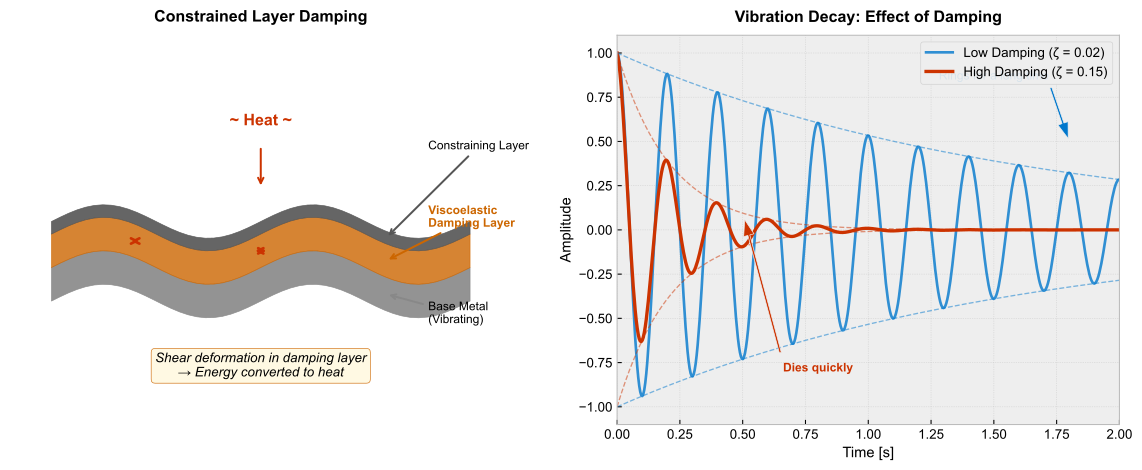
Sometimes, springs aren’t enough. If a structure is already vibrating (like a ship’s hull or a car door), we need to drain that energy. This is Damping.
Viscoelastic materials (like rubber or special polymers) applied to metal structures have high internal friction. When the metal bends, the damping layer stretches and shears. The friction between long-chain molecules converts the ordered mechanical energy of the vibration into heat.
This doesn’t stop the wave from starting, but it kills it before it can travel far or ring for a long time.
What’s Next?
We have now covered the physics of waves, human perception of sound, absorption, insulation, mufflers, and vibration control. But how do we actually see sound to diagnose these problems in the real world?
In the next installment, “Measurement – Holography and Intensity,” we’ll explore modern measurement techniques. We’ll see how engineers use “acoustic cameras” to create heat-map-like images of noise sources and how sound intensity probes measure the direction and magnitude of acoustic energy flow.
References:
- He Lin et al., Theoretical Acoustics and Engineering Applications, Science Press, 2006.
- Ma Dayou, Modern Acoustics Theory Basis, Science Press, 2004.