The Uncanny Valley: Why We Fear the Almost Human
Introduction
Have you ever looked at a humanoid robot or a CGI character in a movie and felt a sudden, inexplicable sense of revulsion or unease? It looks almost human, but something is just… off. The skin is too smooth, the eyes scream “dead inside,” or the movement is slightly jerky.
This unsettling feeling is known as the Uncanny Valley. It’s a concept that has haunted roboticists, animators, and game designers for decades—while horror filmmakers deliberately exploit it. But what exactly is it, and why does our brain react this way?
The Origin of the Theory
The term “Uncanny Valley” (bukimi no tani genshō) was first coined in 1970 by Japanese roboticist Masahiro Mori.
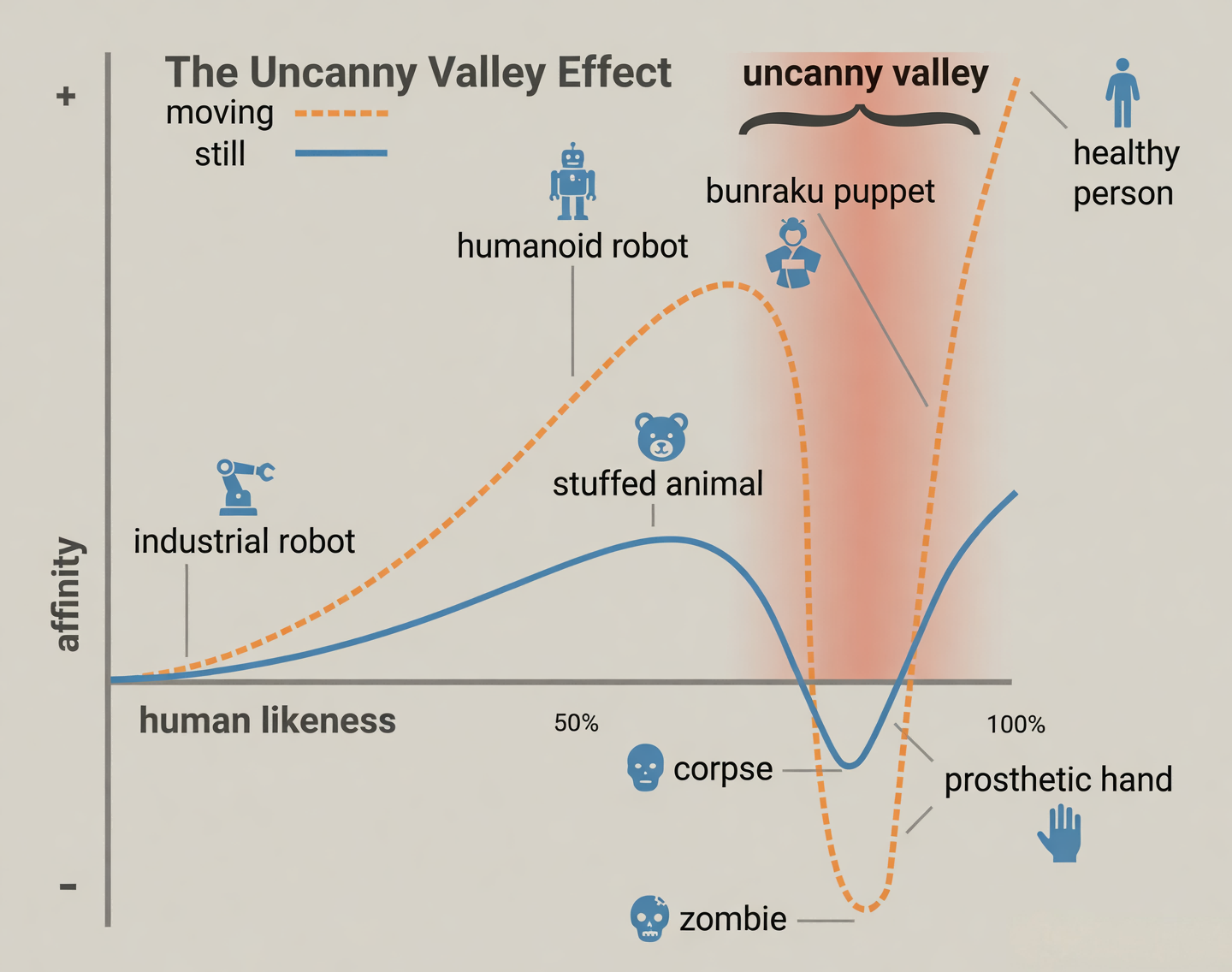
Mori hypothesized that as a robot is made more human-like in its appearance and motion, a human observer’s emotional response to the robot will become increasingly positive and empathetic. However, this trend continues only up to a point.
When the robot becomes very close to human-like but not quite perfect, the affinity suddenly drops into a deep feeling of revulsion. This dip in the graph of comfort vs. human-likeness is the “valley.”
The Curve Explained
- Industrial Robot: Doesn’t look human. We feel neutral.
- Humanoid Robot (e.g., ASIMO): Looks somewhat human but clearly a machine. We find it cute or cool. (Affinity rises)
- The Uncanny Valley: A wax figure, a corpse, or a hyper-realistic android that moves stiffly. It looks human enough to trigger our social recognition but artificial enough to trigger our “something is wrong” alarm. (Affinity plummets)
- Healthy Human: Looks 100% human. We feel high affinity.
Why Does It Happen?
Psychologists and neuroscientists have proposed several theories to explain this phenomenon.
Pathogen Avoidance
This theory suggests that the “uncanny” feeling is an evolutionary defense mechanism. Features that look “off”—like pale skin, stiff movements, or unblinking eyes—might subconsciously remind us of a corpse or a visibly diseased person. Our brain triggers a disgust response to prevent us from contracting potential pathogens.
Mortality Salience
A humanoid robot that is clearly a machine but mimics a human might remind us of our own mortality. It represents a “human without a soul” or a reanimated corpse, triggering an existential fear of death.
Cognitive Dissonance
Our brains like to categorize things: “human” or “object.” When something straddles the line—having human eyes but a plastic face, or a human voice but robotic timing—it creates cognitive conflict. Our brain struggles to process it, leading to a feeling of unease.
graph TD
    A[Visual Input] -->|Categorization| B{Is it Human?}
    B -->|Yes| C[Empathy]
    B -->|No| D[Object/Machine]
    B -->|Ambiguous| E[Cognitive Dissonance]
    E --> F[Uncanny Feeling/Revulsion]
    style E fill:#f9f,stroke:#333,stroke-width:2px
    style F fill:#bbf,stroke:#333,stroke-width:2px
Real-World Examples
The Polar Express (2004)
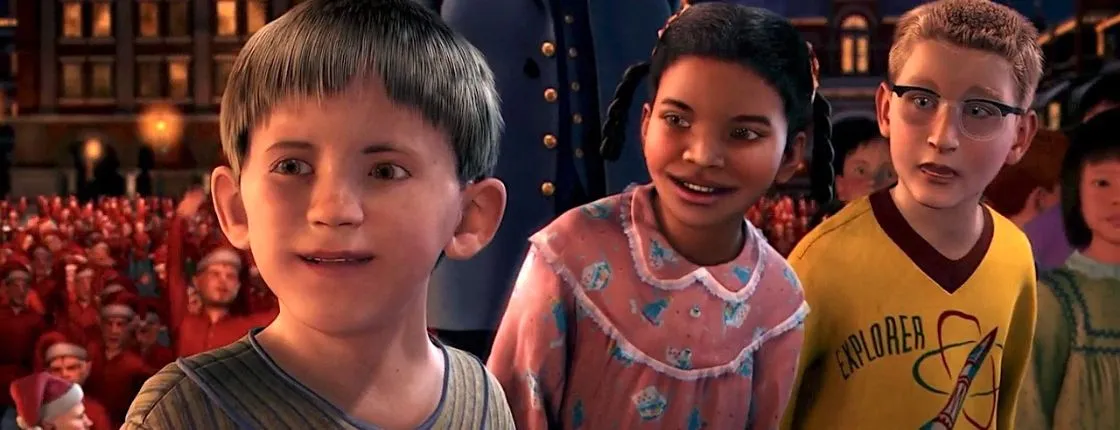
Often cited as a classic example of the Uncanny Valley in film. The characters were motion-captured to move realistically, but their faces were slightly stiff and their eyes often looked dead. This left many audiences feeling uncomfortable rather than charmed.
Humanoid Robots
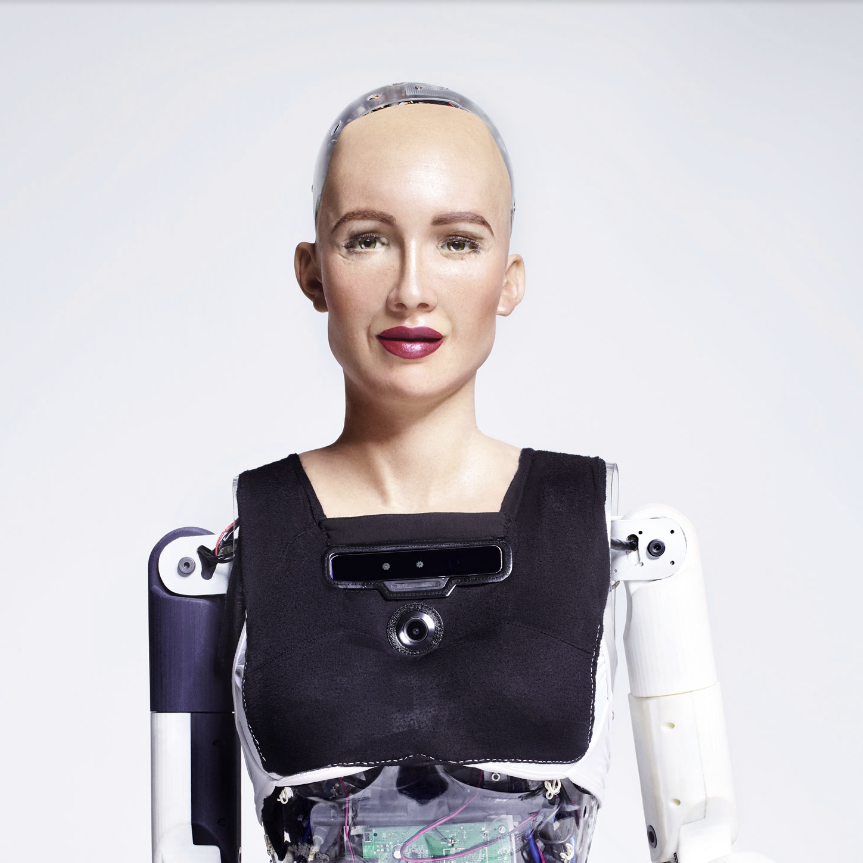
Robots like Sophia (Hanson Robotics) often fall into the valley. While they can make facial expressions and hold conversations, the slight delays in reaction and the unnatural elasticity of their “skin” can be deeply unsettling to some observers.
Cats (2019)
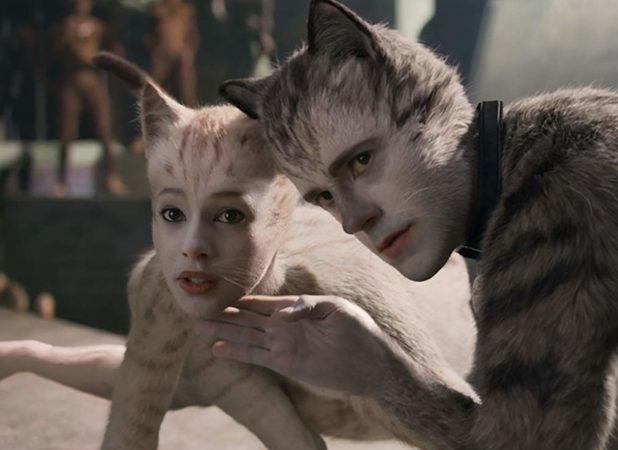
The film adaptation of the musical Cats is a more recent example. The “digital fur technology” grafted human faces onto cat bodies, creating a hybrid that was neither fully cat nor fully human, landing squarely in the valley of nightmares for many viewers.
Horror Films: Weaponizing the Valley
While most designers try to avoid the Uncanny Valley, horror filmmakers deliberately exploit it to unsettle audiences. The same evolutionary responses that make us uncomfortable with imperfect androids—pathogen avoidance, mortality salience, cognitive dissonance—are precisely what horror films leverage.
Techniques That Trigger the Uncanny
| Technique | Uncanny Effect | Example |
|---|---|---|
| Distorted movement | Breaks expectation of normal motion | The spider-walk in The Exorcist (1973) |
| Almost-human faces | Triggers “something is wrong” alarm | Samara in The Ring (2002) |
| Dolls and mannequins | Human-like but lifeless | Annabelle (2014), Dead Silence (2007) |
| Body horror | Human form corrupted | The Thing (1982) |
| Wrong smiles | Familiar expression made sinister | Smile (2022) |
Classic Horror Examples
The Shining (1980) - The Grady Twins
The twins aren’t overtly monstrous—they’re just slightly off. Their synchronized movements, blank stares, and unnatural stillness trigger the uncanny effect without any CGI.
Hereditary (2018)
Director Ari Aster uses subtle facial distortions and unnatural head positions to create dread. The horror comes not from monsters, but from human faces behaving wrong.
Smile (2022)
The film’s central horror is people smiling in ways that are almost normal but subtly wrong—a textbook Uncanny Valley exploitation.
Bridging (or Avoiding) the Valley
For designers, there are two main strategies:
Total Realism: Push through the valley to the other side. This is incredibly difficult and expensive. Films like Avatar (2009) succeeded by creating non-human characters (Na’vi) that were photorealistic but clearly distinguished from humans, avoiding the brain’s “defective human” detector.
Stylization: Avoid the valley entirely. This is why characters in Pixar movies (like The Incredibles or Up) have exaggerated features—big eyes, abnormal proportions. They don’t try to look photorealistic, so our brains judge them as “appealing characters” rather than “defective humans.”
Conclusion
The Uncanny Valley serves as a fascinating reminder of the complexity of human perception. It explains why some CGI fails, why certain robots unsettle us, and why horror films can terrify us with nothing more than a wrong smile.
As technology advances, we may eventually build androids and avatars that are indistinguishable from us, effectively building a bridge across the valley. Until then, designers must choose: push through with total realism, stay safe with stylization, or—if you’re making a horror film—dive straight into the valley and embrace the nightmare.
References
- Mori, M. (1970). The Uncanny Valley. Energy, 7(4), 33-35. [Translated by Karl F. MacDorman and Norri Kageki, IEEE Robotics & Automation Magazine, 2012]
- MacDorman, K. F., & Ishiguro, H. (2006). The uncanny advantage of using androids in cognitive and social science research. Interaction Studies, 7(3), 297-337.
- Tinwell, A. (2014). The Uncanny Valley in Games and Animation. CRC Press.