UML-09: Association Rule Mining

Summary
Master Association Rules: The 'Symbiosis Scouter'. Learn how Apriori finds hidden partnerships (Support, Confidence, Lift) in your data ecosystem.

Learning Objectives

After reading this post, you will be able to:

  • Understand the goal of association rule mining
  • Know the key metrics: support, confidence, and lift
  • Implement the Apriori algorithm for finding frequent itemsets
  • Apply association rules to real-world market basket analysis

Theory

The Intuition: The Symbiosis Scouter

Imagine you are an ecologist exploring a vast Rainforest (The Dataset).

  • Transaction: You examine small 10x10m patches of land.
  • Itemset: The specific plants and animals you find in that patch.
  • Association Rule: You notice a pattern: “Wherever I see a Clownfish, I see an Anemone.”

Association Rule Mining is about finding these Symbiotic Relationships in your data ecosystem, distinguishing true partnerships from random co-occurrences.

graph LR A["๐ŸŒฟ Rainforest Patch\n(Transaction)"] --> B["๐Ÿ” Pattern Scout\n(Apriori)"] B --> C["๐Ÿ“‹ Species Pairs\n(Frequent Itemsets)"] C --> D["๏ฟฝ Symbiosis Rule\n(Association Rules)"] style B fill:#fff9c4 style D fill:#c8e6c9

Applications:

  • ๐Ÿ›’ Nature (Market): Clownfish & Anemone (Bread & Butter).
  • ๐ŸŒ Web: Visited Page A & Page B.
  • ๐Ÿฅ Medicine: Symptom X & Disease Y.

Key Concepts

Support (How Common?)

  • Analogy: “How many patches have both a Clownfish AND an Anemone?”
  • Formula: $Support(A) = \frac{\text{Transactions with A}}{\text{Total Transactions}}$
  • Goal: Filter out rare species. If a pair only appears once in 1,000 patches, it’s not a general rule.

Confidence (How Reliable?)

  • Analogy: “If I see a Clownfish, how sure am I that an Anemone is also there?”
  • Formula: $Confidence(A \rightarrow B) = \frac{Support(A \cup B)}{Support(A)}$
  • Goal: Measure the strength of the implication.

Lift (True Symbiosis vs. Coincidence)

  • Analogy: “Do they need each other? Or are they just both everywhere (like Ants and Grass)?”
  • Formula: $Lift(A \rightarrow B) = \frac{Confidence(A \rightarrow B)}{Support(B)}$
  • Interpretation:
    • Lift > 1 (Symbiosis): They appear together more than expected by chance. Positive correlation.
    • Lift = 1 (Independence): No relationship. (e.g., “People who buy Bread also breathe Air” - useless).
    • Lift < 1 (Competition): They avoid each other. Negative correlation.

The Apriori Algorithm

Apriori efficiently finds frequent itemsets using the apriori principle:

If an itemset is infrequent, all its supersets are also infrequent.

The Notion: “The Rotten Apple”

Think of a fruit basket.

  • If one apple is rotten, the entire basket is considered “bad”.
  • In Apriori: If {Beer} is rare (rotten), then {Beer, Diapers}, {Beer, Milk}, and {Beer, Anything} are also rare.
  • Result: We don’t even bother checking the combinations. We throw the whole branch away.

This allows pruning of the search space.

graph LR A["Start: All 1-itemsets"] --> B["Count support"] B --> C["Prune infrequent"] C --> D["Generate candidates"] D --> E{"More candidates?"} E -->|Yes| B E -->|No| F["Frequent itemsets"] style F fill:#c8e6c9

Algorithm Steps:

  1. Set minimum support threshold
  2. Find frequent 1-itemsets
  3. Generate candidate k+1 itemsets from frequent k-itemsets
  4. Prune candidates with infrequent subsets
  5. Count support and keep frequent ones
  6. Repeat until no new itemsets found

Code Practice

Creating Transaction Data

๐Ÿ Python
 1
 2
 3
 4
 5
 6
 7
 8
 9
10
11
12
13
14
15
16
17
18
19
20
21
22
23
import pandas as pd
import numpy as np

# Sample transaction data
transactions = [
    ['Bread', 'Milk'],
    ['Bread', 'Diapers', 'Beer', 'Eggs'],
    ['Milk', 'Diapers', 'Beer', 'Cola'],
    ['Bread', 'Milk', 'Diapers', 'Beer'],
    ['Bread', 'Milk', 'Diapers', 'Cola'],
    ['Bread', 'Milk', 'Beer'],
    ['Bread', 'Diapers', 'Cola'],
    ['Bread', 'Milk', 'Diapers', 'Eggs'],
    ['Milk', 'Diapers', 'Beer', 'Eggs'],
    ['Bread', 'Milk', 'Cola']
]

print("=" * 50)
print("TRANSACTION DATA")
print("=" * 50)
for i, t in enumerate(transactions[:5], 1):
    print(f"Transaction {i}: {t}")
print(f"... and {len(transactions)-5} more")

Output:

1
2
3
4
5
6
7
8
9
==================================================
TRANSACTION DATA
==================================================
Transaction 1: ['Bread', 'Milk']
Transaction 2: ['Bread', 'Diapers', 'Beer', 'Eggs']
Transaction 3: ['Milk', 'Diapers', 'Beer', 'Cola']
Transaction 4: ['Bread', 'Milk', 'Diapers', 'Beer']
Transaction 5: ['Bread', 'Milk', 'Diapers', 'Cola']
... and 5 more

Using mlxtend for Association Rules

๐Ÿ Python
 1
 2
 3
 4
 5
 6
 7
 8
 9
10
11
12
13
14
15
16
17
# pip install mlxtend
from mlxtend.preprocessing import TransactionEncoder
from mlxtend.frequent_patterns import apriori, association_rules

# Encode transactions
te = TransactionEncoder()
te_array = te.fit_transform(transactions)
df = pd.DataFrame(te_array, columns=te.columns_)

print("\n๐Ÿ“Š Encoded transactions:")
print(df.head())

# Find frequent itemsets
# min_support=0.3: "Ignore species that appear in less than 30% of patches"
frequent_itemsets = apriori(df, min_support=0.3, use_colnames=True)
print(f"\nโœ… Found {len(frequent_itemsets)} frequent itemsets")
print(frequent_itemsets.head(10))

Output:

 1
 2
 3
 4
 5
 6
 7
 8
 9
10
11
12
13
14
15
16
17
18
19
20
๐Ÿ“Š Encoded transactions:
    Beer  Bread   Cola  Diapers   Eggs   Milk
0  False   True  False    False  False   True
1   True   True  False     True   True  False
2   True  False   True     True  False   True
3   True   True  False     True  False   True
4  False   True   True     True  False   True

โœ… Found 18 frequent itemsets
   support                    itemsets
0      0.5           frozenset({Beer})
1      0.8          frozenset({Bread})
2      0.4           frozenset({Cola})
3      0.7        frozenset({Diapers})
4      0.3           frozenset({Eggs})
5      0.8           frozenset({Milk})
6      0.3    frozenset({Bread, Beer})
7      0.4  frozenset({Diapers, Beer})
8      0.4     frozenset({Beer, Milk})
9      0.3    frozenset({Cola, Bread})

Generating Association Rules

๐Ÿ Python
 1
 2
 3
 4
 5
 6
 7
 8
 9
10
11
12
13
# Generate rules
# metric="confidence": "If A is present, B must be present at least 60% of the time"
rules = association_rules(frequent_itemsets, metric="confidence", min_threshold=0.6)
rules = rules.sort_values('lift', ascending=False)

print("\n" + "=" * 50)
print("ASSOCIATION RULES")
print("=" * 50)
print(f"\n๐Ÿ“œ Found {len(rules)} rules with confidence โ‰ฅ 0.6\n")

# Display top rules
cols = ['antecedents', 'consequents', 'support', 'confidence', 'lift']
print(rules[cols].head(10).to_string())

Output:

 1
 2
 3
 4
 5
 6
 7
 8
 9
10
11
12
13
14
15
16
17
==================================================
ASSOCIATION RULES
==================================================

๐Ÿ“œ Found 19 rules with confidence โ‰ฅ 0.6

                   antecedents                 consequents  support  confidence      lift
10           frozenset({Eggs})        frozenset({Diapers})      0.3        1.00  1.428571
13  frozenset({Diapers, Milk})           frozenset({Beer})      0.3        0.60  1.200000
16           frozenset({Beer})  frozenset({Diapers, Milk})      0.3        0.60  1.200000
1            frozenset({Beer})        frozenset({Diapers})      0.4        0.80  1.142857
8            frozenset({Cola})        frozenset({Diapers})      0.3        0.75  1.071429
15     frozenset({Milk, Beer})        frozenset({Diapers})      0.3        0.75  1.071429
2            frozenset({Beer})           frozenset({Milk})      0.4        0.80  1.000000
9            frozenset({Cola})           frozenset({Milk})      0.3        0.75  0.937500
7            frozenset({Milk})          frozenset({Bread})      0.6        0.75  0.937500
3            frozenset({Cola})          frozenset({Bread})      0.3        0.75  0.937500

Visualizing Rules

๐Ÿ Python
 1
 2
 3
 4
 5
 6
 7
 8
 9
10
11
12
13
14
15
16
17
18
19
20
21
22
23
24
25
26
27
28
import matplotlib.pyplot as plt

fig, axes = plt.subplots(1, 2, figsize=(14, 6))

# Support vs Confidence
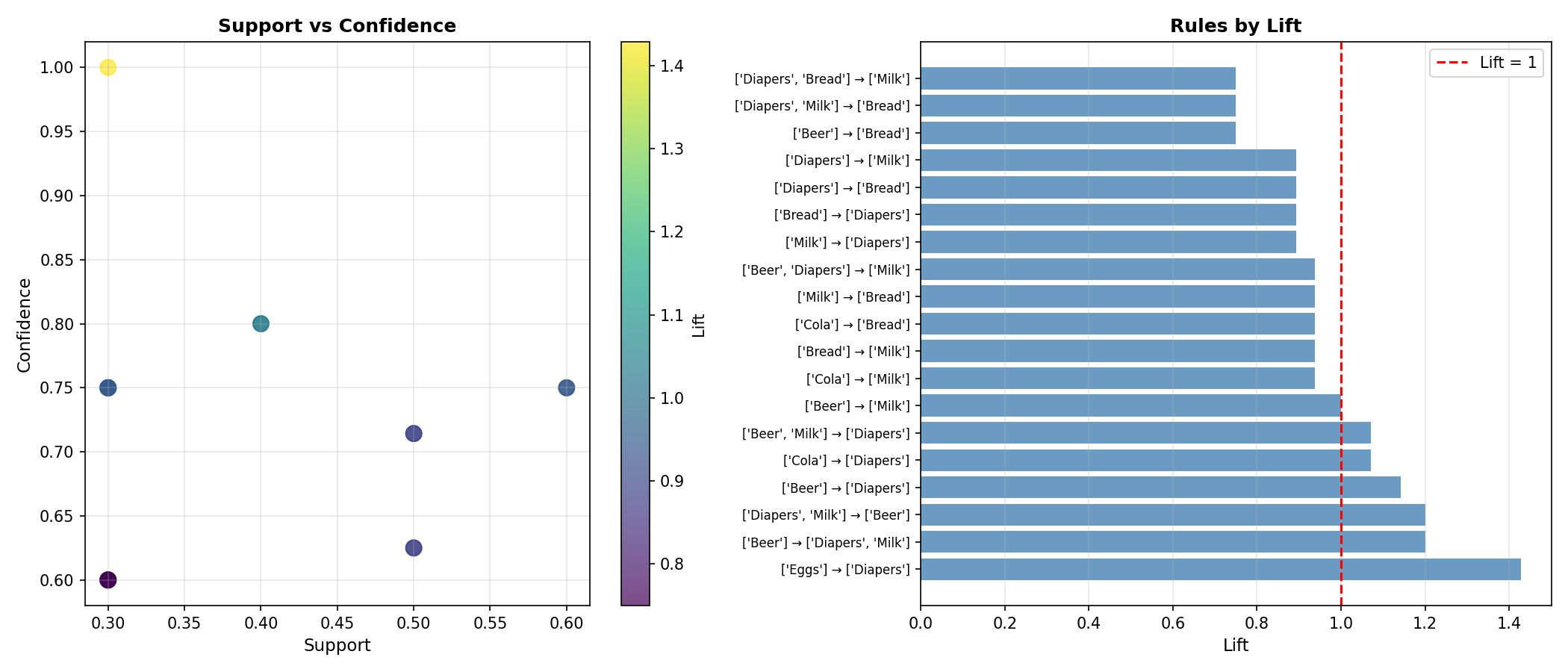
axes[0].scatter(rules['support'], rules['confidence'], 
                c=rules['lift'], cmap='viridis', s=100, alpha=0.7)
axes[0].set_xlabel('Support', fontsize=11)
axes[0].set_ylabel('Confidence', fontsize=11)
axes[0].set_title('Support vs Confidence', fontsize=12, fontweight='bold')
axes[0].grid(True, alpha=0.3)
plt.colorbar(axes[0].collections[0], ax=axes[0], label='Lift')

# Lift distribution
axes[1].barh(range(len(rules)), rules['lift'].values, color='steelblue', alpha=0.8)
axes[1].set_yticks(range(len(rules)))
axes[1].set_yticklabels([f"{list(a)} โ†’ {list(c)}" 
                         for a, c in zip(rules['antecedents'][:len(rules)], 
                                        rules['consequents'][:len(rules)])], fontsize=8)
axes[1].set_xlabel('Lift', fontsize=11)
axes[1].set_title('Rules by Lift', fontsize=12, fontweight='bold')
axes[1].axvline(x=1, color='r', linestyle='--', label='Lift = 1')
axes[1].legend()
axes[1].grid(True, alpha=0.3, axis='x')

plt.tight_layout()
plt.savefig('assets/association_rules.png', dpi=150)
plt.show()
Association rules visualization
Left: Support vs Confidence colored by Lift. Right: All rules ranked by Lift value.

Deep Dive

Interpreting Metrics

MetricHigh Value MeansWhen to Use
SupportCommon patternFilter rare items
ConfidenceRule is reliablePredict behavior
LiftStrong associationFind true patterns
Pro tip: Focus on rules with high lift (> 1) โ€” they indicate genuine associations, not just common items appearing together by chance.

The Popularity Trap (Confidence vs. Lift)

Why isn’t Confidence enough? Imagine a supermarket where everyone buys Water (Support = 90%).

  • Rule: {Bread} -> {Water}
  • Confidence: 90% (Wow! High reliability!)
  • Reality: It’s useless. They would have bought Water anyway.

Lift exposes the truth:

  • If Lift = 1, the rule is just a coincidence.
  • Analogy: “Breathing Air” has 100% confidence with “Buying Bread”, but zero predictive value. Lift detects this independence.

Limitations and Challenges

Challenges in association rule mining:

  1. Combinatorial explosion: Many possible itemsets
  2. Threshold selection: min_support and min_confidence affect results
  3. Spurious patterns: High support doesn’t mean meaningful
  4. Scalability: Large transaction databases are expensive

Alternatives to Apriori

AlgorithmAdvantage
FP-GrowthFaster, uses tree structure
EclatVertical data format, efficient
Spark MLlibDistributed, big data

Summary

ConceptKey Points
Association RulesFind patterns like “If A, then B”
SupportFrequency of itemset
ConfidenceHow often rule is true
LiftStrength of association (> 1 = positive)
AprioriPrunes search space using subset property

References

  • Agrawal, R. & Srikant, R. (1994). “Fast Algorithms for Mining Association Rules”
  • mlxtend Documentation
  • “Data Mining: Concepts and Techniques” by Han, Kamber & Pei - Chapter 6