MV-10: Vibration Measurement – Sensors, Analysis, and Diagnosis
Theory gives us equations; measurement gives us reality.
We can derive natural frequencies and design sophisticated absorbers on paper, but real-world systems—engines, bridges, wind turbines—are complex, messy, and imperfect. How do we verify our models? How do we detect a failing bearing buried deep inside a massive gearbox before it causes a catastrophic shutdown?
The answer lies in vibration measurement.
In this post, based on Chapter 10 of Rao’s Mechanical Vibrations, we will explore the hardware and techniques engineers use to “listen” to machines, from the piezoelectric crystals that sense motion to the sophisticated signal analysis that diagnoses machine health.
Transducers: The Eyes and Ears of Vibration Analysis
To measure vibration, we convert mechanical motion into an electrical signal using a transducer. Different transducers measure different quantities: displacement, velocity, or acceleration.
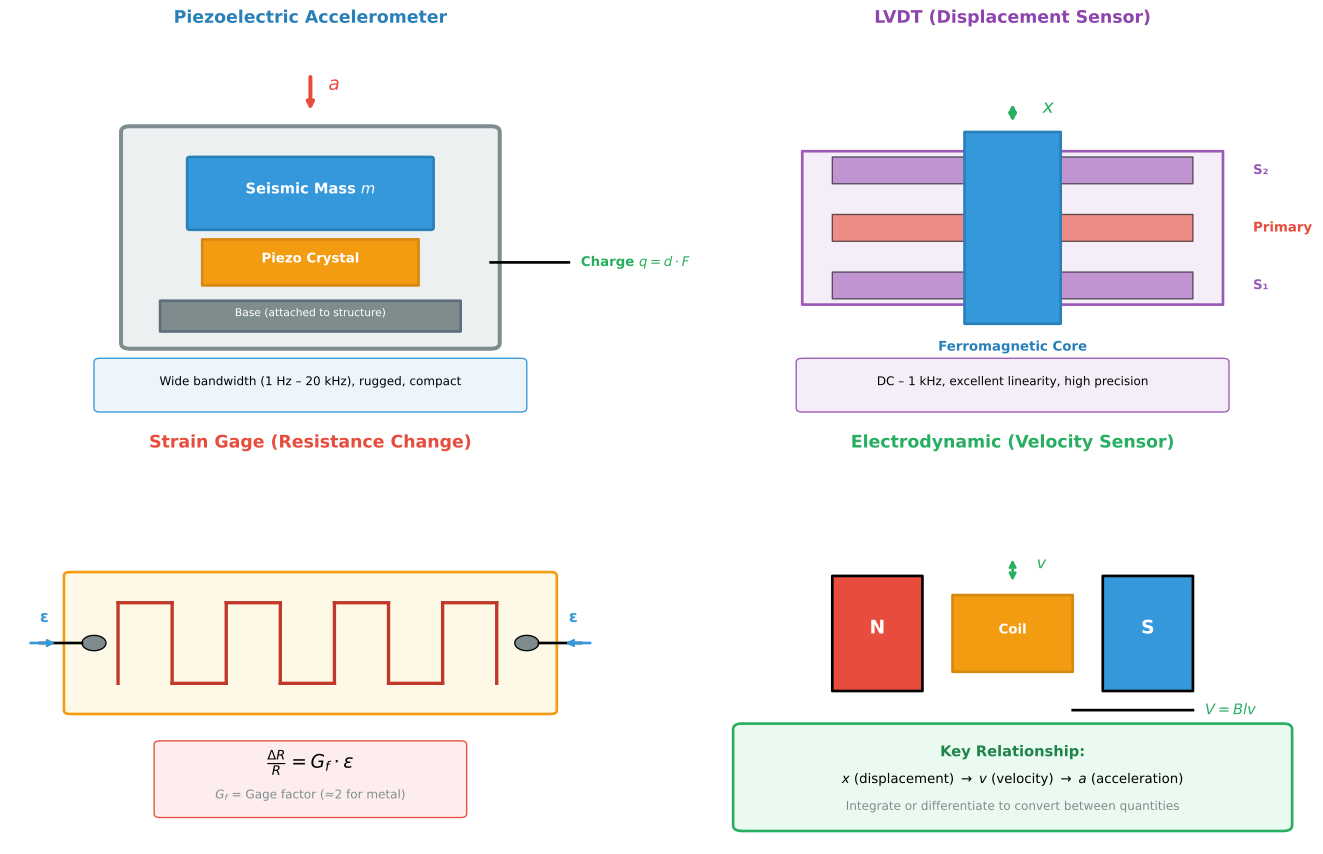
| Transducer Type | Measures | Operating Principle | Best Application |
|---|---|---|---|
| Piezoelectric | Acceleration | Crystal generates charge under stress | General purpose, high frequency |
| LVDT | Displacement | Magnetic coupling in coils | Low frequency, high precision |
| Strain Gage | Strain/Force | Resistance changes with deformation | Force and stress measurement |
| Electrodynamic | Velocity | Conductor moving in magnetic field | Seismology, geophone applications |
Why Acceleration is Preferred
While displacement and velocity can be measured directly, accelerometers dominate modern practice because:
- Compact, rugged, and wide frequency range
- Easy to integrate signal to get velocity/displacement
- Directly proportional to dynamic force ($F = ma$)
The Seismic Instrument: One Design, Two Functions
Most practical vibration sensors are Seismic Instruments. The design is deceptively simple: a mass-spring-damper system mounted inside a casing.
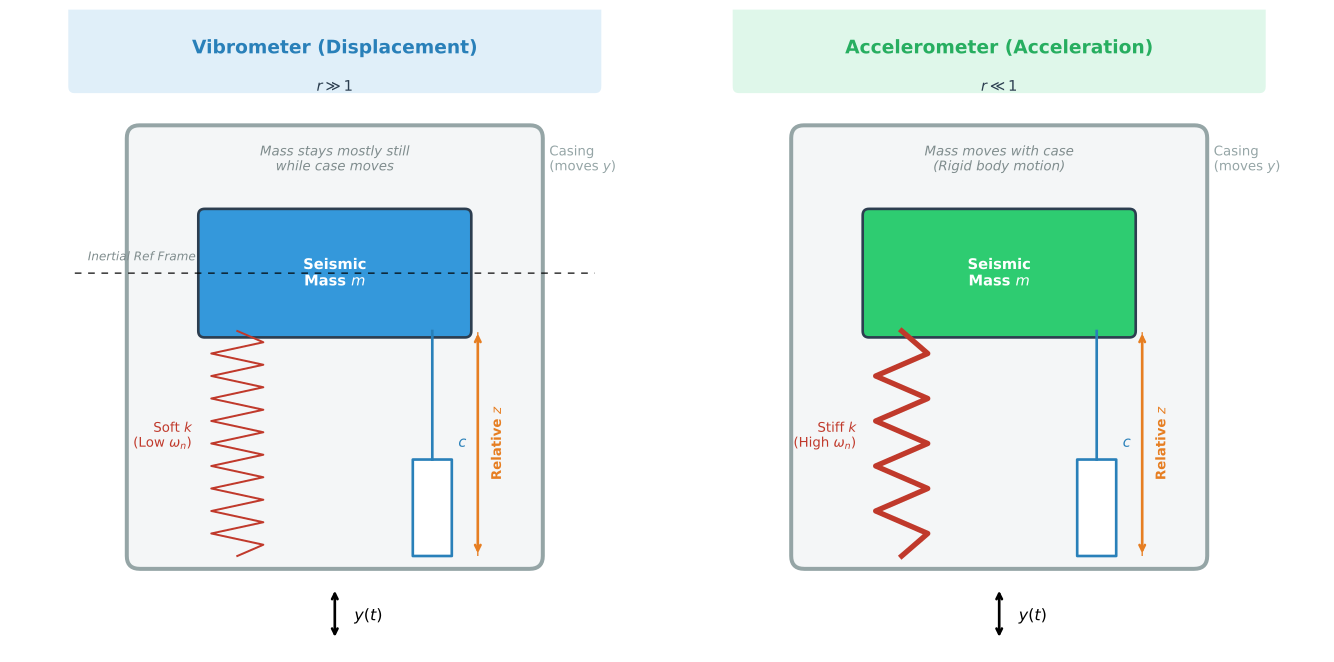
The equation of relative motion $z$ inside the casing is:
$$ m\ddot{z} + c\dot{z} + kz = -m\ddot{y} $$
Depending on the tuning of the natural frequency $\omega_n$, the instrument behaves differently:
| Sensor Type | Design | Condition | Result |
|---|---|---|---|
| Vibrometer | Soft spring (Low $\omega_n$) | $r \gg 1$ | Mass stays still, measures displacement |
| Accelerometer | Stiff spring (High $\omega_n$) | $r \ll 1$ | Mass follows base, measures acceleration |
The Vibrometer ($r \gg 1$)
With a very soft spring ($\omega_n$ is low), the internal mass has high inertia and essentially remains stationary in space while the casing moves around it.
- Physics: Since the mass doesn’t move ($x_{mass} \approx 0$), the relative motion $z$ inside the casing is simply the negative of the base motion ($z \approx -y$).
- Result: We measure displacement directly.
The Accelerometer ($r \ll 1$)
With a very stiff spring ($\omega_n$ is high), the internal mass moves rigidly with the casing.
- Physics: The mass follows the base motion almost perfectly. The spring must exert a force to accelerate the mass. According to Hooke’s Law ($F=kz$) and Newton’s Law ($F=ma$), the spring deflection $z$ becomes proportional to the acceleration $\ddot{y}$.
- Result: We measure acceleration.
Signal Analysis: From Time to Frequency
The raw signal from a transducer is a Time Domain waveform—a messy, squiggly line that represents total vibration amplitude over time. To make sense of it, we use a Spectrum Analyzer to convert it into the Frequency Domain.
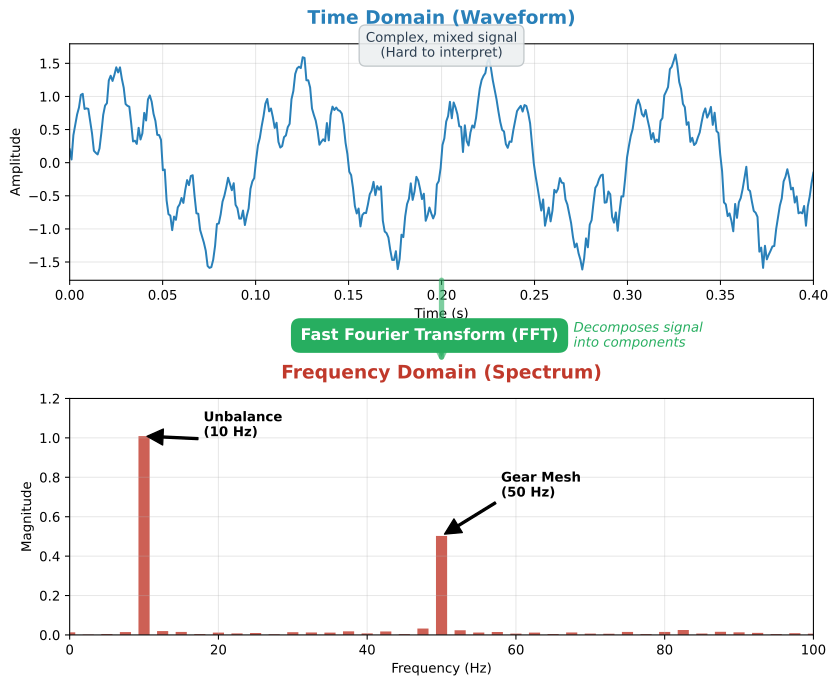
Using the Fast Fourier Transform (FFT), complex signals are broken down into simpler components. Think of it like music: The time domain is the sound of a chord; the frequency domain tells you exactly which musical notes make up that chord.
- Time Domain: Shows how much it is vibrating (Total Amplitude). Good for overall severity checking (e.g., “Is the machine shaking too much?”).
- Frequency Domain (Spectrum): Shows what is vibrating (Specific Frequencies). Good for diagnosis (e.g., “Is it the bearing or the fan blade?”).
For example, a messy noise in the time plot becomes clear peaks in the spectrum:
- A 10 Hz spike match the shaft speed $\rightarrow$ Unbalance.
- A 50 Hz spike matches the gear teeth frequency $\rightarrow$ Gear Mesh.
Experimental Modal Analysis (EMA)
Sometimes we need to determine the natural frequencies and mode shapes from a physical structure experimentally—a process called Modal Testing.
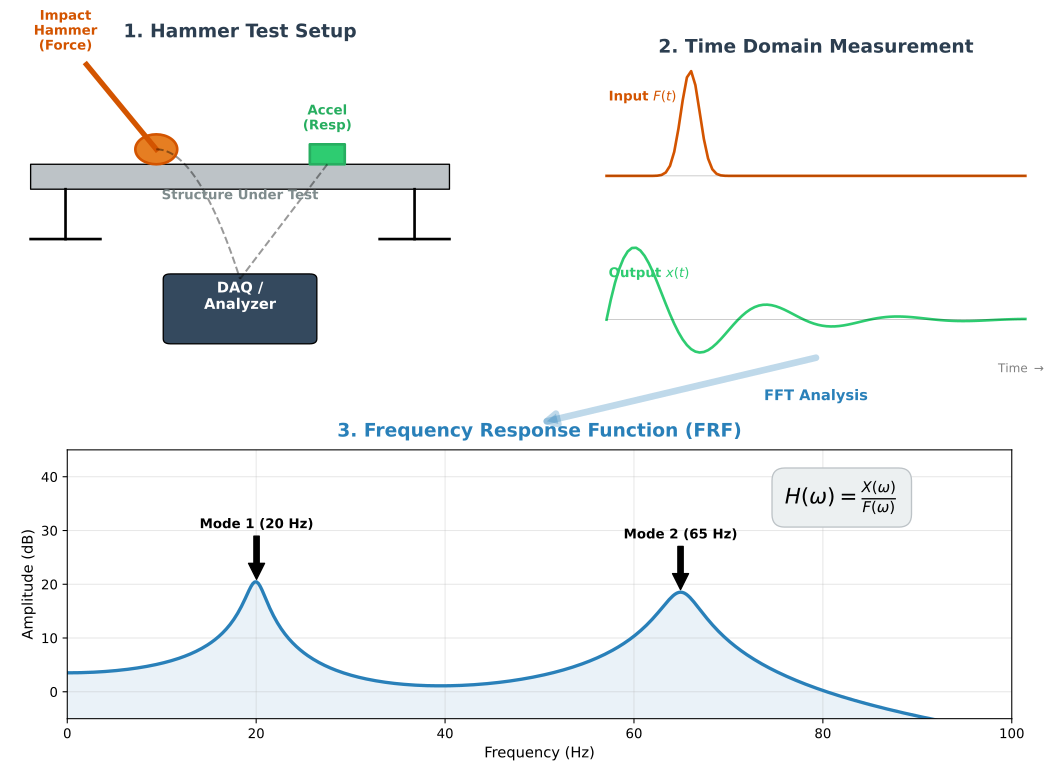
The Hammer Test Process:
- Strike (The Impulse): An instrumented hammer hits the structure.
- Why a hammer? Mathematically, a sharp impact approximation a Dirac Delta function (Impulse). In the frequency domain, an impulse contains all frequencies at once. This means a single tap excites all the natural modes of the structure simultaneously—like ringing a bell.
- Measure (The Response): An accelerometer records how the structure rings down (decaying oscillation).
- Analyze (FRF): The analyzer divides the output response by the input force at every frequency to get the Frequency Response Function (FRF): $$ H(\omega) = \frac{\text{Output } X(\omega)}{\text{Input } F(\omega)} $$
- Result: Peaks in the FRF graph correspond to resonance. These are the structure’s natural frequencies ($\omega_n$). By testing multiple points, we can connect the dots to visualize the mode shapes.
Machine Condition Monitoring
Machines rarely fail without warning. They “talk” to us through vibration. Condition Monitoring is the proactive practice of listening to these signals to predict failures before they happen.
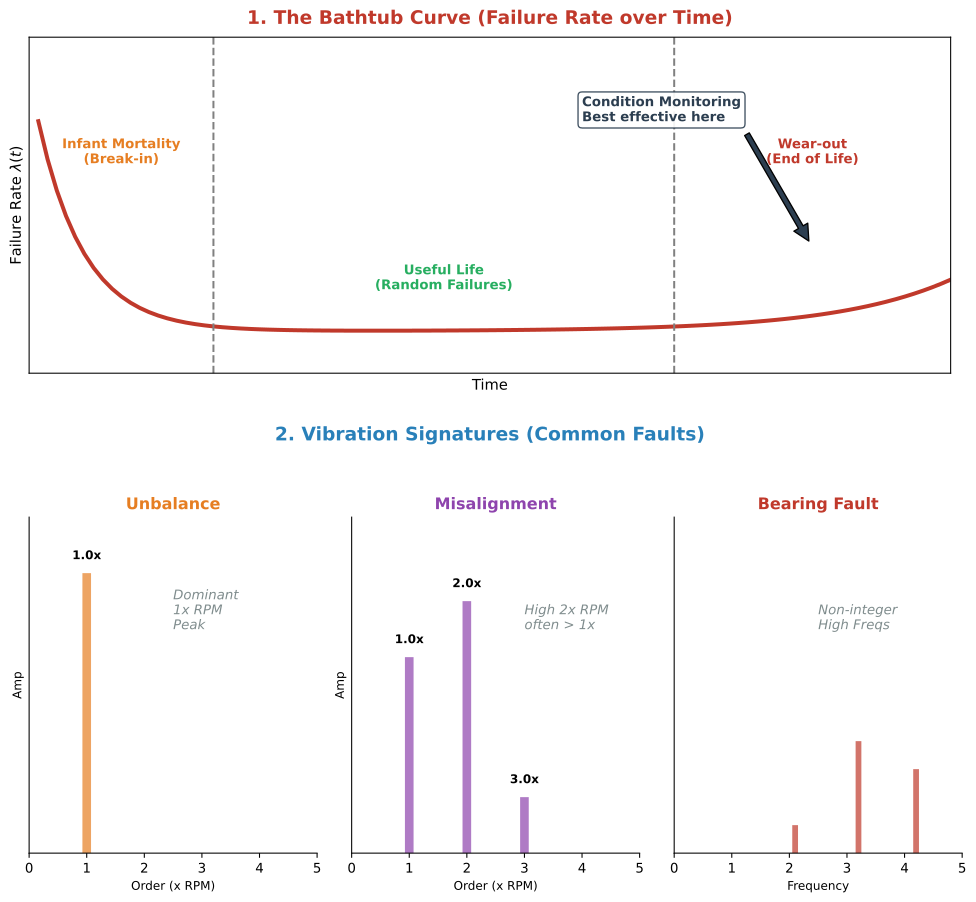
Key Concepts:
- Bathtub Curve: Machinery failure rates typically follow a “bathtub” shape: high during break-in (infant mortality), low/constant during useful life, and rising during wear-out.
- Trend Analysis: By monitoring vibration levels over time, we can detect rising trends that indicate developing faults (e.g., a bearing starting to spall).
Common Diagnosis Signatures:
- Unbalance (1x RPM): A heavy spot on the rotor creates a centrifugal force that pushes outwards once per revolution. This creates a dominant sine wave at the running speed.
- Misalignment (1x & 2x RPM): When shafts aren’t straight, they “bind” twice per revolution (once at the top, once at the bottom), often creating a strong peak at 2x running speed.
- Bearing Defects (Non-integer): As balls roll over a pit in the race, they generate high-frequency clicks. Because the ball geometry ratio is not a whole number, these peaks appear at non-integer multiples (e.g., 3.6x, 5.2x), distinguishing them from normal shaft rotation.
Summary: Theory Meets Reality
We’ve moved from the whiteboard to the test bench. Here’s the toolkit we built:
- Transducers: The bridge between the physical and digital worlds, converting motion ($x, v, a$) into electrical signals.
- Accelerometers: The industry standard. By using a stiff spring ($r \ll 1$), they measure acceleration robustly across a wide frequency range.
- FFT Analysis: The “decoder ring” that turns messy time signals into clear frequency peaks, revealing the root cause of vibration.
- Modal Testing: “Hammering” a structure to experimentally determine its natural frequencies and mode shapes.
- Condition Monitoring: Listening to a machine’s “voice” to predict failures (e.g., bathtub curve, bearing signatures) before they occur.
What’s Next?
What happens when $m\ddot{x} + c\dot{x} + kx = F(t)$ becomes too complex to solve by hand? In MV-11, we enter the world of Computational Dynamics, exploring how to solve vibration problems numerically using Finite Difference and Runge-Kutta methods.
References
Rao, S. S. (2018). Mechanical Vibrations (6th ed.). Pearson.