MV-05: Two-Degree-of-Freedom Systems – Modal Analysis Fundamentals
So far, we have analyzed the world through Single-Degree-of-Freedom (SDOF) systems—modeling cars, buildings, and machines as single masses moving in one direction. While this approach provides valuable insights, reality is often more complex.
A lathe vibrates not just up and down, but also rocks back and forth. An automobile chassis bounces vertically and pitches angularly. To describe these motions, a single coordinate is insufficient—we need at least two independent coordinates. This leads us into the world of Two-Degree-of-Freedom (2-DOF) Systems.
This post, based on Chapter 5 of Rao’s Mechanical Vibrations, explores systems where two masses interact, introduces matrix notation for vibration analysis, and explains why your washing machine might walk across the floor only at specific spin speeds.
The Equations of Motion: Coupled and Complex
Consider a system with two masses, $m_1$ and $m_2$, connected by springs and dampers as shown below. To describe the motion completely, we need two independent coordinates: $x_1(t)$ and $x_2(t)$. This is a 2-DOF system.
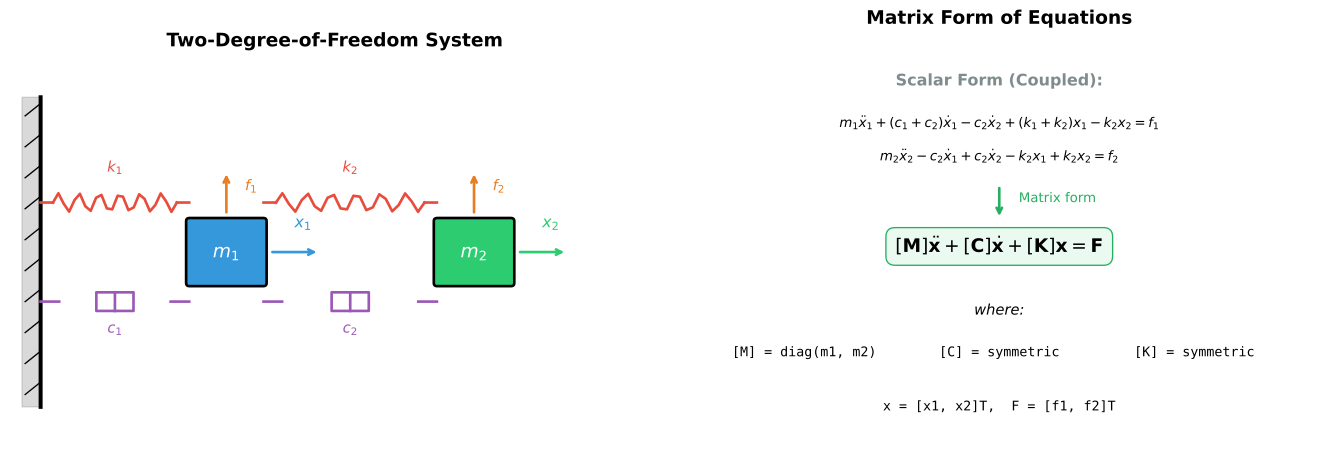
Applying Newton’s second law to each mass and carefully accounting for all spring and damper forces yields two equations:
$$ m_1\ddot{x}_1 + (c_1+c_2)\dot{x}_1 - c_2\dot{x}_2 + (k_1+k_2)x_1 - k_2x_2 = f_1 $$ $$ m_2\ddot{x}_2 - c_2\dot{x}_1 + c_2\dot{x}_2 - k_2x_1 + k_2x_2 = f_2 $$
Notice the problem: the equation for $m_1$ contains terms involving $x_2$ and $\dot{x}_2$ (the terms $-k_2x_2$ and $-c_2\dot{x}_2$). Similarly, the equation for $m_2$ contains $x_1$ and $\dot{x}_1$. The masses are dynamically coupled—you cannot solve one equation without knowing the solution to the other.
Matrix Notation
Writing out scalar equations quickly becomes unwieldy as the number of DOFs increases. Instead, we express the system in matrix form:
$$ [\mathbf{M}]\ddot{\mathbf{x}} + [\mathbf{C}]\dot{\mathbf{x}} + [\mathbf{K}]\mathbf{x} = \mathbf{F} $$
where:
- $[\mathbf{M}]$ is the mass matrix (usually diagonal for lumped-mass systems)
- $[\mathbf{C}]$ is the damping matrix (often symmetric)
- $[\mathbf{K}]$ is the stiffness matrix (symmetric for conservative systems)
- $\mathbf{x}$, $\mathbf{F}$ are displacement and force vectors
This compact notation scales naturally from 2-DOF to systems with hundreds or thousands of degrees of freedom—the mathematical foundation of finite element analysis (FEA).
Free Vibration: Two Natural Frequencies
With external forces removed ($\mathbf{F}=0$) and no damping, how does the system vibrate naturally?
Unlike an SDOF system with one natural frequency, a 2-DOF system has two natural frequencies ($\omega_1$ and $\omega_2$). To find them, we assume harmonic motion $\mathbf{x} = \boldsymbol{\phi}e^{i\omega t}$ and substitute into the equation of motion. This leads to an eigenvalue problem:
$$ ([\mathbf{K}] - \omega^2[\mathbf{M}])\boldsymbol{\phi} = \mathbf{0} $$
For non-trivial solutions, the determinant must vanish:
$$ \det([\mathbf{K}] - \omega^2[\mathbf{M}]) = 0 $$
This characteristic equation is a polynomial in $\omega^2$ with degree equal to the number of DOFs. For a 2-DOF system, it yields two natural frequencies.
Mode Shapes
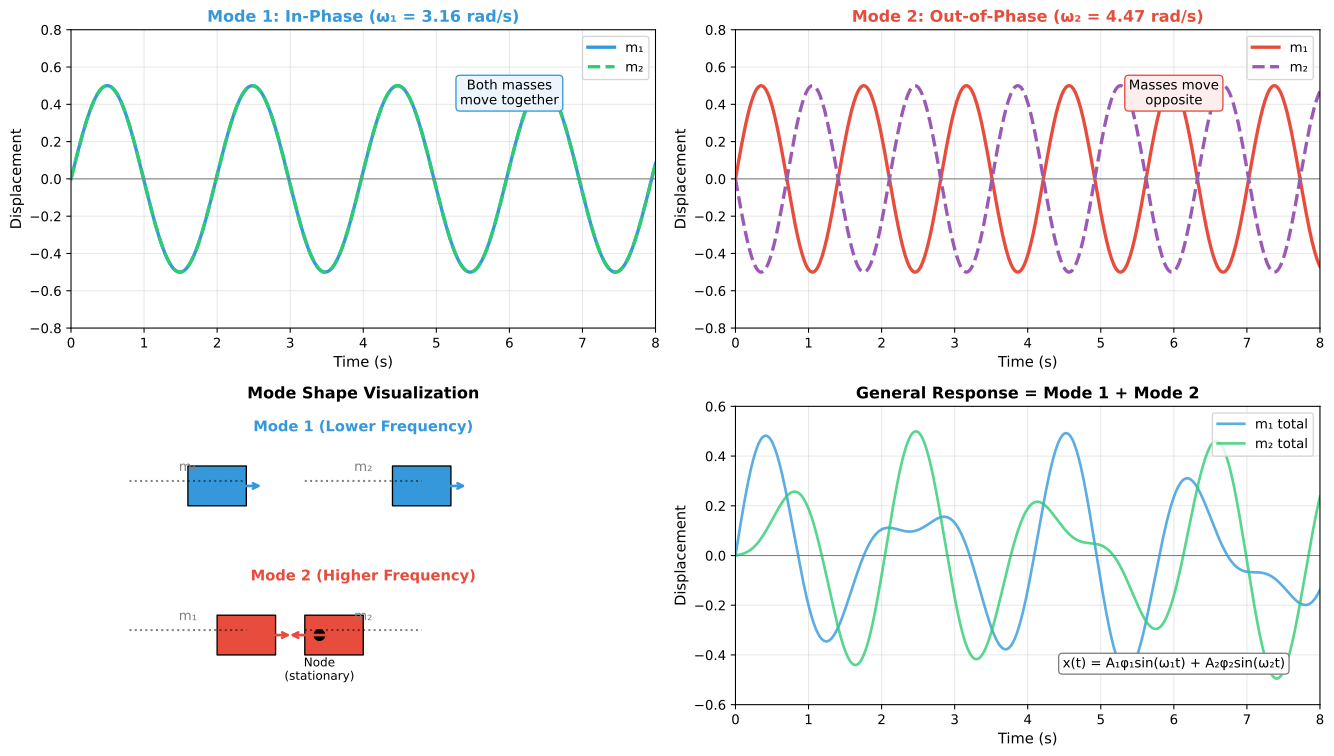
Associated with each natural frequency is a mode shape (or eigenvector) $\boldsymbol{\phi}$ describing the relative motion of the masses. The mode shape tells us how the system vibrates at that frequency—not how much, but in what pattern.
| Mode | Frequency | Motion | Physical Interpretation |
|---|---|---|---|
| 1st | $\omega_1$ (lower) | In-phase | Masses move together; middle spring barely compressed |
| 2nd | $\omega_2$ (higher) | Out-of-phase | Masses move opposite; middle spring heavily stressed |
The first mode has the lower frequency because less strain energy is stored in the springs—the masses move together, so the coupling spring between them experiences minimal deformation. The second mode has higher frequency because the coupling spring is alternately stretched and compressed, storing more energy.
Superposition Principle: The general free vibration response is a superposition of both modes:
$$ \mathbf{x}(t) = A_1\boldsymbol{\phi}_1\sin(\omega_1 t + \psi_1) + A_2\boldsymbol{\phi}_2\sin(\omega_2 t + \psi_2) $$
The amplitudes $A_1, A_2$ and phases $\psi_1, \psi_2$ are determined by initial conditions.
Coordinate Coupling: Static vs. Dynamic
Why are the equations coupled? The answer lies in our choice of coordinates.
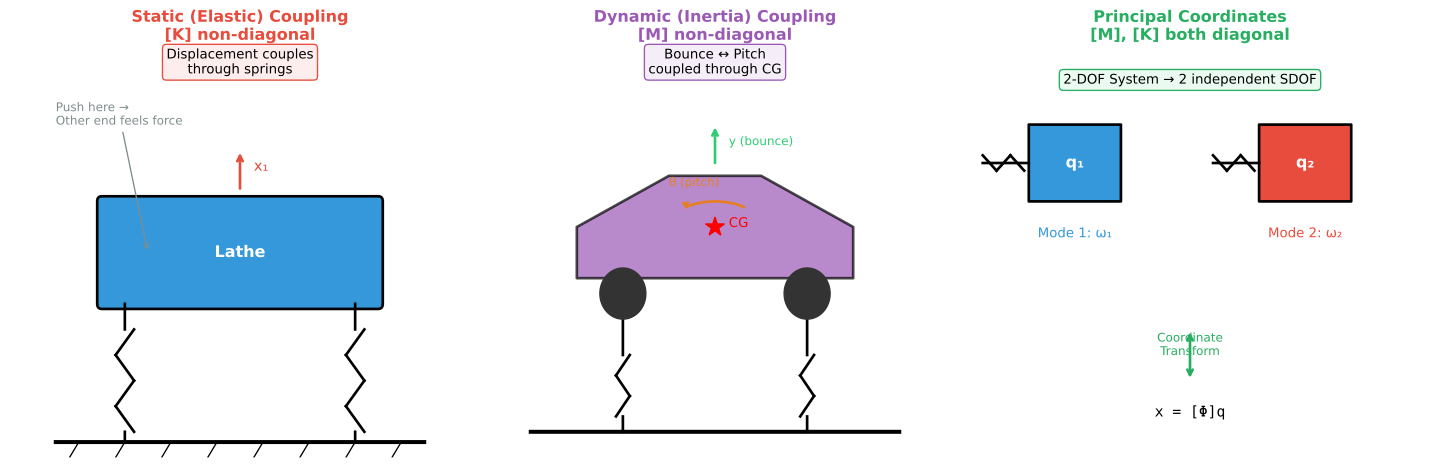
Static (Elastic) Coupling occurs when the stiffness matrix $[\mathbf{K}]$ is non-diagonal. Physically, this means that displacing one mass creates a restoring force on the other—they are connected through elastic elements. Consider a lathe mounted on flexible supports: if you push down on one end, the other end tilts up because the springs are interconnected.
Dynamic (Inertia) Coupling occurs when the mass matrix $[\mathbf{M}]$ is non-diagonal. This happens when coordinates are defined relative to a reference point that doesn’t coincide with the center of mass. For example, in a car, vertical acceleration of the chassis naturally induces rotation (pitch) because the mass is distributed along the length.
| Coupling Type | Matrix Affected | Physical Cause | Example |
|---|---|---|---|
| Static (Elastic) | $[\mathbf{K}]$ non-diagonal | Displacement of one mass creates force on another | Lathe on elastic mounts |
| Dynamic (Inertia) | $[\mathbf{M}]$ non-diagonal | Acceleration couples through mass distribution | Car bounce ↔ pitch motion |
Principal Coordinates
Can we eliminate coupling entirely? Yes—through principal coordinates (also called natural or normal coordinates).
The key insight is that mode shapes are orthogonal with respect to both mass and stiffness matrices. By transforming coordinates using the modal matrix:
$$ \mathbf{x} = [\boldsymbol{\Phi}]\mathbf{q} $$
where $[\boldsymbol{\Phi}]$ contains the mode shapes as columns, both $[\mathbf{M}]$ and $[\mathbf{K}]$ become diagonal. The coupled 2-DOF system splits into two independent SDOF equations—each describing motion in a single mode.
Semidefinite Systems: When Frequency is Zero
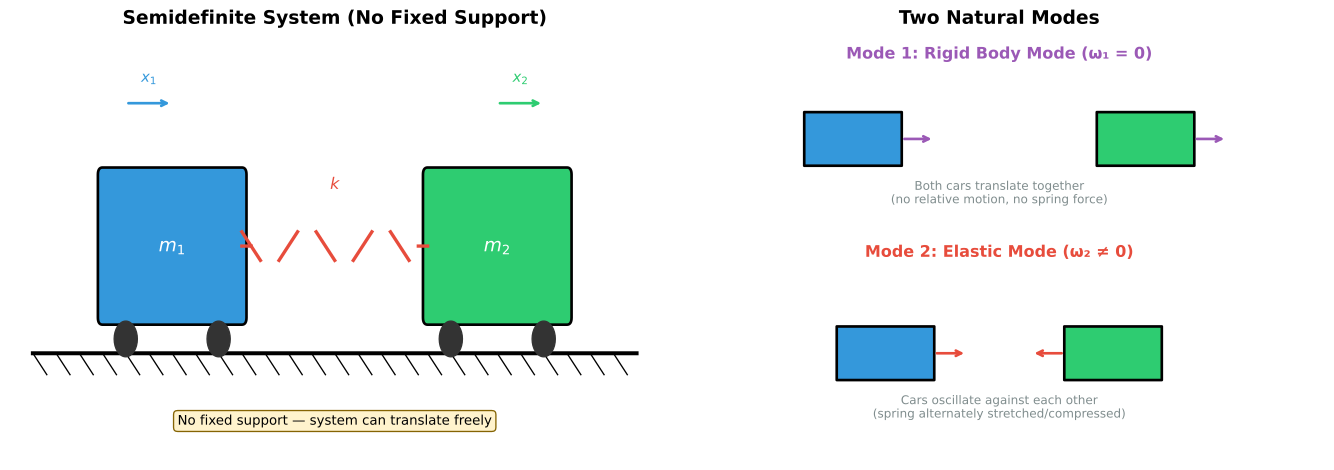
Not all systems are rigidly attached to a fixed frame. Consider two train cars connected by a spring, rolling freely on a track. There’s no wall, no anchor—just two masses and a coupling between them.
For such unrestrained (or semidefinite) systems, the stiffness matrix $[\mathbf{K}]$ is singular, meaning its determinant is zero. This has a profound consequence: one of the natural frequencies is zero.
Physical Interpretation
| Mode | Frequency | Motion | What’s Happening |
|---|---|---|---|
| Rigid Body | $\omega_1 = 0$ | Both masses translate together | No relative motion → no spring force → no restoring force → no oscillation |
| Elastic | $\omega_2 \neq 0$ | Masses oscillate against each other | Spring stretched/compressed → restoring force → vibration |
The rigid body mode represents pure translation of the entire system. Since there’s no external restraint, the center of mass can move freely—this is Newton’s first law in action.
Julia Example: Solving the Eigenvalue Problem
Calculating natural frequencies (eigenvalues) and mode shapes (eigenvectors) by hand is tedious. Julia solves this elegantly using the eigen function from LinearAlgebra.
| |
Output:
| |
The mode shape tells us how much each mass moves relative to the other. In Mode 1, both masses move in the same direction (in-phase). In Mode 2, they move in opposite directions (out-of-phase).
Summary
This post introduced multi-degree-of-freedom systems, laying the groundwork for more complex vibration analysis:
| Concept | Key Takeaway |
|---|---|
| Matrix Notation | Essential for managing coupled equations; scales to any number of DOFs |
| Natural Frequencies | 2-DOF system has two: $\omega_1$ (lower) and $\omega_2$ (higher) |
| Mode Shapes | Describe relative motion pattern at each frequency |
| Coupling Types | Static (stiffness) vs Dynamic (inertia); eliminated by principal coordinates |
| Semidefinite Systems | Zero frequency indicates rigid body mode |
What’s Next?
What happens with 3, 10, or 100 degrees of freedom? In the next post, we generalize to Multi-Degree-of-Freedom (MDOF) Systems, introducing orthogonality conditions and modal analysis techniques.
References
Rao, S. S. (2018). Mechanical Vibrations (6th ed.). Pearson.