Acoustics-05: Absorption II – Micro-Perforated Panels
In Part 4, we saw how porous materials—foam, glass wool, heavy curtains—absorb sound through viscous friction in their fiber maze. It works, but comes with serious baggage: fibers shed, materials burn, and maintenance is a nightmare. You wouldn’t line a jet engine nacelle with foam, nor drape curtains in a hospital operating room.
For decades, engineers searched for a “clean” absorber—something durable like metal but absorbent like a sponge.
The breakthrough came in the 1970s with a theory that turned conventional wisdom on its head: you don’t need fibers to absorb sound—you just need very small holes. This installment explores the Micro-Perforated Panel (MPP)—a design that transforms a sheet of metal or plastic into a powerful, fiber-free sound absorber.
The Theory Gap: Between Capillaries and Tubes
Before MPP theory, acoustics textbooks covered two extremes:
- Rayleigh’s Theory: We understood wide tubes (where viscosity is negligible).
- Crandall’s Theory: We understood microscopic capillaries (where viscosity dominates).
flowchart LR
    A["Wide Tubes
(low friction)"] ---|"Gap"| B["MPP Regime
d = 0.1 ~ 1 mm"]
    B ---|"Gap"| C["Capillaries
(high friction)"]
    style B fill:#27AE60,color:#fff
But what happens in between? Holes that are small (sub-millimeter), but not microscopic? This intermediate regime was poorly understood—until a theoretical bridge was built in the 1970s.
The key insight: when hole diameter drops below 1 mm, viscous friction becomes significant without completely choking the flow. The hole starts acting less like a window and more like a resistor.
The Mechanism: How a Hole Becomes a Sponge
Usually, if you drill a hole in a metal sheet, sound passes right through. It acts as a “mass” but has very little “resistance.”
Modern MPP theory revealed that as the hole gets smaller, the “viscous boundary layer” of the air (the layer that sticks to the wall) begins to fill the entire cross-section of the hole.
- High Acoustic Resistance: When sound waves try to squeeze through these sub-millimeter holes, the friction against the hole walls becomes immense. The metal plate itself acts like a piece of dense fabric.
- The “Micro” Definition: For air, this effect kicks in when the hole diameter is between 0.05 mm and 1 mm.
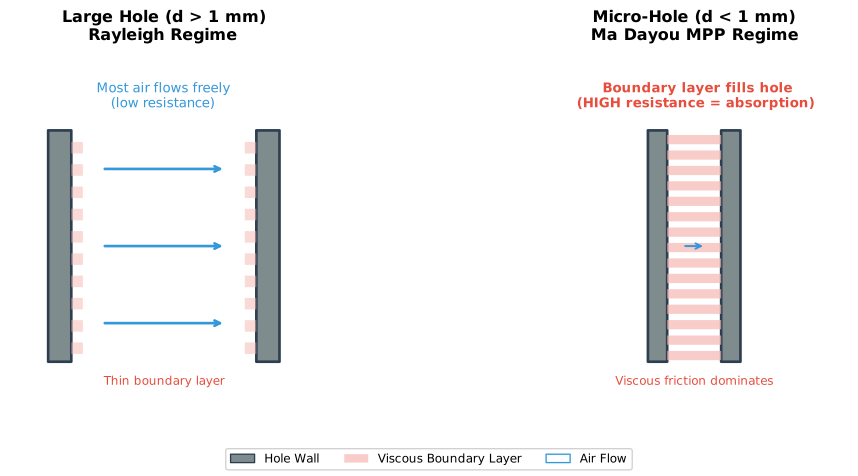
This means we don’t need fiber behind the panel. The panel is the absorber.
The MPP Structure: A Trap of Air
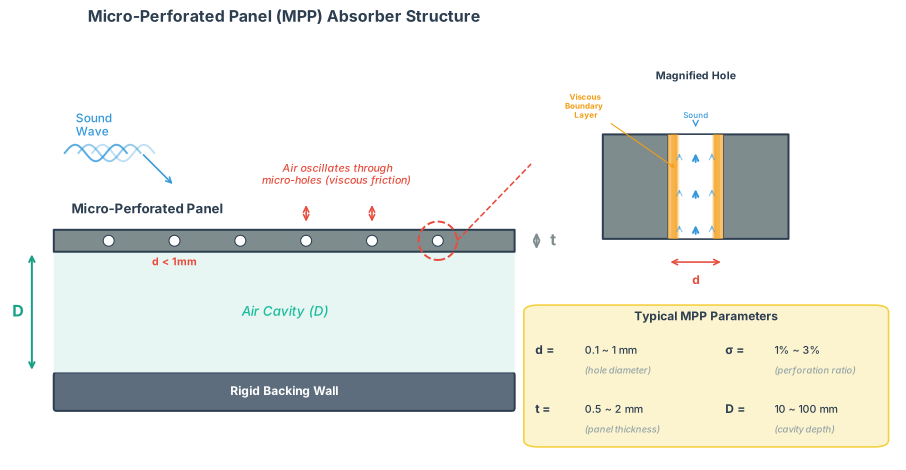
A Micro-Perforated Panel absorber is deceptively simple. It consists of two parts:
- The Panel: A thin sheet (usually metal or plastic) with thousands of tiny holes (diameter < 1mm). The perforation ratio (the percentage of the surface that is holes) is usually very low, often between 1% and 3%.
- The Cavity: An air gap behind the panel, backed by a rigid wall.
The Circuit Analogy
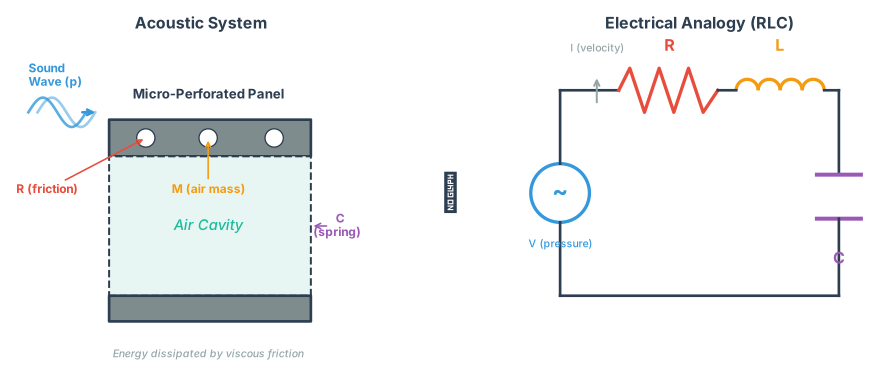
Using the electro-acoustic analogy (discussed in previous posts), the MPP acts like a Resistor-Inductor-Capacitor (RLC) circuit:
- The Holes provide Resistance ($R$, friction) and Mass ($M$, inertia).
- The Air Cavity acts as a Spring (Compliance or Capacitance, $C$).
When the sound wave hits the panel, the air in the cavity “bounces” against the air plugs in the tiny holes. The friction in the holes dissipates the energy.
The acoustic impedance of an MPP (normalized to air) can be approximated as:
$$ Z_{MPP} = \frac{32 \mu t}{\sigma \rho c d^2} \left(1 + \frac{x^2}{32}\right)^{1/2} + j \frac{\omega t}{\sigma c} \left(1 + \frac{1}{\sqrt{9 + x^2/2}}\right) $$
where $x = d\sqrt{\omega \rho / 4\mu}$ is the perforate constant, $d$ is hole diameter, $t$ is panel thickness, and $\sigma$ is porosity.
By carefully choosing these parameters, engineers can tune the impedance to match air ($Z = 1$), creating a “broadband” absorber that sucks in sound without reflecting it.
Why MPP is a Game Changer
The engineering advantages that make MPP superior to traditional materials include:
- Clean and Durable: Because it is made of metal, glass, or plastic, it releases no fibers. It is perfect for hospitals, electronics factories, and food processing plants where dust is unacceptable.
- Extreme Environments: MPPs can withstand high temperatures, high humidity, and high-speed airflow. They are used in aircraft engine liners and industrial exhaust stacks where foam would melt or blow away.
- Tunable: Unlike foam, which has fixed properties, an MPP can be mathematically designed to target specific noise frequencies.
- Broadband Performance: While a single panel absorbs a specific range, using a Double-Layer MPP (two panels with two air gaps) can create a “super absorber” that covers a massive frequency range, functioning effectively across two to three octaves.
A Calculation Example
To give you a sense of scale, here is the step-by-step calculation for a typical MPP absorber designed for 500 Hz:
The Parameters
- $d$ (Hole Diameter): 1 mm ($0.001$ m)
- $t$ (Panel Thickness): 2 mm ($0.002$ m)
- $\sigma$ (Porosity): 1% ($0.01$)
- $D$ (Cavity Depth): 48 mm ($0.048$ m)
- Target Frequency ($f$): 500 Hz
The Constants
First, we calculate the angular frequency and the key “perforate constant” ($x$), which determines if the flow is viscous or inertial.
- Air Properties: Density $\rho = 1.21$ kg/m³, Viscosity $\mu = 1.81 \times 10^{-5}$ Pa·s, Speed of Sound $c = 343$ m/s.
- Angular Frequency: $\omega = 2\pi f = 1000\pi \approx 3141.6$ rad/s.
- Perforate Constant ($x$): $$ x = d \sqrt{\frac{\omega \rho}{4\mu}} = 0.001 \sqrt{\frac{3141.6 \times 1.21}{4 \times 1.81 \times 10^{-5}}} \approx 7.25 $$
The Acoustic Impedance
Now we plug these into Ma Dayou’s impedance formula.
Resistive Part ($r$ - Friction): $$ r = \frac{32 \mu t}{\sigma \rho c d^2} \sqrt{1 + \frac{x^2}{32}} \approx 0.279 \times \sqrt{1 + 1.64} \approx \mathbf{0.45} $$
Reactive Part ($m$ - Mass Inertia): $$ m = \frac{\omega t}{\sigma c} \left(1 + \frac{1}{\sqrt{9 + x^2/2}}\right) \approx 1.83 \times 1.17 \approx \mathbf{2.14} $$
Cavity Reactance (Spring): The air cavity acts as a “spring” with negative reactance. $$ \cot\left(\frac{\omega D}{c}\right) = \cot\left(\frac{3141.6 \times 0.048}{343}\right) \approx \cot(0.44 \text{ rad}) \approx \mathbf{2.12} $$
The Result
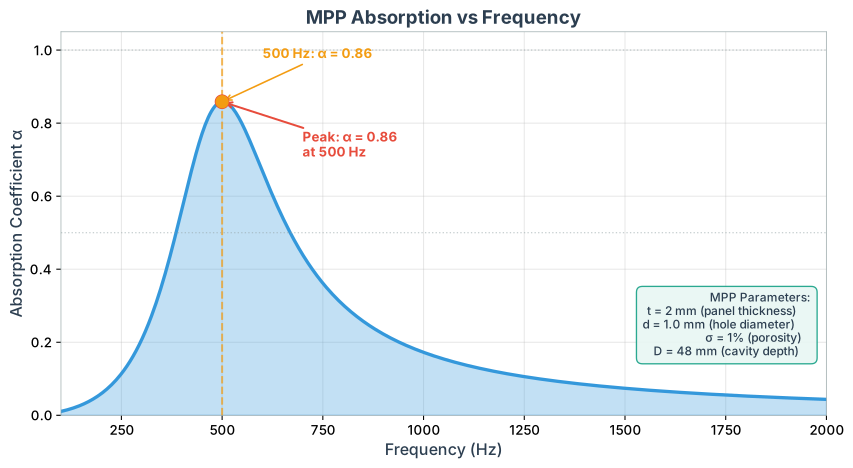
At resonance, the mass reactance ($2.14$) and cavity reactance ($-2.12$) almost cancel out, leaving just the resistance.
$$ \alpha = \frac{4r}{(1+r)^2 + (m - \cot(\dots))^2} \approx \frac{4(0.45)}{(1.45)^2 + (0.02)^2} \approx \frac{1.80}{2.10} \approx \mathbf{0.86} $$
Conclusion: At 500 Hz, this simple metal sheet with 1% holes absorbs 86% of the sound energy hitting it. By adjusting the cavity depth $D$ or porosity $\sigma$, we can tune this peak to any frequency we want.
What’s Next?
We have mastered the art of absorbing sound using porous fibers, resonators, and now, micro-holes. But sometimes, we don’t want to absorb sound; we want to block it. We want to keep the street noise out of our bedroom or the engine noise out of the cabin.
In the next installment, “Insulation – Mass Law and Double Walls,” we will explore the physics of Sound Insulation. We will learn why heavy walls work better than light ones, and why a double-pane window is the ultimate sound barrier.
References:
- He Lin et al., Theoretical Acoustics and Engineering Applications, Science Press, 2006.
- Ma Dayou, Modern Acoustics Theory Basis, Science Press, 2004.