Acoustics-02: Perception – Decibels, Loudness, and A-Weighting
In Part 1, we established that sound is a physical disturbance—a matter wave governed by the laws of fluid mechanics. However, measuring the physical pressure of a sound wave ($p$) doesn’t tell the whole story of how we experience it.
Why do we measure sound in “decibels” (dB) instead of Pascals? Why is 60 dB plus 60 dB not equal to 120 dB? And why do engineers use a specific “A-weighted” scale for noise control?
In this installment, we bridge the gap between objective physics and subjective human perception, exploring the logarithmic nature of hearing and the engineering tools used to quantify it.
The Decibel: Taming the Range of Hearing
The human ear is an instrument of terrifying sensitivity and range. We can detect a mosquito buzzing in a quiet room and withstand the roar of a jet engine.
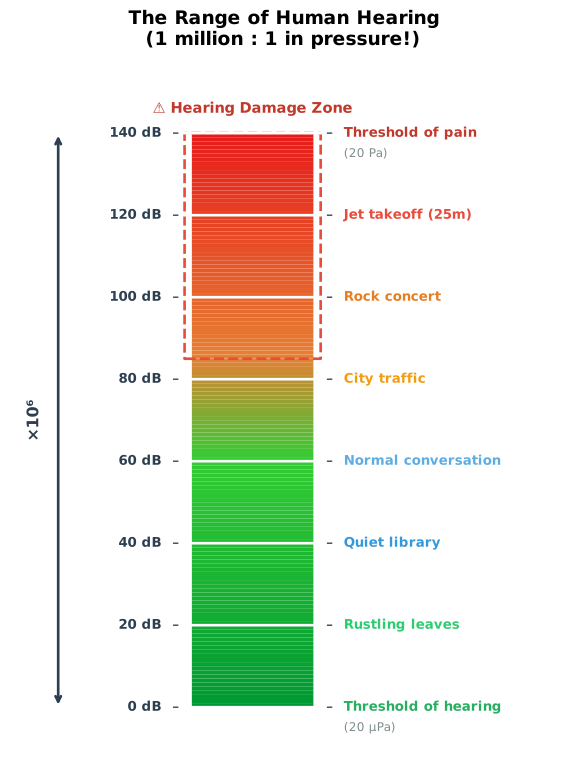
If we measured this in linear units of pressure (Pascals), the range would be unmanageable. The threshold of hearing is approximately $20 \mu Pa$ ($0.00002 \text{ Pa}$), while the threshold of pain is around $20 \text{ Pa}$—a difference of one million times. To manage these astronomical numbers, acousticians use a logarithmic scale: the decibel (dB).
The Definition
The decibel is not an absolute unit like a meter or a kilogram; it is a ratio. In fundamental acoustics, the Sound Pressure Level ($L_p$) is defined based on sound energy. Since acoustic intensity (power per unit area) is proportional to the square of the sound pressure ($I \propto p^2$), the formula uses a factor of 20 (which is $10 \times 2$) instead of 10:
$$ L_p = 10 \log_{10} \left( \frac{p^2}{p_0^2} \right) = 20 \log_{10} \left( \frac{p}{p_0} \right) $$
Where:
- $p$ is the effective sound pressure you are measuring.
- $p_0$ is the reference pressure, standardized at $20 \mu Pa$ (the limit of human hearing sensitivity).
This means that $0 \text{ dB}$ is not the absence of sound; it simply means the sound pressure is equal to the reference pressure ($20 \log 1 = 0$). Conversely, a sound pressure level of $140 \text{ dB}$ represents a jet engine at 25 meters—a potentially damaging physical force.
The Math of Noise: Why 60 + 60 = 63
One of the most confusing aspects of acoustics for beginners is that decibels do not add up linearly. If you have one machine making 60 dB of noise and you turn on a second identical machine, the total noise is 63 dB, not 120 dB.
This occurs because sound sources in a typical noise environment are incoherent. When sound waves are incoherent (having random phase differences), their superposition is based on the addition of their energies (or mean square pressures), not their linear pressures.
To add two sound levels, you must convert them back to power ratios, add them, and convert back to logs. The exact formula is:
$$ L_{total} = 10 \log_{10} \left( 10^{\frac{L_1}{10}} + 10^{\frac{L_2}{10}} + \dots \right) $$
For quick estimations, a simplified look-up method is often used:
flowchart LR
    A["L₁ = 60 dB"] --> C["Convert to power"]
    B["L₂ = 60 dB"] --> C
    C --> D["Add powers"]
    D --> E["Convert back to dB"]
    E --> F["L_total = 63 dB"]
| Difference between sources | Add to higher level |
|---|---|
| 0 dB (equal) | +3 dB |
| 1 dB | +2.5 dB |
| 3 dB | +1.8 dB |
| 10 dB | +0.4 dB |
| >15 dB | +0 dB (negligible) |
This principle is crucial for noise control: if a factory has a dominant noise source of 90 dB and a secondary source of 80 dB, silencing the 80 dB source will have almost no effect on the total noise level.
Subjective Perception: Loudness and Pitch
Physical magnitude does not equal subjective sensation. The human ear is not a flat-response microphone; it is a biological sensor with complex non-linearities.
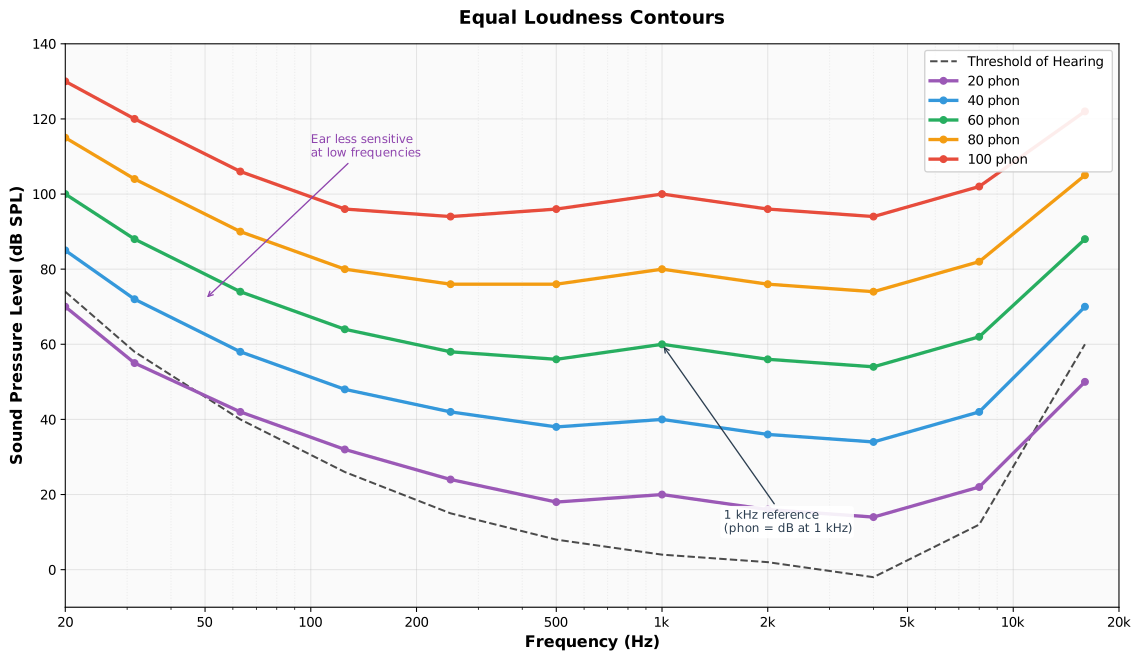
- Loudness vs. Intensity: A 100 Hz tone and a 1000 Hz tone played at the same physical intensity will not sound equally loud. The ear is much less sensitive to low frequencies. Subjective loudness is a psychological quantity, distinct from the objective physical quantity of sound intensity.
- Pitch vs. Frequency: Similarly, “pitch” is the subjective attribute corresponding to the physical “frequency.” While closely related, the human perception of pitch can be influenced by loudness and other factors.
To standardize this, acousticians use Equal Loudness Contours (also known as Fletcher-Munson curves). These curves map out the sound pressure levels required at different frequencies for a sound to be perceived as equally loud as a standard 1000 Hz tone.
The unit for this subjective loudness level is the phon. By definition, a sound has a loudness of $X$ phons if it is perceived to be equally loud as a $X$ dB SPL tone at 1 kHz.
Engineering the Ear: A-Weighting
Because the ear discriminates against low frequencies, a raw physical measurement (linear dB) often fails to represent how annoying a noise actually is. To solve this, engineers apply a filter to sound level meters that mimics the ear’s frequency response. This is called A-weighting.
Standard engineering practice uses A-weighting to apply a significant correction (attenuation) to low frequencies.
Why this shape? The A-weighting curve is essentially the inverse of the 40-phon equal loudness contour. It mimics the human ear’s reduced sensitivity to low frequencies at moderate sound levels.
- At 63 Hz, the A-weighting subtracts -26.2 dB.
- At 1000 Hz, the correction is 0 dB.
- At 2000 Hz, it adds a slight boost of +1.2 dB.

The resulting measurement is expressed as dB(A). This unit is the standard for environmental noise assessment because it correlates well with the human perception of noisiness and the potential for hearing damage.
Hearing Damage Exposure Limits
The relationship between exposure level and safe duration is critical. OSHA and NIOSH provide guidelines:
| Sound Level (dBA) | Example | Max Safe Exposure (per day) |
|---|---|---|
| 85 | City traffic | 8 hours |
| 88 | Loud restaurant | 4 hours |
| 91 | Motorcycle | 2 hours |
| 94 | Power tools | 1 hour |
| 100 | Nightclub | 15 minutes |
| 110 | Rock concert | ~1 minute |
| 120+ | Jet engine | Immediate damage risk |
What’s Next?
We have defined the wave physically (Part 1) and explored how we measure and perceive it (Part 2). But sound does not stay still. It bounces, bends, and flows.
In the next post, “The Journey of a Wave: Reflection, Refraction, and Ducts,” we will explore how sound behaves when it hits a wall or travels through a pipe, examining the boundary conditions that dictate the behavior of sound in confined spaces.
References:
- Ma Dayou, Modern Acoustics Theory Basis, Science Press, 2004.
- He Lin et al., Theoretical Acoustics and Engineering Applications, Science Press, 2006.