Similitude Analysis and Scaling Laws in Elastic Waves and Acoustic Metamaterials
Introduction
Full-scale experiments in structural dynamics and acoustics are often prohibitively expensive, logistically complex, or simply infeasible. Consequently, laboratory testing of scaled models and numerical simulation at reduced dimensions constitute standard practice across disciplines—from naval architecture to seismic metamaterial development. A fundamental question arises: under what conditions can results obtained at one scale be extrapolated to another?
Similitude analysis provides the rigorous framework to address this question. By identifying governing dimensionless parameters and enforcing their equivalence across scales, one ensures that essential physics is preserved during scale transformation. This methodology underpins wind tunnel testing, wave tank experiments, laboratory metamaterial demonstrations, and interpretation of parametric numerical studies.
For wave-based systems—where wavelength, frequency, geometry, and material properties are tightly coupled—scaling is not merely convenient but necessary for valid experimental inference. The following sections establish the theoretical foundations, derive explicit scaling laws for acoustic and flexural waves, and examine their application to metamaterial systems.
Theoretical Framework
Definitions and Nomenclature
In engineering practice, the full-scale system is termed the prototype, while the laboratory version is the model. Similitude is the condition under which the model accurately predicts prototype performance—requiring physical, not merely visual, equivalence.
Two systems are similar if their governing equations reduce to identical dimensionless form with matching parameter values.
Hierarchy of Similarity Conditions
Similitude is typically discussed in terms of three progressively restrictive levels:
flowchart TB
    subgraph Dynamic["Dynamic Similarity"]
        direction TB
        D1["Force ratios identical"]
        D2["Dimensionless groups matched"]
    end
    subgraph Kinematic["Kinematic Similarity"]
        direction TB
        K1["Velocity fields proportional"]
        K2["Time scaling consistent"]
    end
    subgraph Geometric["Geometric Similarity"]
        direction TB
        G1["All lengths scale by α"]
    end

    Geometric --> Kinematic --> Dynamic

    style Geometric fill:#3498db,stroke:#2980b9,color:#fff
    style Kinematic fill:#27ae60,stroke:#1e8449,color:#fff
    style Dynamic fill:#e74c3c,stroke:#c0392b,color:#fff
Geometric Similarity requires that all linear dimensions scale by a constant factor:
$$ \mathbf{x}’ = \alpha \mathbf{x} $$
where $ \alpha $ denotes the geometric scaling factor. In elastic and acoustic systems, this encompasses thickness, lattice constants, cavity dimensions, and boundary curvature.
Kinematic Similarity concerns the scaling of motion-related quantities—displacement, velocity, and time. For wave phenomena, this implies that normalized mode shapes and wavefields remain identical when expressed in scaled coordinates.
Dynamic Similarity is the most physically meaningful condition. It requires that the ratios of all forces governing the system are identical across scales, which in practice demands matching of all relevant dimensionless parameters. For elastic waves, dynamic similarity ensures invariance of dispersion relations, band gaps, attenuation characteristics, and resonance phenomena under scaling.
While geometric similarity is a prerequisite, it is not sufficient for physical equivalence. Dynamic similarity—requiring equal dimensionless groups—is the operative criterion.
Dimensional Analysis and Dimensionless Groups
With the similarity hierarchy established, we now identify the specific dimensionless parameters that govern wave phenomena.
The Buckingham Pi Theorem
The foundation of similitude analysis lies in dimensional analysis. According to the Buckingham $ \pi $ theorem, a physical problem described by $ n $ dimensional variables involving $ k $ fundamental dimensions can be reformulated using $ (n - k) $ independent dimensionless groups.
In wave-related problems, typical dimensional variables include:
| Symbol | Quantity | Dimension |
|---|---|---|
| $ L $ | Characteristic length | [L] |
| $ t $ | Time | [T] |
| $ \rho $ | Mass density | [M L⁻³] |
| $ E, G $ | Elastic moduli | [M L⁻¹ T⁻²] |
| $ c $ | Wave velocity | [L T⁻¹] |
| $ \omega $ | Angular frequency | [T⁻¹] |
Recasting governing equations in dimensionless form reveals which parameters control system behavior independent of absolute scale.
Key Dimensionless Numbers in Wave Physics
Several dimensionless parameters appear frequently in elastic wave and acoustic problems:
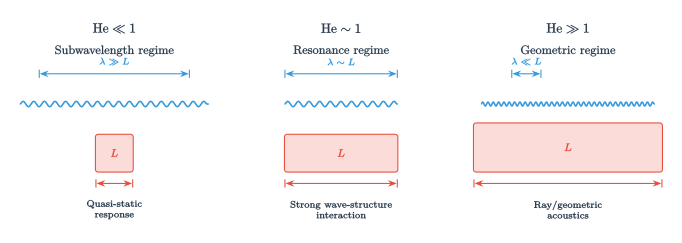
Helmholtz Number
$$ \mathrm{He} = \frac{\omega L}{c} $$
This quantity compares the characteristic length to the acoustic wavelength, governing resonance, scattering efficiency, and radiation impedance in cavities and waveguides.
Normalized Wavenumber
$$ kL $$
Widely employed in dispersion analysis of periodic structures, this parameter determines band structures and Bragg scattering conditions. The first Brillouin zone boundary corresponds to $ kL = \pi $.
Frequency–Thickness Parameter
$$ \Omega = \omega h \sqrt{\frac{\rho}{D}} $$
where $ D = Eh^3 / [12(1-\nu^2)] $ is the flexural rigidity. This parameter governs bending wave behavior in thin plates and shells.
Damping Ratio
$$ \zeta = \frac{c_d}{2\sqrt{km}} $$
While often neglected in idealized models, damping ratios strongly influence attenuation and resonance bandwidth—and critically, they do not scale automatically with geometry.
Derivation of Scaling Laws
Having identified the relevant dimensionless groups, we now derive how physical quantities transform under geometric scaling.
Scaling laws describe how physical quantities must transform when a system is scaled geometrically by a factor $ \alpha $. Assume:
$$ L’ = \alpha L $$
To preserve dynamic similarity in wave problems, dimensionless groups such as $ \omega L / c $ or $ kL $ must remain constant across scales.
Frequency Scaling for Acoustic Waves
For wave propagation in continua:
$$ \frac{\omega’ L’}{c’} = \frac{\omega L}{c} $$
If the material remains unchanged ($ c’ = c $):
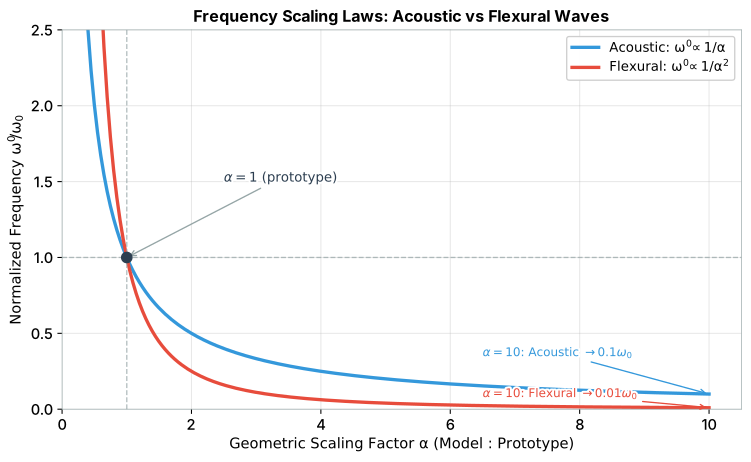
$$ \omega’ = \frac{1}{\alpha} \omega $$
Physical interpretation: Doubling the dimensions of an acoustic structure halves the corresponding eigenfrequencies. Wavelengths scale directly with geometry when wave speed is preserved.
Time Scaling
Consistent with frequency scaling:
$$ t’ = \alpha t $$
This relation ensures identical waveform evolution in the scaled time domain.
Force and Energy Scaling
In elastic systems, forces generically scale as:
$$ F’ = \alpha^2 F $$
for surface-distributed loads, and stored strain energy scales as:
$$ U’ = \alpha^3 U $$
for volumetric deformation. These higher-order scalings must be derived from the specific governing equations of the system under consideration.
Case Study: Flexural Waves in Thin Plates
The preceding analysis assumed non-dispersive wave propagation. Flexural waves in plates provide a contrasting example where dispersion fundamentally alters the scaling behavior.
Consider wave propagation governed by the Kirchhoff–Love plate equation:
$$ D \nabla^4 w + \rho h \frac{\partial^2 w}{\partial t^2} = 0 $$
where $ D = Eh^3 / [12(1-\nu^2)] $ is the bending stiffness, $ h $ is the plate thickness, and $ w $ is the transverse displacement.
The dispersion relation for flexural waves is:
$$ \omega = \sqrt{\frac{D}{\rho h}} , k^2 $$
Now apply geometric scaling $ L \to \alpha L $ (including $ h \to \alpha h $). The wavenumber scales as:
$$ k \sim \frac{1}{L} \to \frac{1}{\alpha L} $$
Substituting into the dispersion relation and noting that $ D \propto h^3 $ yields:
$$ \omega’ = \frac{1}{\alpha^2} \omega $$
Flexural wave frequencies scale with the inverse square of the geometric factor—not linearly as in acoustic propagation. A model scaled down by $ \alpha = 10 $ requires excitation frequencies 100× higher to reproduce equivalent wave behavior.
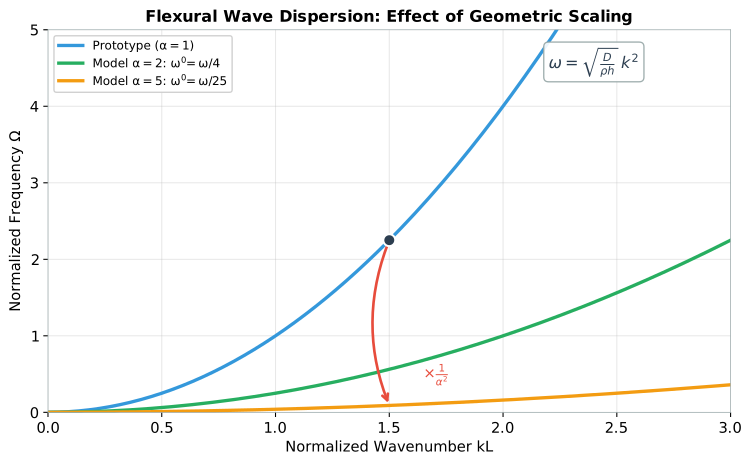
This quadratic scaling is a direct consequence of the dispersive character of bending waves and has profound implications for plate-based metamaterials and vibration isolation systems.
Application to Acoustic and Elastic Metamaterials
Metamaterial systems present unique scaling challenges because their properties arise from subwavelength structuring and local resonance rather than bulk material behavior.
Bragg-Type Metamaterials
For Bragg scattering in periodic structures, the governing condition is:
$$ k a = \pi $$
where $ a $ is the lattice constant. Under geometric scaling with fixed material properties, the band gap frequency transforms as:
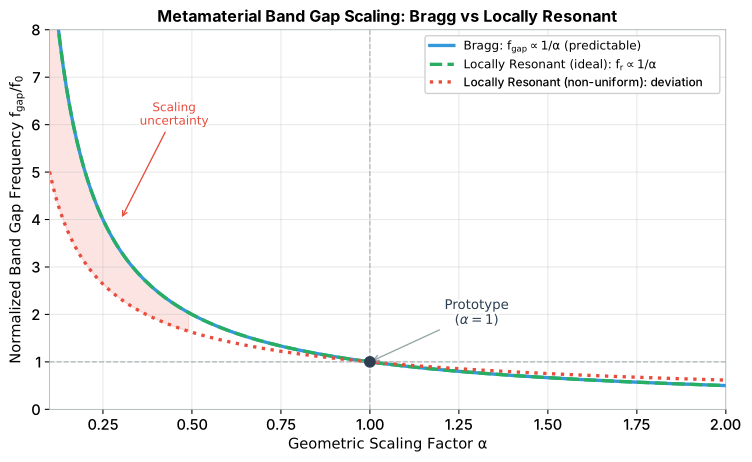
$$ f_{\text{gap}}’ = \frac{1}{\alpha} f_{\text{gap}} $$
This direct scaling relationship makes Bragg-type metamaterials amenable to straightforward similitude analysis.
Locally Resonant Metamaterials
For locally resonant units, the resonance frequency scales as:
$$ \omega_r \sim \sqrt{\frac{k_{\text{eff}}}{m_{\text{eff}}}} $$
When both stiffness and mass scale geometrically ($ k \propto \alpha $, $ m \propto \alpha^3 $), the resonance frequency follows:
$$ \omega_r’ \sim \frac{1}{\alpha} \omega_r $$
However, if the resonator geometry is scaled non-uniformly or if material properties cannot be preserved, the resonance-based band gap may shift unpredictably or disappear entirely. This constitutes a significant practical constraint in metamaterial design.
Implications for Numerical Simulation
Scaling laws permit efficient parametric studies through:
- Domain reduction: Simulating smaller computational domains while preserving physics
- Frequency interpretation: Correctly translating eigenfrequencies between model and prototype
- Convergence studies: Distinguishing physical scaling effects from numerical discretization error
However, particular care is required with damping models, absorbing boundary conditions, and element size selection, which may not scale naturally with geometry.
Limitations and Scale Effects
Despite its utility, similitude analysis has intrinsic limitations that practitioners must acknowledge:
| Limitation | Physical Origin |
|---|---|
| Material property constraints | Elastic moduli, density, and acoustic impedance are intrinsic and cannot be arbitrarily scaled |
| Damping non-conformity | Dissipative mechanisms (material damping, radiation losses) rarely obey simple geometric scaling |
| Nonlinear amplitude dependence | Finite-amplitude effects introduce explicit amplitude-dependent terms that break similitude |
| Multiphysics coupling | Thermoelastic, fluid–structure, and electromagnetic interactions introduce additional dimensionless groups |
The scale effect—the deviation between model and prototype behavior attributable to imperfect similitude—is an inherent feature of physical modeling. Engineering practice addresses this through:
- Identification of dominant dimensionless parameters
- Empirical correction factors for non-matched secondary parameters
- Uncertainty quantification accounting for similitude violations
Conclusions
Similitude analysis and scaling laws provide an essential framework for wave physics research across scales. The principal findings are:
- Dynamic similarity, achieved through matching of dimensionless parameters, is the operative criterion for valid model-to-prototype extrapolation.
- Acoustic wave frequencies scale inversely with the geometric factor ($ \omega’ \propto 1/\alpha $) when material properties are preserved.
- Flexural wave frequencies exhibit quadratic scaling ($ \omega’ \propto 1/\alpha^2 $) due to the dispersive nature of bending modes.
- Bragg-type metamaterials follow classical wave scaling, while locally resonant systems require careful assessment of effective stiffness and mass scaling.
- Damping, nonlinearity, and multiphysics effects introduce irreducible deviations that must be addressed through empirical correction or explicit modeling.
When applied with appropriate rigor, similitude analysis enables confident extrapolation of laboratory and numerical results to application-scale systems—a capability central to modern experimental wave physics and metamaterial engineering.
References
- Buckingham, E. (1914). On physically similar systems; illustrations of the use of dimensional equations. Physical Review, 4(4), 345–376.
- Langhaar, H. L. (1951). Dimensional Analysis and Theory of Models. Wiley.
- Szucs, E. (1980). Similitude and Modelling. Elsevier.
- Graff, K. F. (1975). Wave Motion in Elastic Solids. Dover Publications.
- Hussein, M. I., Leamy, M. J., & Ruzzene, M. (2014). Dynamics of phononic materials and structures: Historical origins, recent progress, and future outlook. Applied Mechanics Reviews, 66(4), 040802.